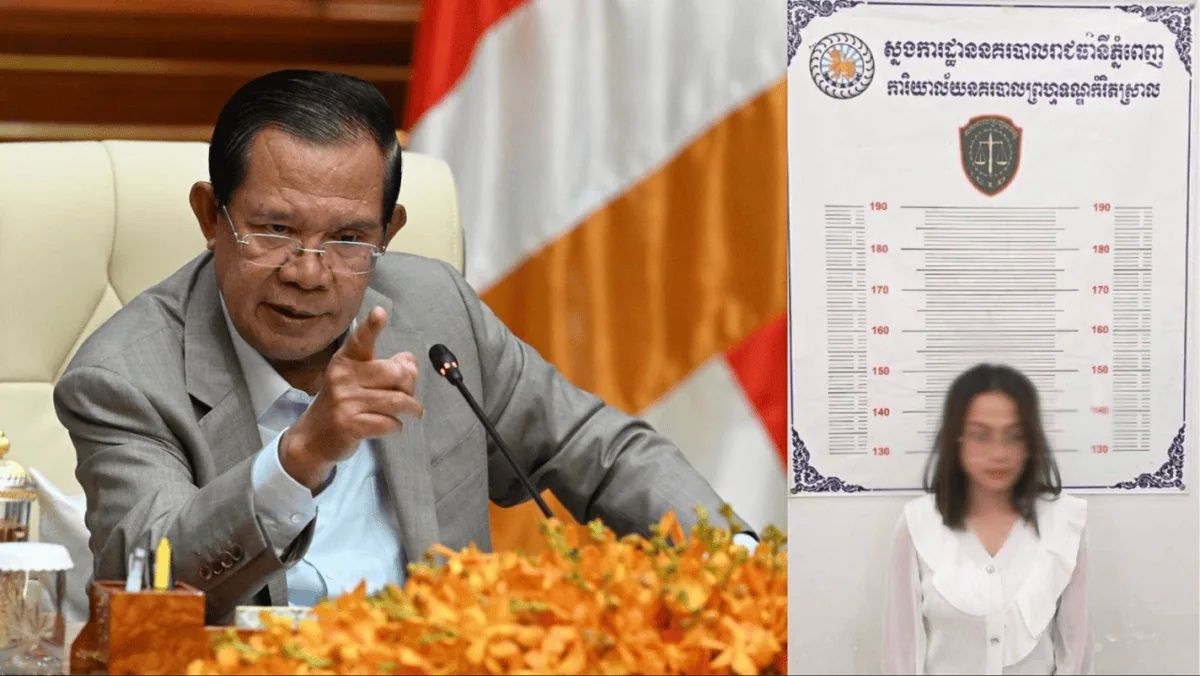
Cambodia's Senate President Hun Sen has ordered the National Council for Women to spearhead legal action against individuals whose inflammatory speech he argues degrades women and violates core Khmer social standards. The directive emerged during an August 14 meeting with council representatives, positioning the government's intervention as a necessary defense of national moral values rather than a restriction on free expression.
The push reflects Hun Sen's framing of social decorum as a matter requiring state enforcement. He referenced an unidentified woman who allegedly used profanity to demean government bodies and state employees, noting that authorities had already compelled her and her spouse to issue a written apology. This case exemplifies the administration's approach: identifying alleged offenders, applying administrative or legal pressure, and extracting public contrition before formal court proceedings commence.
A more specific example driving the initiative involves Chenda Sovannary, accused of insulting a soldier during a dispute over a mobile phone transaction. Hun Sen's comments on this incident reveal his underlying concern: the notion that status—whether military rank or civilian occupation—warrants protection from verbal disrespect. His rhetorical question—why would anyone insult a soldier over a phone disagreement—underscores a hierarchy of respect he believes the legal system should enforce, extending protections beyond soldiers to construction workers and other working-class individuals.
The broader institutional framework being constructed to address these concerns is ambitious in scope. Hun Sen instructed the National Council for Women to coordinate across five government ministries: Interior, Information, Culture and Fine Arts, and Post and Telecommunications. This multi-agency approach suggests coordination on monitoring social media platforms, particularly Facebook, where Hun Sen identified a concentration of the problematic speech he wishes to curtail. The coordination mechanism represents an attempt to formalize surveillance and enforcement across communication channels and institutional silos.
Hun Sen's defense of these measures addresses an anticipated critique: that such prosecutions constitute authoritarian overreach. He drew an analogy to corporate content moderation, arguing that if Facebook maintains community standards and ethical guidelines, the Cambodian state similarly possesses legitimate authority to establish and enforce behavioral norms. This comparison, however, obscures a critical distinction—private platforms operate within a regulatory framework and face market competition, whereas government prosecution involves state coercive power and lacks equivalent accountability mechanisms. The analogy, therefore, functions primarily as rhetorical justification rather than legal precedent.
The initiative gains significance within Cambodia's broader political context, where freedom of expression remains contested terrain. Civil society organizations and international human rights bodies have repeatedly documented constraints on speech, particularly regarding government criticism and political dissent. While Hun Sen frames this enforcement as protecting women's dignity and social morality, critics may view it as another mechanism for narrowing the space for public criticism and dissent, particularly when directed against state actors or institutions. The emphasis on monitoring Facebook specifically reflects the platform's role as a primary medium for Cambodian public discourse and citizen journalism.
For Malaysia and broader Southeast Asia, the Cambodian initiative carries implications worth monitoring. Regional governments increasingly invoke social harmony, moral values, and dignity as justifications for speech restrictions. Singapore, Indonesia, and Thailand have deployed similar rhetoric. The convergence of such approaches suggests a regional pattern wherein governments leverage concepts of respect, decorum, and social ethics to justify legal action against speech deemed offensive—creating a chilling effect on public expression and potential political dissent. The precedent set in Cambodia may embolden similar measures elsewhere.
The role designated to women's affairs institutions is particularly noteworthy. By channeling enforcement through the National Council for Women rather than criminal prosecution directly by state attorneys, the government creates institutional distance while maintaining substantive control. This approach allows the state to present enforcement as driven by women-focused advocacy rather than political will, potentially blunting criticism that such prosecutions represent authoritarian governance. However, it also instrumentalizes women's rights institutions, converting them from independent advocacy bodies into enforcement mechanisms for government-defined morality.
Underlying Hun Sen's directive is an implicit concern about erosion of hierarchical social respect in an increasingly digital Cambodia. As social media democratizes speech and younger Cambodians adopt more informal communication norms, traditional structures of deference—particularly toward state officials, military personnel, and authority figures—face pressure. The government's response is to leverage legal instruments to reinforce these hierarchies, treating disrespect toward officials or uniformed personnel as a matter warranting state intervention and punishment.
The mechanism Hun Sen envisions would require careful monitoring, reporting, and coordination across agencies to identify and prosecute alleged offenders. Implementation will likely depend on the activism of officials within the National Council for Women and collaborating ministries, creating potential for inconsistent application and partisan targeting. Citizens posting criticism or mockery directed at government policies or officials might find themselves legally vulnerable if authorities characterize such speech as disrespectful toward the state or its representatives.
As Cambodia proceeds with establishing this enforcement mechanism, regional observers and international human rights organizations will likely scrutinize implementation closely. The stated objective—protecting women's dignity and social morality—appears legitimate on its surface; however, the expansive institutional apparatus being mobilized and the emphasis on state-determined standards of appropriate speech raise questions about the true scope and effect of these measures on public discourse and political freedom in Cambodia.

