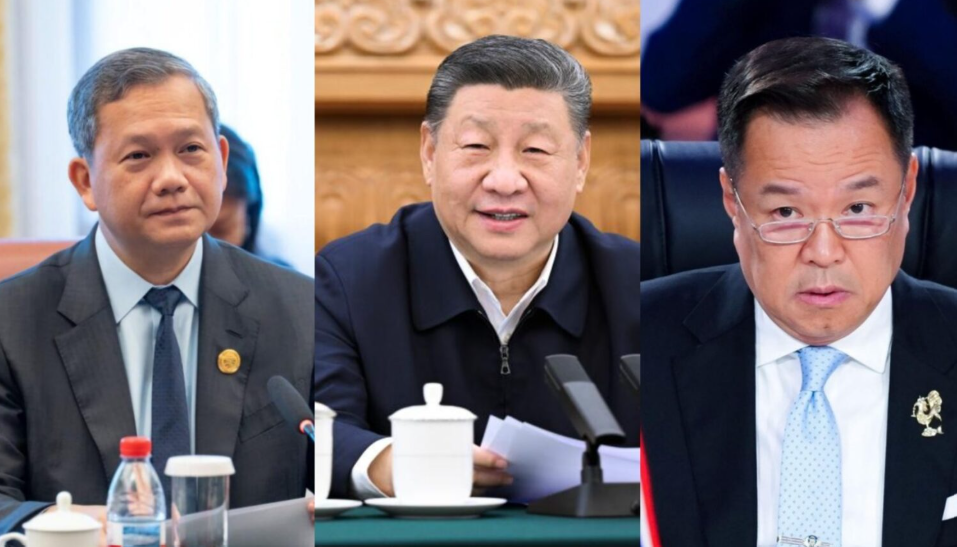
Cambodia's Prime Minister Hun Manet and Thailand's Anutin Chanvirakul are scheduled to converge on Shanghai next month for the World AI Conference 2026, summoned by Chinese President Xi Jinping for the July 17 opening ceremony. The event represents a rare diplomatic opportunity in a region where tensions persist, particularly the longstanding territorial disputes that have kept the two Southeast Asian neighbours at loggerheads for months. Since their last substantive negotiating session in December, the two leaders have engaged in only ceremonial handshakes at regional forums, with substantive progress on their border conflicts remaining elusive.
Manet's delegation will be notably senior, reflecting Cambodia's apparent diplomatic prioritisation of the visit. Accompanying the premier are Foreign Minister Prak Sokhonn, Defence Minister Tea Seiha, and Sun Chanthol, first vice-chairman of the Council for the Development of Cambodia. Anutin will bring Foreign Minister Sihasak Phuangketkeow, signalling that Bangkok also treats the engagement as strategically significant. Both leaders are scheduled for separate audiences with Xi and Chinese Premier Li Qiang, ensuring multiple channels for bilateral discussion and potential mediation efforts.
For Cambodia, the visit carries symbolic weight beyond the artificial intelligence symposium. Phnom Penh's foreign ministry framed the journey as reinforcing the "long-standing friendship" and advancing the Comprehensive Strategic Partnership of Cooperation between the two nations. Language in official statements references deepening the Diamond Cooperation Framework and constructing an "all-weather Cambodia-China Community with a Shared Future," diplomatic terminology that signals both commitment and expectation of Chinese support for Cambodian interests. Similarly, Thailand's foreign ministry characterised the trip as strengthening bilateral ties and the Thailand-China Comprehensive Strategic Cooperative Partnership, though Bangkok's messaging emphasised mutual benefit rather than deeper integration.
The substantive question haunting this summit is whether China will deploy its considerable economic and diplomatic leverage to push both nations back to the negotiating table. Analysts increasingly suggest that Beijing, as a major trading partner to both Cambodia and Thailand, possesses unique leverage to compel dialogue and compromise. Yet the barriers to resolution remain formidable and rooted in structural power imbalances within Thai politics. According to Kin Phea, director of the Royal Academy of Cambodia's International Relations Institute, the fundamental obstacle is not governmental disagreement but rather the Thai military's apparent unwillingness to implement agreements reached by civilian administrators.
Phea argues that Thailand's military establishment has systematically violated commitments made between the two governments, using its institutional autonomy to conduct independent operations in disputed areas. This dynamic creates an asymmetry where civilian diplomacy becomes essentially performative, subordinated to military prerogatives that operate outside formal accountability structures. The Thai military has permitted incursions into Cambodian sovereign territory despite agreements intended to prevent such actions, effectively undermining the negotiation process itself. This institutional friction within Thailand complicates any diplomatic breakthrough, as Chinese pressure on Bangkok's civilian leadership may prove insufficient if the military maintains its independent operational authority.
The diplomatic framework that should theoretically guide resolution already exists in the form of the Fuxian Consensus, brokered by China in December 2025. This agreement established principles for peaceful resolution through diplomatic channels and international law. However, implementation has stalled almost immediately after signature, suggesting that consensus on paper does not translate into consensus in practice. Phea emphasises that Thailand must demonstrate genuine commitment by withdrawing troops from occupied areas, returning to substantive negotiations, and engaging the Joint Boundary Commission without further delay. These are not abstract requirements but concrete steps that would immediately signal Thai willingness to resolve longstanding tensions.
The human cost of the impasse remains substantial and largely overlooked in regional diplomatic calculations. Approximately 20,000 Cambodian civilians remain unable to return to their homes in territories under Thai occupation, constituting a humanitarian dimension that transcends diplomatic protocol. These displaced persons represent not merely political abstractions but communities severed from ancestral lands, with families fragmented across borders and livelihoods disrupted indefinitely. Resolution of the border dispute is thus fundamentally linked to enabling the return and reintegration of these populations, a humanitarian imperative that should theoretically command urgent attention from both governments and their international partners.
For Malaysian and broader Southeast Asian observers, this diplomatic moment carries significant implications. Border disputes that remain unresolved create regional instability, complicate ASEAN cohesion, and invite external powers to exploit tensions. The Cambodia-Thailand situation demonstrates how unresolved territorial questions can fester for decades, poisoning bilateral relations and creating recurring crises. Malaysia, having successfully negotiated complex maritime boundaries with neighbouring states, understands that sustained political will and international mediation can achieve resolution. The Shanghai conference represents a critical juncture where Chinese diplomatic pressure could either catalyse genuine progress or merely produce another ceremonial gathering followed by continued stalemate.
China's approach to this situation will reveal much about Beijing's diplomatic methodology in Southeast Asia. Will China leverage its economic dominance to demand concrete behavioural change, or will it settle for maintaining stable relationships with both parties regardless of substantive progress? The choice carries implications for regional confidence in Chinese mediation efforts more broadly. If China demonstrates willingness to push both nations toward genuine negotiated settlement, it enhances Beijing's credibility as a stakeholder in regional stability. Conversely, if the Shanghai summit produces only rhetorical commitments and cosmetic gestures, it reinforces scepticism about whether economic leverage can actually drive political change when domestic military establishments resist civilian-brokered agreements.
The prospects for breakthrough remain uncertain, constrained by Thai military institutional interests and the absence of demonstrated consequences for non-compliance with existing agreements. Yet the Shanghai gathering provides an undeniable opportunity that has been absent since December. Both Hun Manet and Anutin will stand before Xi Jinping and Li Qiang, symbolically representing their nations before China's paramount leadership. This heightened diplomatic context, combined with China's demonstrated interest in regional stability, creates conditions where meaningful pressure could be applied. Whether that pressure materialises, and whether Thailand's civilian government can convince its military establishment to honour commitments, remains the question that will determine whether 2026 marks a turning point or merely another false dawn in resolving Southeast Asia's most stubbornly intractable territorial dispute.

