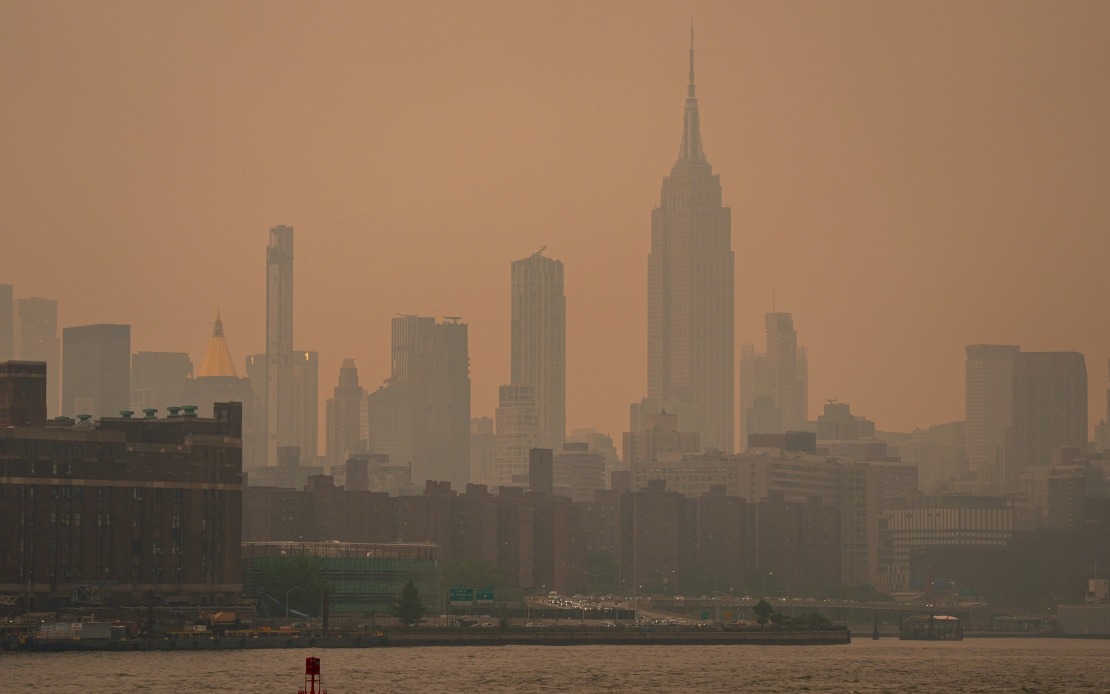
Mexican President Claudia Sheinbaum encountered unexpected travel complications en route to Sunday's Argentina-Spain World Cup final in East Rutherford, New Jersey, when hazardous air conditions blanketing New York forced the cancellation of her scheduled flight. The visibility challenges and poor air quality stemmed from smoke drifting southward from wildfires raging across Canada in recent days, a phenomenon that has affected multiple North American regions.
Sheinbaum's initial departure from Cancún on Saturday morning faced a two-hour postponement due to the deteriorating atmospheric conditions over New York. Rather than risk further delays, Mexican authorities ultimately scrapped the commercial flight altogether, recognising that conditions were unlikely to improve sufficiently for safe operations into the New York area. The decision reflected growing concern about the scale and persistence of the Canadian wildfire crisis, which has periodically disrupted air travel and outdoor activities across the continent.
Rather than abandon her attendance at the prestigious sporting event, the Mexican government pivoted to an alternative solution. Sheinbaum subsequently departed Mexico City overnight into Sunday aboard an aircraft operated by Mexico's Defence Ministry, allowing her to reach New Jersey despite the atmospheric obstacles. This arrangement underscored the importance both Mexico and the United States placed on high-level representation at the tournament, despite the logistical complications posed by environmental factors beyond either nation's immediate control.
The invitation itself carried considerable diplomatic significance. US President Donald Trump had extended a surprise invitation to Sheinbaum to witness the final, an overture that reflected attempts to maintain ceremonial engagement between the two neighbouring nations despite substantial underlying tensions. The gesture of inclusion positioned the World Cup final as a venue for diplomatic representation, signalling that sporting events continue to serve as platforms for international relations and public demonstration of bilateral engagement.
Canadian Prime Minister Mark Carney was similarly expected to attend, representing the third host nation of the tournament. The presence of leaders from all three co-hosting countries underscored the multinational character of the competition and the symbolic importance of the final match. Their attendance would serve not merely as spectators but as official representatives of their respective governments, lending state-level prestige to the proceedings in East Rutherford.
The strained relationship between Mexico and the United States looms in the background of such diplomatic encounters. Trade disputes and security concerns have created friction between the neighbours, complicating bilateral relations beyond the realm of sporting events. Yet these periodic high-level meetings, even when orchestrated around major sporting occasions, provide opportunities for political leaders to interact and maintain channels of communication that remain essential despite disagreements on substantive policy matters.
Sheinbaum's interactions with Trump have been limited so far. Their only previous engagement connected to the World Cup occurred during the tournament draw held in Washington last December, a relatively brief official encounter. The invitation to the final represented a more substantial gesture of engagement, suggesting that both capitals recognised value in maintaining diplomatic visibility and cordiality even amid underlying tensions.
The World Cup finals represented a rare moment when the leaders of three major North American nations would converge publicly at a single event. Such convergence, regardless of the underlying political complexities, carries symbolic weight in international relations. The gathering provided an opportunity for informal interaction and public demonstration of peaceful coexistence between nations with divergent interests.
Canadian wildfires have emerged as an increasingly consequential environmental and transnational issue. The smoke they generate crosses borders with indifference to jurisdiction, affecting air quality and travel across North America. This incident illustrates how climate-related phenomena can disrupt the schedules and plans even of national leaders, underscoring the pervasive nature of environmental challenges in contemporary governance.
For Malaysian observers, the incident demonstrates how major sporting events serve as diplomatic focal points and how environmental disruptions can complicate international travel and protocol arrangements. The World Cup final, while primarily a sporting spectacle, operates simultaneously as a venue for high-level political engagement and representation. The flexibility demonstrated by the Mexican government in adapting to unforeseen circumstances—switching to military aircraft when commercial options became unavailable—reflects pragmatic problem-solving in diplomatic contexts.
The narrative also reflects broader patterns in North American relations, where despite tensions and disagreements, ceremonial participation in major events continues to occur. Sheinbaum's determination to attend, despite significant travel obstacles, signalled commitment to this diplomatic engagement. Her arrival via military aircraft, while unconventional, proved sufficient to ensure Mexico's presidential representation at an event deemed important enough to warrant such alternative arrangements.

