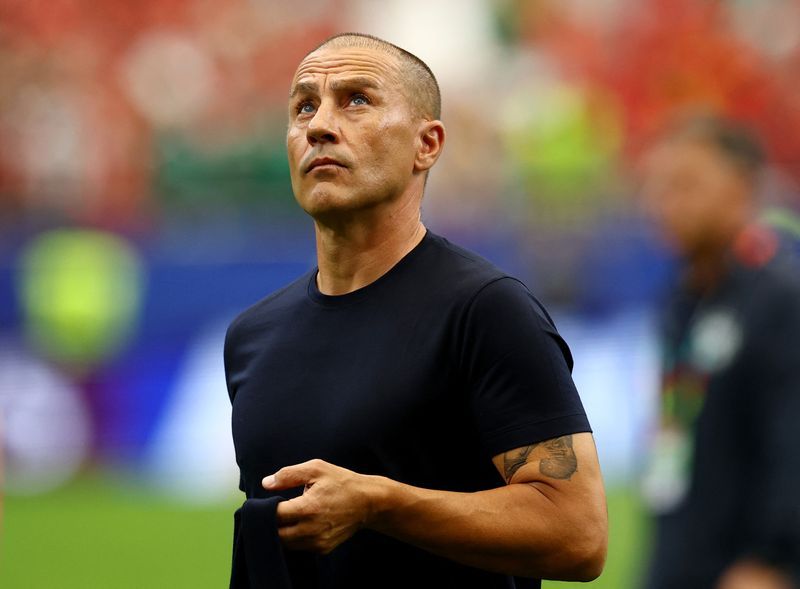
Uzbekistan's World Cup campaign suffered a devastating blow in Houston on Tuesday when they fell to a crushing 5-0 defeat at the hands of Portugal, but head coach Fabio Cannavaro has moved swiftly to shoulder the blame, framing the loss as a harsh but valuable lesson for a young national team making their maiden appearance on football's grandest stage. The Italian tactician, whose credentials include a World Cup winners' medal from Italy's triumph in 2006, stressed that responsibility for the capitulation rests entirely with his strategic decisions rather than with his players' commitment or effort on the field.
The Central Asian nation now finds itself in a precarious position in Group K, having already suffered a 3-1 reversal against Colombia in their opening fixture. With only a final group-stage match remaining against the Democratic Republic of Congo on Saturday, Uzbekistan's path to the round-of-32 has narrowed considerably, requiring nothing short of a victory to keep their tournament hopes mathematically alive. The mathematical elimination of a major footballing nation at the group stage is never straightforward, and Cannavaro made clear his unwillingness to abandon hope regardless of the mounting odds against his squad's advancement.
When speaking with the assembled media contingent following the Portugal match, Cannavaro adopted a measured tone that acknowledged the severity of the scoreline without descending into despair. He praised his players' mentality and willingness to battle despite being heavily outmatched, emphasising that their energy and willingness to attempt ambitious play had not wavered throughout the ninety minutes. For a coach of Cannavaro's stature—someone who has experienced the highest peaks of international football success—there was a deliberate humility in the way he articulated his message, suggesting that blame deflection holds no place in his managerial philosophy.
Central to Uzbekistan's collapse was a moment of acute frustration that appeared to undermine their psychological resilience at a critical juncture. When midfielder Azizjon Ganiev had what appeared to be a brilliantly-executed goal disallowed for an infringement committed during the build-up phase, it represented not merely a procedural setback but rather a turning point in the team's emotional trajectory. Cannavaro acknowledged candidly that this decision—whether rightly or wrongly made—had a tangible impact on his team's confidence and attacking intent, effectively shifting the momentum irreversibly in Portugal's direction.
The narrative Cannavaro constructed around this defeat carries particular significance for a nation competing at the World Cup for the very first time. Rather than frame the 5-0 loss as evidence of unbridgeable quality gaps or fundamental inadequacy, he positioned it as an inevitable component of the learning experience that debuts at this level invariably entail. His consistent emphasis on future growth and individual player development suggests a coaching philosophy rooted in long-term vision rather than short-term results, an approach that may resonate with supporters seeking perspective during a disappointing tournament.
Cannavaro's comments about the tactical approach reveal his deliberate attempts to encourage his squad to play with imagination and boldness despite operating as significant underdogs against more established footballing powers. He had explicitly instructed his players to embrace risk and creativity rather than retreating into defensive negativity, a directive that left Uzbekistan vulnerable to the kind of devastating counter-attacking football that Portugal's more technically gifted players could execute. This willingness to pursue an ambitious tactical blueprint, even in the face of predictable consequences, underscores Cannavaro's conviction that tournament education trumps results-based caution for emerging squads.
The former Parma and Real Madrid defender drew upon his extensive experience navigating high-pressure situations to frame the disallowed goal as a catalyst for reflection rather than despondency. He noted that in the minutes preceding this incident, Uzbekistan had actually acquitted themselves reasonably well, initiating attacking plays with the kind of purposefulness and structure they had also demonstrated during their opening encounter with Colombia. The suggestion that his team was capable of competing in passages against elite opposition, even if incapable of sustaining such efforts across full matches, provides a slender foundation upon which to build for Saturday's decisive fixture.
Looking forward to the Democratic Republic of Congo encounter, Cannavaro indicated that maintaining self-belief would remain paramount, regardless of the statistical improbability of qualification. His explicit statement that the team would continue to "believe until we mathematically cannot go through" signals an unwillingness to concede the tournament prematurely, though pragmatic observers will recognise that overturning a challenging goal differential whilst securing victory represents an uphill battle. For a coach who has witnessed the full spectrum of football's emotional extremes, this stoicism may constitute the most valuable lesson he can impart to a squad learning international football's harsh realities.
Cannavaro's willingness to accept personal culpability reflects a broader philosophy about leadership accountability that distinguishes his approach from coaches who habitually deflect criticism onto external factors or player limitations. By explicitly stating that he, not his players, bears responsibility for the comprehensive nature of the defeat, he simultaneously accomplishes two objectives: he provides psychological protection for his squad members by absorbing the reputational damage, whilst also signalling that he retains agency and control over the team's trajectory. This psychological framework may prove essential if Uzbekistan is to approach the Congo match with appropriate urgency and focus rather than resignation.
The implications of Uzbekistan's World Cup struggles extend beyond the immediate tournament context, carrying ramifications for Central Asian football's development on the international stage. A competitive showing, even in defeat, can enhance a nation's footballing prestige and attract greater investment in youth development and infrastructure. Conversely, capitulations of the magnitude witnessed against Portugal can reinforce perceptions of regional inferiority and discourage aspiring young players from pursuing professional careers in less established leagues. Cannavaro's emphasis on growth and experience thus carries significance that transcends his immediate squad, potentially influencing the trajectory of Uzbek football for years to come.