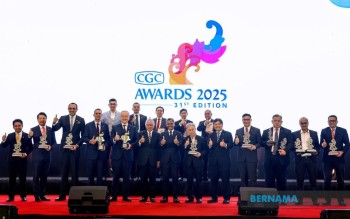
The Credit Guarantee Corporation Malaysia Bhd (CGC) celebrated the entrepreneurial spirit of Malaysia's micro, small and medium enterprises at the 31st annual CGC Awards 2025, where 32 companies and financial partners were recognised for demonstrating exceptional resilience, adaptability and commitment to inclusive business practices. Held in Kuala Lumpur on August 11, the ceremony underscored the critical role that smaller enterprises play in Malaysia's economic ecosystem and the collaborative framework required to sustain their growth amid volatile market conditions.
CGC chairman Datuk Mohammed Hussein articulated a holistic vision of business resilience that extends far beyond mere access to capital and credit facilities. In his remarks, Hussein emphasised that true resilience emerges from the character, discipline and adaptive capacity of business owners themselves—qualities that become most evident when enterprises face external shocks or market disruptions. This framing reflects a growing recognition within Malaysia's financial and policy circles that sustainable MSME growth depends not simply on monetary support, but on cultivating an ecosystem where entrepreneurial attributes and institutional support systems reinforce one another.
The chairman's address highlighted the interconnected responsibilities of multiple stakeholders in building a robust MSME sector. Hussein called on government to establish a business-friendly regulatory and policy environment; research institutions to facilitate the commercialisation of innovations; large corporations to open their supply chains to smaller suppliers; and financial institutions to deploy growth capital strategically. This multi-stakeholder framing acknowledges that no single actor—not even CGC itself—can drive sustainable MSME development alone. Instead, success requires coordinated action across public agencies, research bodies, private enterprises and the financial system, a model increasingly relevant as Malaysian policymakers navigate post-pandemic recovery and global economic headwinds.
CGC's commitment to Bumiputera enterprise development formed a significant pillar of the awards recognition. The corporation provided RM223 million in guarantees to 27 Bumiputera-owned companies during the preceding year, reinforcing the government's longstanding policy objective of broadening economic participation among indigenous Malaysians. Simultaneously, CGC's environment, social and governance-linked guarantees reached RM1.2 billion, exceeding an initial target of RM1 billion and reflecting mounting business sector interest in sustainable and socially responsible operations. This dual focus—on Bumiputera inclusion and ESG-aligned growth—signals how Malaysia's development agenda is integrating social equity objectives with emerging global sustainability standards.
The awards ceremony recognised excellence across three distinct categories, spanning financial institution partners, non-financial partners and small and medium enterprises themselves. Alliance Bank Malaysia Bhd and CIMB Islamic Bank Bhd jointly received the Best Financial Partner award, acknowledging their contributions to MSME financing. OCBC Al-Amin Bank Bhd earned the Bumiputera SMEs Award, while Maybank Islamic Bhd secured the Special Recognition Bumiputera Award, indicating strong participation from Islamic financial institutions in supporting indigenous-owned businesses. The distribution of accolades across conventional, Islamic and development-focused financial institutions reflects Malaysia's hybrid financial landscape and the diverse pathways through which MSMEs access working capital and growth finance.
Beyond the recognition programme, the awards ceremony served as the official launch platform for a transformative financing initiative: the RM10 billion Bank Negara Malaysia-CGC Portfolio Guarantee (PG) and Portfolio Guarantee-i (PG-i) schemes. These instruments employ a risk-sharing model between CGC and participating financial institutions, designed to unlock guaranteed financing for an estimated 12,100 MSMEs across priority economic sectors. The schemes address a persistent constraint in Malaysia's MSME ecosystem—the tendency of commercial banks to impose stringent collateral requirements and risk thresholds that exclude otherwise viable smaller enterprises from formal credit markets. By pooling risk between CGC and lenders, the schemes lower barriers to financing without necessarily lowering lending standards.
The dual Portfolio Guarantee structures—one conventional (PG) and one Islamic (PG-i)—accommodate the diverse financing preferences within Malaysia's business community. This twin-track approach reflects both Malaysia's position as a leading Islamic finance hub and the reality that many MSME operators have religious and cultural preferences regarding financial products. The schemes also target specific economic objectives: business expansion, productivity enhancement, sustainability transitions and enhanced global competitiveness. These priorities align with Malaysia's broader economic diversification agenda and the government's commitment to greening the economy, suggesting that credit allocation will increasingly favour enterprises demonstrating environmental and social responsibility.
The scheme announcement carries particular significance for Malaysia's regional position and manufacturing landscape. As global supply chains reconfigure in response to geopolitical tensions and trade friction, Malaysian MSMEs face mounting pressure to invest in productivity improvements, technological adoption and sustainable practices to retain export competitiveness. The RM10 billion facility, by making growth capital more accessible, effectively lowers the cost of such investments for smaller enterprises that might otherwise lack the financial cushion to upgrade independently. For Southeast Asia writ large, the scheme demonstrates how national development banks and guarantee corporations can leverage risk-sharing instruments to channel capital toward productive use rather than consumption or asset speculation.
CGC's institutional positioning reflects Malaysia's broader development strategy. As a publicly-backed entity sitting at the intersection of government policy, commercial finance and entrepreneurship, CGC operates at a critical leverage point in the financial system. By guaranteeing credit extended by commercial and Islamic banks, it effectively amplifies the impact of any given monetary stimulus or policy initiative. The corporation's mandate to support Bumiputera enterprises while simultaneously advancing sustainability creates a natural alignment between social equity, environmental protection and financial inclusion—objectives that have historically been treated as competing priorities in development policy. This integration suggests evolving thinking about how Malaysia can simultaneously pursue inclusive growth and environmental stewardship.
The awards and scheme launch occur against a backdrop of persistent MSME challenges across Southeast Asia. Many smaller enterprises continue to operate with limited access to formal credit, inadequate technological capabilities and exposure to volatile commodity and exchange rates. Malaysia's MSME sector, while more developed than in some regional peer nations, still faces productivity gaps relative to large corporations and international competitors. The RM10 billion guarantee scheme, by potentially supporting 12,100 additional enterprises, represents a material injection of supportive finance into this segment. However, guarantees alone cannot address underlying constraints such as digital capability gaps, management depth or export market access—ancillary challenges that require complementary interventions.
Looking forward, CGC's articulated strategy under its CGC Group 2030 framework commits the organisation to deepening impact among MSMEs, advancing financial inclusion and supporting sustainable economic development through sustained collaboration with banks, government agencies, large corporations and entrepreneurial communities. This long-term institutional commitment provides continuity for Malaysian businesses seeking to access guarantee-backed financing and reflects confidence that the MSME sector will remain central to Malaysia's economic strategy through the remainder of this decade. As regional competition for MSME growth intensifies and global capital flows toward countries perceived as offering stability and sustainable development pathways, Malaysia's willingness to deploy public finance and institutional capacity to support smaller enterprises may offer competitive advantage in attracting entrepreneurial talent and retaining manufacturing resilience.

