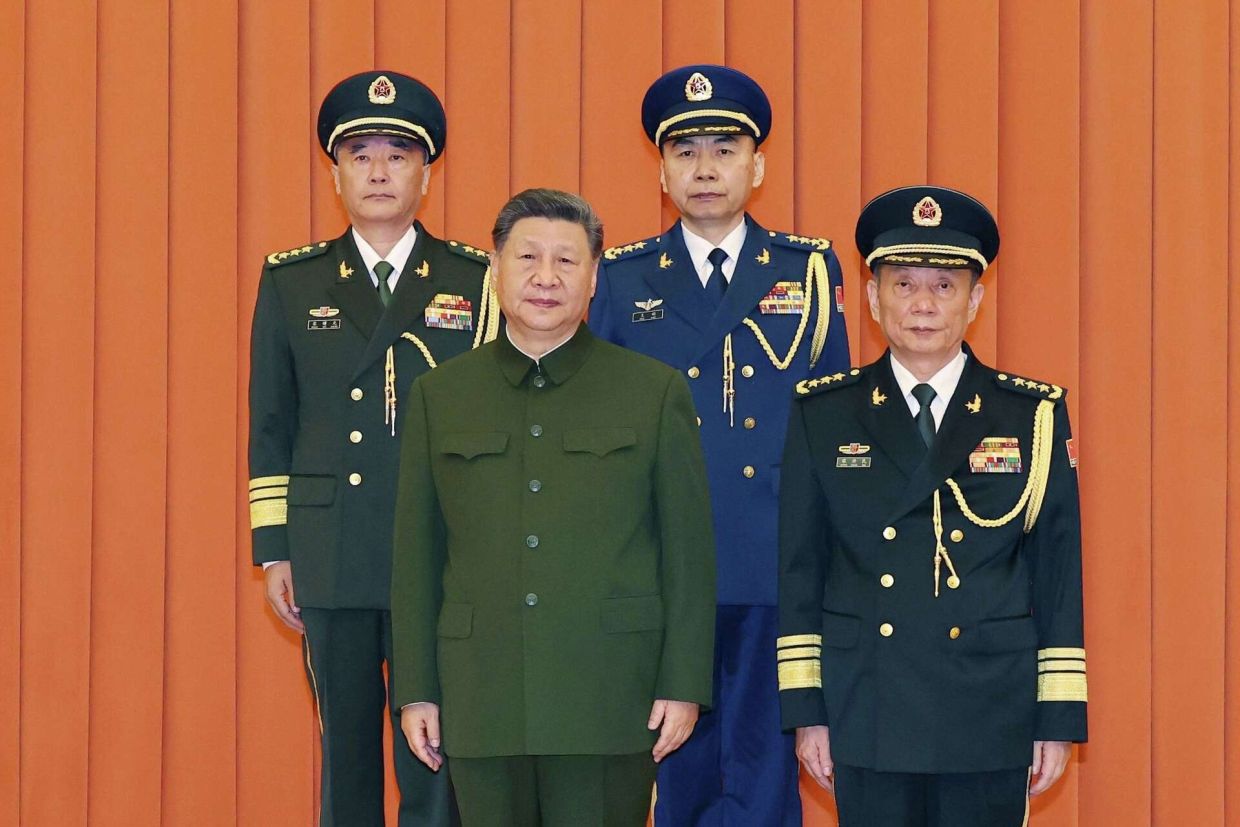
China's military leadership structure is undergoing significant transformation with the advancement of two senior officers to general rank, signalling what observers believe may be an imminent reorganisation at the highest echelons of defence command. The promotions, formally presented by Xi Jinping at a ceremony on Friday, July 3rd, reflect the ongoing reshaping of China's armed forces following an extensive anti-corruption investigation that has substantially depleted the senior ranks.
The two officers elevated to general rank are Zhang Shuguang and Wang Gang, the latter serving as commander of China's air force. Beyond the symbolic significance of their promotions, Zhang has simultaneously been appointed to lead the division tasked with investigating corruption within the Central Military Commission, the paramount military body overseeing all armed forces operations and strategic direction. This dual appointment underscores the leadership's determination to maintain momentum in its cleansing campaign while installing trusted figures in positions of institutional influence.
The Central Military Commission, which functions as the supreme military authority under civilian party oversight, comprises seven members and is chaired by Xi Jinping himself. The commission's effective capacity has been severely compromised by the anti-corruption investigations, with only two members currently active in their roles: Xi as chairman and Vice Chair Zhang Shengmin. This dramatic reduction from a full complement illustrates the scale of the purge affecting military hierarchy and the extent to which the leadership has prioritised loyalty and ideological alignment over institutional continuity.
Two former vice chairs—positions traditionally held by highly influential military strategists—have been removed or substantially sidelined through the investigations. Most significantly, the individual occupying the role of the military's top general has been effectively removed from active service, representing a fundamental shift in the command structure that would have been unthinkable in previous administrations. These departures have created substantial vacancies within the commission's seven-member composition, creating pathways for newly promoted officers like Zhang and Wang to ascend into senior decision-making roles.
The timing of these promotions carries considerable strategic implications for how China's military leadership will be constituted during the coming years. A new commission membership is anticipated to be formally announced in autumn of next year, coinciding with the expiration of the current commission's five-year term in 2017. This timeline suggests that the promotions of Zhang and Wang may represent preliminary positioning for roles within this restructured body, effectively offering these officers opportunities to compete for or be selected for positions on the reformed commission.
From a broader geopolitical perspective, the anti-corruption campaign targeting military officials serves multiple concurrent purposes within China's political structure. Beyond the ostensible objective of rooting out corrupt practices and financial malfeasance within defence institutions, the extended purge functions as a mechanism for consolidating Xi Jinping's personal authority over the military apparatus. By removing or marginalising older generals who may have accumulated independent power bases or factional allegiances, the leadership strengthens the institutional bonds connecting the armed forces directly to the party hierarchy and, by extension, to Xi's personal authority.
The appointment of Zhang to oversee the corruption investigation division creates a particularly noteworthy institutional dynamic. By placing a newly promoted general in charge of investigating his peers and predecessors, the leadership ensures that the investigative process remains guided by someone whose advancement depends directly on successfully executing the purge agenda. This structural arrangement suggests that the anti-corruption drive is unlikely to conclude in the near term, but rather represents an ongoing process of institutional realignment that will continue reshaping military command relationships through the transition period leading to the commission's reconstitution.
For Southeast Asian nations monitoring China's military development and strategic intentions, these institutional changes warrant careful attention. A military command structure undergoing significant leadership transitions can sometimes exhibit unpredictable behaviour or employ aggressive posturing to demonstrate unity and resolve. Conversely, a military focused inward on consolidating loyalty and managing succession questions may present fewer external threats during the transition period. Understanding the factional dynamics emerging from this purge could provide insights into how China's military brass will approach regional disputes and security challenges in the coming years.
The broader pattern of these promotions and appointments demonstrates Xi Jinping's sustained commitment to fundamentally remaking China's military institutions in his image. Unlike previous Chinese leaders who often accommodated existing power structures and factional arrangements within the defence establishment, Xi has opted for a more aggressive approach to centralising military authority and ensuring unambiguous subordination to his personal leadership. The elevation of officers like Zhang and Wang, coupled with their assignment to oversight roles, represents the architectural blueprint for a military organisation that remains institutionally aligned with the party leadership through carefully managed appointments and loyalty-based advancement.

