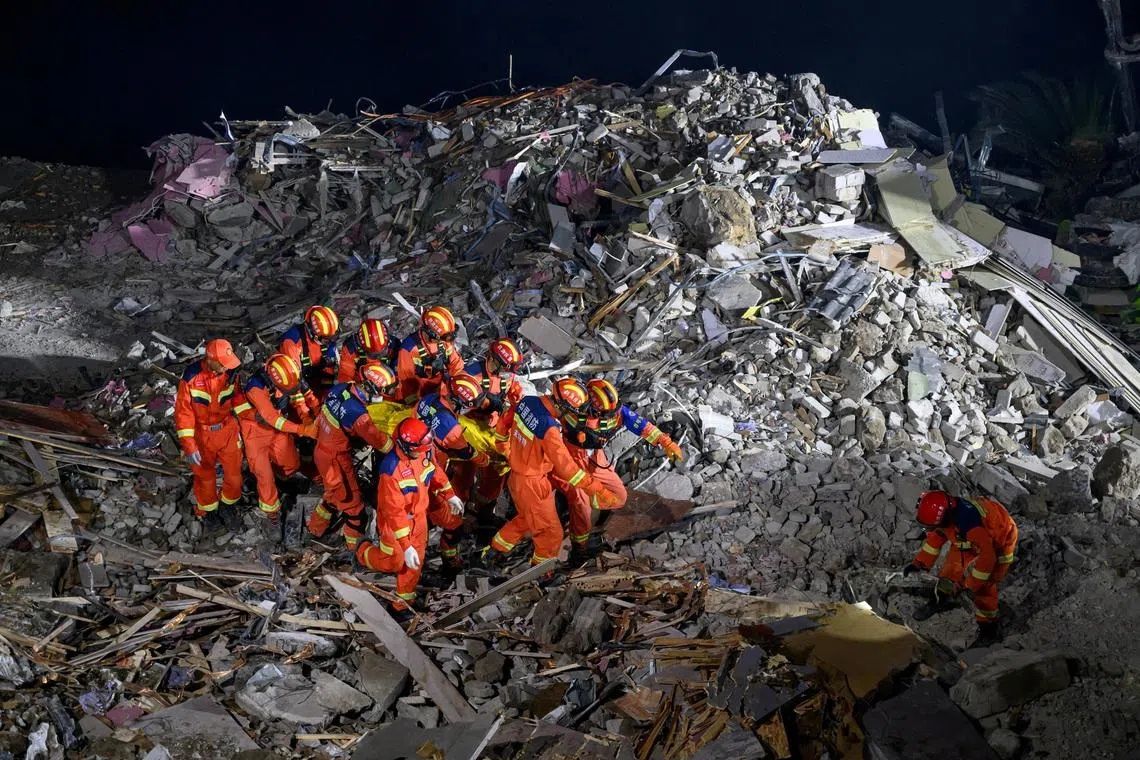
Rescue operations intensified in southwestern China on Monday as teams deployed explosives to shatter obstructing boulders, pushing forward their desperate search for 34 individuals unaccounted for since a devastating landslide struck on Friday. The incident unfolded in Penghui county, nestled approximately 270 kilometres from the sprawling municipality of Chongqing, claiming at least eight lives as torrential downpours inundated the region. State media footage captured the moment detonation teams successfully fragmented a colossal boulder that had impeded progress, marking what officials described as the transition into a deeper, more intensive phase of the rescue mission.
The geographical positioning of Penghui county exemplifies the particular vulnerability that characterizes much of southwestern China's landscape. The mountainous terrain, where numerous settlements perch precariously on steep hillsides adjacent to the Wujian river, creates both engineering challenges and natural disaster risks. Dramatic video documentation from the scene revealed a section of mountainside collapsing directly into the river channel, effectively severing the main thoroughfare through the narrow township and isolating affected communities. For a county housing approximately 500,000 residents, such geographical constraints mean that landslides pose an existential threat to connectivity and emergency response capacity.
President Xi Jinping directed rescue authorities to employ scientifically grounded search methodologies and simultaneously launch a comprehensive investigation into the underlying causes of the disaster. This directive reflected concerns at the highest levels of government about both immediate rescue efforts and longer-term prevention strategies. The political emphasis on scientific approach signaled the leadership's determination to demonstrate competent crisis management while addressing systemic vulnerabilities that recurrently claim lives across the nation's western provinces.
The scale of precautionary measures undertaken revealed the severity authorities assigned to the situation. Evacuation operations displaced more than 1,100 residents from areas surrounding the primary disaster site, a significant undertaking requiring coordination across multiple administrative levels. Simultaneously, technical teams dispersed throughout the region to survey subsurface geological conditions and assess probabilities of secondary landslides or further mountainside failures that could jeopardize rescue personnel and remaining residents.
China's particular susceptibility to landslide disasters stems from converging environmental and developmental factors that extend well beyond Penghui county. Mountainous and hilly terrain comprises roughly two-thirds of the national landmass, while intense seasonal precipitation—especially during summer months—creates hydrostatic pressures that destabilize slopes. Contemporary rapid urbanization and extensive construction activity, frequently conducted on marginal terrain, amplifies these natural hazards by introducing additional weight, altering drainage patterns, and removing vegetation that stabilizes soil and rock. Tectonic activity along major fault systems adds geological instability to the equation, creating conditions where landscape failure occurs with disturbing regularity.
The meteorological forecast issued for the days following the Penghui disaster underscored the persisting threat environment. Predictions indicated heavy to torrential rainfall would persist across multiple provinces throughout the week, prompting authorities nationwide to strengthen protective measures in geologically compromised areas where groundwater saturation and intensive construction had elevated hazard levels. Such warnings reflected the reality that landslide risk cascades geographically across interconnected systems, as saturated soils in headwater regions destabilize slopes hundreds of kilometres downstream.
Hydraulic pressure from excessive moisture emerged as an immediate concern across several river systems. By Monday, eight minor and medium-sized watercourses in Yunnan, Guangxi, Guangdong, Anhui, and Shanghai had surged above official flood warning thresholds, creating potential for secondary disasters if sustained precipitation continued. These conditions represented the kinds of compound emergencies that stretch rescue infrastructure across vast territories simultaneously, fragmenting emergency response capabilities.
Historical patterns demonstrate the catastrophic toll that recurrent landslides impose upon China's population. Over a decade preceding the Penghui disaster, at least five major incidents collectively claimed approximately 294 lives, with individual events occasionally producing far more severe casualties. The December 2015 collapse of an enormous accumulation of construction debris at an industrial facility in Shenzhen, a major technological and economic hub in the south, killed more than 70 people—a stark reminder that even developed, well-resourced urban areas remain vulnerable to terrain-related disasters when construction practices fail to account for underlying geological realities.
For Malaysian and Southeast Asian observers, the Penghui incident carries implications extending beyond humanitarian concern. The region shares geographical characteristics with southwestern China—mountainous topography, seasonal monsoon rainfall, and accelerating urbanization—making landslide risks similarly endemic across Malaysian highlands, Indonesian volcanic regions, and other terrain-prone areas throughout the peninsula and archipelago. The technological approaches adopted by Chinese rescue teams, including precision explosive placement and real-time geological monitoring, represent methodologies potentially transferable to regional disaster management frameworks. Moreover, the incident underscores how rapid development pressures in Southeast Asian nations must be calibrated against natural hazard exposure, particularly in mountainous zones where construction inevitably disturbs fragile slope equilibrium and drainage systems.
The ongoing search operation in Penghui county, supported by advanced detection equipment and sustained by centralized government coordination, will likely require weeks to achieve full resolution. Whether rescue teams successfully locate survivors among the 34 missing individuals depends partly upon access speed and partly upon chance survival conditions within debris zones. The international dimension of such disasters—their documentation through modern communication channels and their resonance across geographically similar regions—increasingly shapes how nations assess and respond to natural hazard risks within their own territories.

