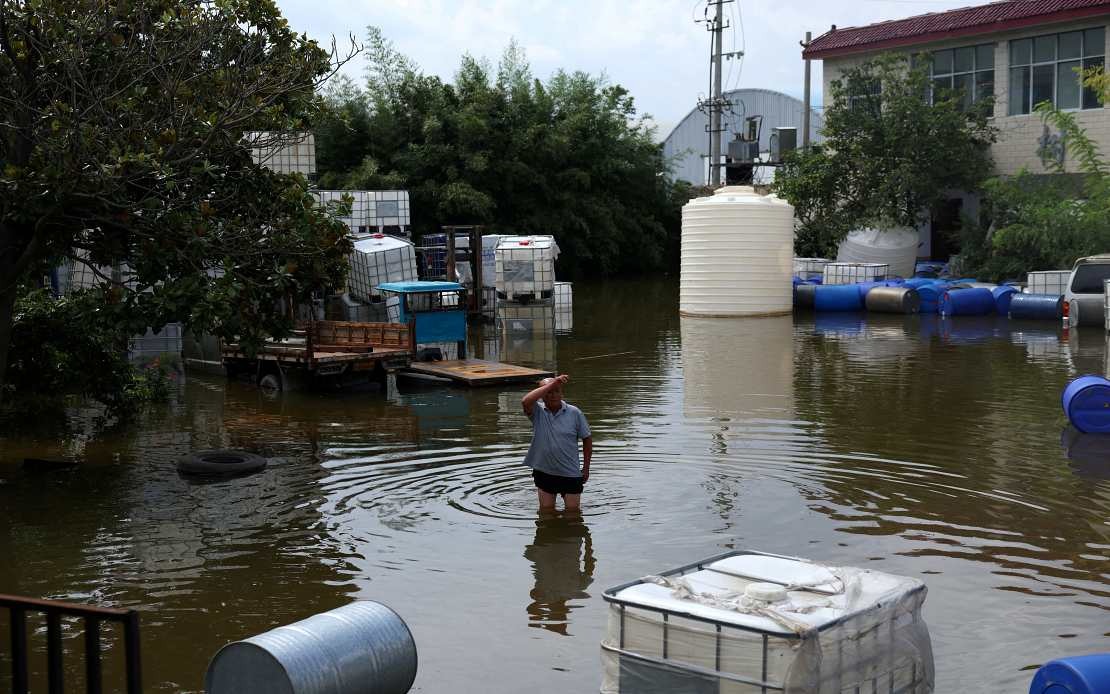
China's emergency authorities have launched a substantial rescue and relief campaign in central Henan Province after Typhoon Dolphin's remnants spawned catastrophic flooding that breached a critical levee in Zhoukou City. The levee failure occurred around 11 pm on Thursday, with floodwaters surging through the region as the storm system dumped exceptional rainfall across the province. The Ministry of Emergency Management responded swiftly, dispatching a specialized rescue contingent that arrived on Friday to join ongoing emergency operations and coordinate the broader disaster response.
The rescue deployment represents a coordinated mobilization of national resources. The taskforce comprises 200 engineering rescue personnel sourced from China Anneng Group, a state-owned enterprise specializing in emergency response and disaster mitigation. Accompanying the personnel are 110 sets of large-scale engineering equipment specifically configured for flood response operations, including pumps, excavators, and barrier systems designed to manage water flow and prevent further embankment failures. This combination of human expertise and mechanized capacity reflects the scale of infrastructure damage officials assessed from preliminary reports.
The disaster triggered formal activation of China's national emergency framework. The National Commission for Disaster Prevention, Reduction and Relief declared a Level-IV national disaster relief emergency response for Henan Province, positioning the incident within the country's standardized crisis management hierarchy. This classification indicated authorities recognized the severity of the situation and the need for coordinated central government intervention beyond local capacity. Typhoon Dolphin, identified as the 13th typhoon of the year, demonstrated how tropical systems transitioning through inland regions can generate catastrophic hydrological events even after weakening from oceanic strength.
China's central government mobilized significant material support to complement the rescue operations. The National Commission for Disaster Prevention, Reduction and Relief allocated 30,000 units of emergency supplies drawn from national strategic reserves. These provisions encompassed folding beds for displaced persons, summer quilts, and family emergency kits containing essential survival items. The supplies were immediately dispatched on Friday through coordinated logistics involving the commission's office, the Ministry of Emergency Management, and the National Food and Strategic Reserves Administration, ensuring rapid distribution to affected municipalities.
The relief operation targeted multiple population centers beyond the initial breach location. While Zhoukou City represented the epicenter of the crisis, authorities recognized that flooding propagates through connected waterway systems and extends across administrative boundaries. Consequently, relief supplies were allocated to Xuchang and other affected areas within Henan's territory, anticipating that secondary inundation and water displacement would create humanitarian needs across a broader geographic zone. This preventive approach to resource distribution reflects accumulated experience from previous typhoon seasons and understanding of how floodwaters migrate through provincial terrain.
The incident underscores infrastructure vulnerability in regions prone to extreme weather. Levee systems, while engineered to withstand normal seasonal variation, face unprecedented pressure when tropical systems deliver rainfall exceeding design specifications. Climate patterns in recent years have shifted toward more intense precipitation events concentrated in shorter timeframes, challenging infrastructure conceived under older hydrological datasets. The breach in Zhoukou highlights how investment in emergency response capabilities, while essential, addresses symptoms rather than fundamental structural resilience questions.
For regional observers including Malaysia, the event illustrates the severity of tropical weather impacts on East and Southeast Asian territories. Typhoon Dolphin's trajectory and intensification pattern demonstrate how atmospheric systems developing over warm western Pacific waters pose transnational hazards. Malaysian meteorological and emergency management agencies track these systems closely, as their progression patterns can influence weather developments affecting the peninsula and East Malaysia. Understanding China's response mechanisms and casualty management protocols provides comparative insight into regional disaster preparedness standards.
The coordination between central ministries and state enterprises demonstrated in this response reflects China's institutional capacity for rapid resource mobilization during crises. The pre-positioned emergency supply reserves maintained by the National Food and Strategic Reserves Administration enable immediate distribution without procurement delays typical in ad hoc emergency contexts. This systematic approach, developed through multiple typhoon seasons and earlier flooding events, has become a model for how large continental nations manage localized disasters without permitting them to escalate into nationwide emergencies.
Challenges remain in the affected regions as rescue operations continue. Beyond immediate life-safety concerns, authorities must address infrastructure reconstruction, agricultural impact assessment across Henan's productive farmland, and the longer-term displacement of populations whose homes sustained water damage. Disease surveillance protocols become critical in post-flood environments where water contamination threatens public health. Preliminary damage assessments will shape subsequent recovery investments and inform revisions to provincial infrastructure standards.

