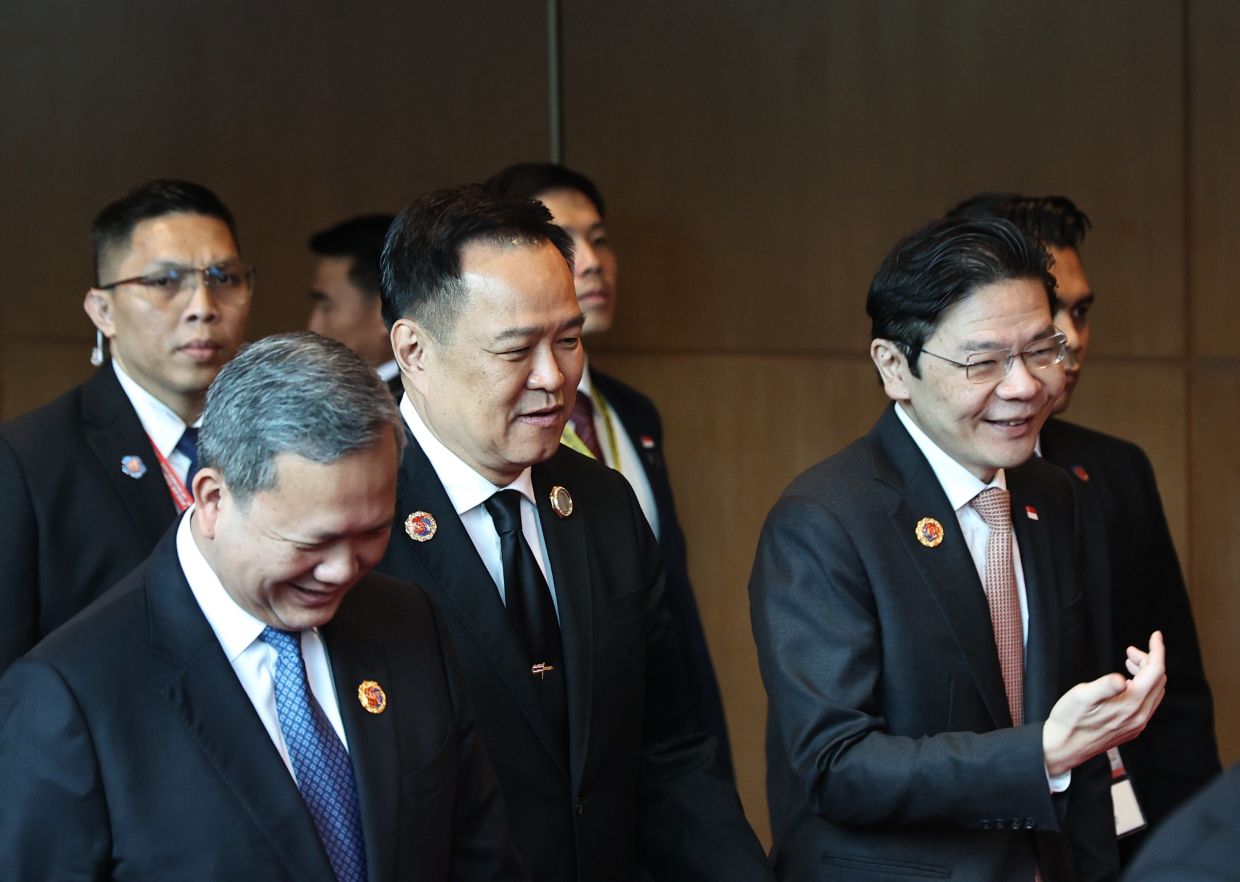
The possibility of China stepping into a diplomatic void between Cambodia and Thailand has resurfaced with new urgency following high-level meetings in Beijing this week, raising questions about Beijing's expanding role as a peacemaker in Southeast Asian territorial disputes. Cambodian Prime Minister Hun Manet used bilateral talks with Chinese Premier Li Qiang to brief senior Chinese leadership directly on the latest developments along the disputed frontier, marking one of the most formal discussions between Phnom Penh and Beijing on this sensitive matter since tensions flared last year. Simultaneously, Thai Prime Minister Anutin Charnvirakul indicated that Bangkok would not reject Chinese involvement if Beijing chose to offer its services as a neutral broker, fundamentally shifting the diplomatic calculus around a conflict that has periodically threatened regional stability.
The timing of these statements carries particular significance. Both Hun Manet and Anutin are in China simultaneously for the 2026 World Artificial Intelligence Conference, yet neither has announced a bilateral meeting between the two leaders themselves. This absence is revealing—it suggests that direct talks between the countries remain constrained by the underlying tensions, while engagement with Beijing offers a safer alternative channel for maintaining dialogue and signalling intent. Hun Manet's decision to personally brief Li Qiang demonstrates Phnom Penh's determination to keep its closest strategic partner thoroughly informed of border developments, reflecting Cambodia's historical dependence on China for security and economic support.
Official statements from both Cambodia and China carefully avoided mentioning mediation explicitly, maintaining diplomatic ambiguity that leaves room for future manoeuvres. In their joint communiqué, Hun Manet and Li reaffirmed the Cambodia-China comprehensive strategic partnership while emphasizing Phnom Penh's commitment to peaceful resolution based on international law and existing treaties and agreements. Li described the two nations as "ironclad friends," a characterization that carries considerable weight in Chinese diplomatic vocabulary and suggests Beijing's willingness to stand by Cambodia regardless of broader regional pressures. However, the absence of specific mediation language in official statements does not indicate unwillingness; rather, it reflects careful diplomatic footwork designed to avoid the appearance of external pressure or interference on either side.
Thailand's position, articulated through Anutin's comments to Thai media, represents a subtle but important shift in Bangkok's approach. By explicitly stating that Thailand has "not asked China to mediate, but we are not closing the door," Anutin preserved Thailand's preference for direct bilateral dialogue while simultaneously inviting Chinese intervention if Beijing deems it appropriate. This formulation allows Thailand to maintain its negotiating position without appearing defensive or desperate for external support, while simultaneously acknowledging the reality that regional tensions require some form of facilitation. Anutin's emphasis on Thailand's preference for direct talks with Cambodia reflects Bangkok's concern about appearing weak or unable to resolve disputes independently, a consideration that carries political weight in Thailand's domestic discourse.
China's historical positioning on this dispute provides essential context for understanding the present moment. During last year's Asean Foreign Ministers' Meeting, Chinese Foreign Minister Wang Yi publicly stated Beijing's willingness to "uphold an objective and fair position and play a constructive role for the harmonious coexistence between Thailand and Cambodia." This was neither a formal offer of mediation nor a rejection of such a role, but rather a carefully calibrated statement that preserved Beijing's flexibility. Since then, China has hosted trilateral discussions involving senior officials from all three nations and has actively supported implementation of existing ceasefire arrangements, demonstrating commitment to preventing escalation while stopping short of formal mediation.
The broader context of Cambodia-Thailand tensions extends beyond the immediate border dispute. The relationship between these two nations has historical complications rooted in their shared border and competing territorial claims that date back decades. Previous flare-ups have occasionally threatened to draw in regional actors and destabilize the wider area, making any mechanism that reduces tensions worthy of serious consideration. Cambodia has pursued a multi-faceted approach that includes welcoming Asean observer missions and invoking international law and legal mechanisms, while repeatedly affirming its commitment to non-military resolution. This approach signals Phnom Penh's confidence that international law favours its position, a crucial consideration that shapes its receptiveness to various forms of engagement.
For Malaysia and other Southeast Asian nations, the prospect of Chinese mediation in this dispute carries complex implications. A successful Chinese role could demonstrate Beijing's capacity to facilitate regional peace and deepen its influence across the region, potentially setting precedents for Chinese involvement in other disputes. Conversely, it could raise concerns about Beijing's ability to shape outcomes in ways that serve its strategic interests rather than genuine neutrality. From a Malaysian perspective, the situation exemplifies the delicate balance that smaller regional powers must maintain in an environment where great power influence is increasingly assertive, and where institutional mechanisms like Asean sometimes prove insufficient for managing bilateral tensions between member states.
The uncertainty surrounding whether China will actually assume a formal mediation role remains significant. Neither Cambodia nor Thailand has officially requested mediation, and China has not announced any initiative in this direction. This studied ambiguity may be intentional—it allows all parties to maintain negotiating flexibility while keeping diplomatic options open. Should tensions escalate, any of the three capitals could invoke the possibility of formal mediation; should tensions ease, none would be bound by previous statements. This approach reflects sophisticated diplomatic calculation in an environment where rigid commitments can become liabilities.
Looking forward, the evolution of China's role will depend on multiple factors, including the trajectory of actual border incidents, domestic political developments in both Cambodia and Thailand, and broader regional security considerations. The current moment appears to represent a critical juncture where Chinese diplomatic engagement is being carefully expanded without triggering alarm bells among either party or broader regional observers. Whether this measured approach ultimately leads to formal mediation or remains a form of behind-the-scenes facilitation will depend on developments over the coming months.

