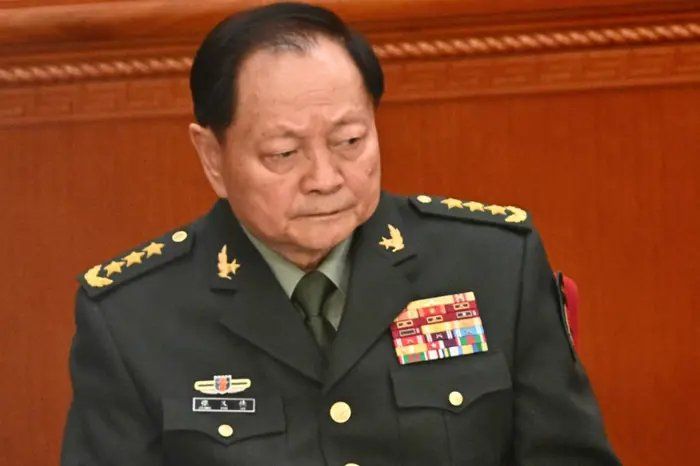
China's political establishment has moved to strip former General Zhang Youxia of his position as vice chairman of the Central Military Commission (CMC), the country's principal military decision-making body, in a significant reshuffling of the nation's defence hierarchy. The removal, announced through state media on Friday, marks the culmination of disciplinary proceedings launched in January when authorities revealed that Zhang and Liu Zhenli, another senior military figure, faced investigation for "serious violations of discipline and the law" — phrasing that in the Chinese political lexicon typically signals allegations of corruption or abuse of power.
Zhang's departure from the CMC carries particular weight given the prominence he previously held within China's military structure. As the more senior of two vice chairmen serving on the commission, he had occupied China's highest-ranking general officer position, placing him among the nation's most powerful defence officials and in close proximity to strategic decision-making at the very pinnacle of the Communist Party leadership. His removal therefore represents a notable shake-up in the upper echelons of the People's Liberation Army at a time when military modernisation and strategic readiness remain central to Beijing's governance priorities.
The disciplinary action against both Zhang and Liu, who served as chief of staff of the CMC's joint staff department responsible for overseeing military combat operations and strategic planning, reflects the intensifying pressure within China's military establishment to root out misconduct. The joint staff department that Liu headed plays a crucial coordinating role in China's defence planning, making his removal equally significant for the operational continuity of the military apparatus. The announcement came through Xinhua, China's state news agency, following a meeting of the standing committee of the National People's Congress, signalling that the decision carried formal parliamentary sanction.
The timing and scale of these removals underscore President Xi Jinping's sustained commitment to an anti-corruption drive that has become a hallmark of his tenure. Since consolidating power over the past decade, Xi has weaponised corruption investigations as a mechanism for both eliminating rivals and consolidating loyalty within the party and military structures. The campaign has touched virtually every echelon of Chinese governance, but the targeting of figures like Zhang — who held one of the nation's most senior defence positions — demonstrates that no rank provides immunity from the scrutiny.
What has surprised observers and analysts tracking China's political dynamics is the apparent closeness that Zhang previously enjoyed to Xi himself. Intelligence and political observers had long regarded Zhang as a figure within Xi's inner circle, suggesting a degree of personal trust and alignment that might ordinarily protect senior officials from such high-profile investigations. His downfall therefore signals either a significant fracture in Xi's immediate network or a recalibration of factional dynamics within the military leadership that had previously sheltered Zhang from investigation.
The investigation's seven-month duration, from January's public announcement through to Friday's formal removal, follows a familiar pattern in Chinese political discipline proceedings. Such extended investigative periods typically involve detailed examinations of financial records, official conduct, and interpersonal relationships, often conducted in isolation from the subject. The lag between announcement and formal removal provides the Party's discipline apparatus time to consolidate evidence and ensure that successor appointments are properly aligned with central leadership preferences.
For the wider military establishment, these removals inject a degree of uncertainty into the chain of command at a sensitive moment. The CMC, which sits at the apex of military decision-making under Xi's direct chairmanship, requires stability and clear lines of authority, particularly given ongoing tensions across the Taiwan Strait and China's broader strategic competition with the United States. The departure of experienced senior officers, even when necessary for Party discipline, creates tactical gaps that must be filled by capable successors aligned with current strategic direction.
The implications extend beyond Beijing's military hierarchy into regional security considerations affecting Southeast Asia and the broader Indo-Pacific. China's neighbours, including Malaysia, monitor closely the composition and stability of the PLA's leadership because it directly influences military doctrine, operational temperament, and strategic decision-making. Purges at the highest levels occasionally presage shifts in military strategy or emphasis, though the full ramifications may take months to become apparent through observable changes in force posture or operational tempo.
Zhang's removal also illustrates how China's anti-corruption mechanism functions as an instrument of internal Party management, distinct from Western judicial processes. The absence of public trials, detailed charges, or transparent evidence presentation reflects the Communist Party's preference for administrative discipline conducted within its own institutional structures. For international observers and Southeast Asian strategists seeking to understand elite dynamics within Beijing, such opaque proceedings present interpretive challenges, requiring careful analysis of patterns and contextual clues rather than reliance on explicit official statements.

