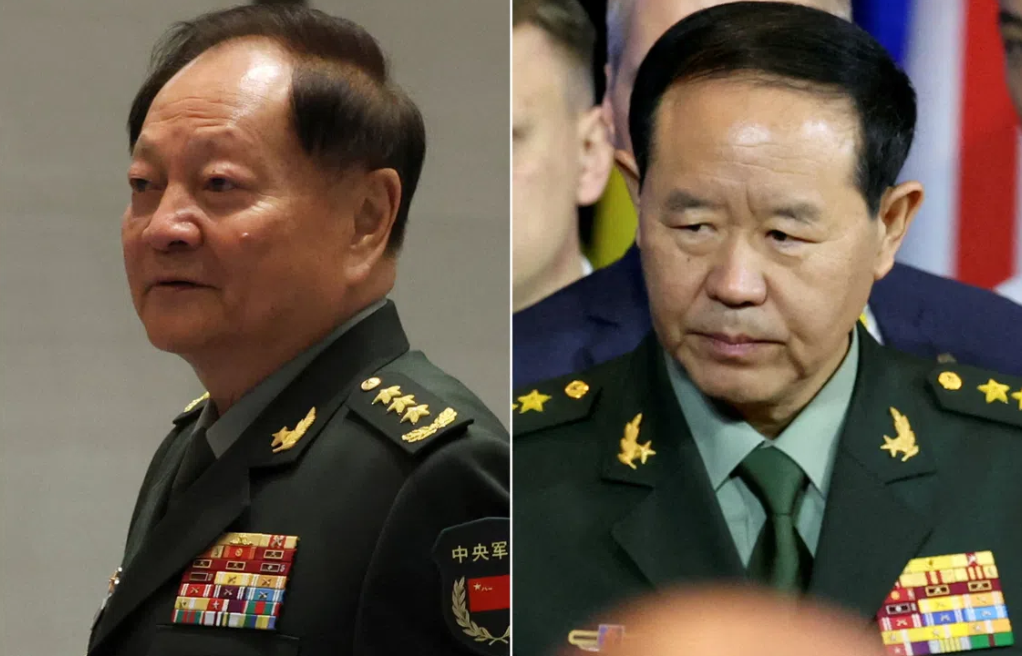
Beijing has removed two of its most senior military commanders from the Central Military Commission (CMC), China's supreme military authority, in a significant consolidation of power within the armed forces. The dismissals follow formal investigations into what state media described as grave breaches of discipline and law, though specific charges remain undisclosed. The departures of Zhang Youxia and Liu Zhenli represent another major milestone in Xi Jinping's sustained campaign to reshape military leadership and assert tighter control over the armed forces, a process that has accelerated markedly over the past decade.
Zhang Youxia occupied one of the most influential positions in China's military hierarchy as vice-chairman of the state CMC, serving as second-in-command to President Xi Jinping himself. Beyond this military role, Zhang held membership in the Politburo, the Communist Party's top policy-making body, placing him at the apex of both civilian and military power structures. Liu Zhenli, meanwhile, commanded significant institutional authority as both a CMC member and chief of staff of the CMC's Joint Staff Department, effectively overseeing the day-to-day operational machinery of the Chinese military. Their simultaneous removal signals an unprecedented reshaping of the commission's composition and decision-making structure.
The departures have created an unusual situation within the CMC, which originally comprised seven active members. Following Friday's announcement by the Standing Committee of the National People's Congress, only two serving members remain—a dramatic reduction that underscores either a deliberate restructuring or the scale of internal investigations gripping military leadership. Xi Jinping himself continues as a member, but the loss of experienced vice-chairs and senior commanders raises questions about operational continuity and succession planning within China's defence establishment. This skeletal membership may be temporary while investigations proceed, or it may reflect a strategic decision to centralise decision-making among fewer, more trusted officials.
The anti-corruption drive sweeping through the military represents one of Xi Jinping's most consequential policy initiatives since assuming power in 2012. Military institutions were identified early as priority targets for what the Communist Party framed as necessary institutional cleansing. Over the past twelve years, this campaign has ensnared scores of senior officers and defence officials, resulting in investigations, removals, and in some cases criminal prosecutions. The military, which controls vast resources and maintains significant autonomy in certain spheres, has been progressively brought under tighter central supervision and ideological alignment with Xi's vision for the party and state.
In recent weeks, the intensity of these actions has escalated noticeably. Last month, Xi convened senior Communist Party leaders and delivered remarks explicitly calling for an intensification of anti-corruption efforts within military ranks. These public statements signal that the purge remains an active priority rather than a concluded campaign, suggesting that further high-profile removals may be anticipated. The timing and frequency of such announcements often coordinate with major party meetings or policy initiatives, serving both as genuine administrative actions and as demonstrations of Xi's authority and commitment to institutional discipline.
The administrative structure through which these removals occurred reveals the complexity of China's dual military command systems. China maintains parallel organisations for both the Communist Party and the state apparatus, with separate CMCs nominally operating under each structure. However, these institutions function in practice as a single integrated entity, with the same senior officers holding positions across both hierarchies simultaneously. Friday's announcement addressed only Zhang and Liu's removal from state CMC positions, as their dismissals from the party CMC have not yet been formally or publicly announced. This staggered disclosure pattern may allow authorities to control information flow or provide technical opportunities for officials to resign from one position before formal removal from another.
The National People's Congress published an updated list of deputies on Friday, reflecting the official loss of parliamentary seats by Zhang, Liu, and ten other officials whose names were removed. Among these additional figures were Lieutenant General Zhong Shaojun, who previously directed the CMC General Office, and General Ju Qiansheng, a former commander of the Strategic Support Force—the military's elite cyber and space operations branch. Their removals indicate that the investigation spans multiple command structures and functional areas throughout the defence establishment, suggesting either a coordinated purge or widespread institutional problems affecting numerous commands simultaneously.
The list also included Gao Shiwen, the former mayor of Nanchang in southern China, whose career trajectory illustrates how investigations can extend beyond active military personnel into civilian officials with defence connections. Gao previously served in leadership positions at China Aerospace Science and Technology Corporation, a state-owned enterprise controlling sensitive space and military technology development. This inclusion suggests investigators are examining potential misconduct spanning the civil-military nexus, where defence procurement, technology transfer, or resource allocation may have involved irregular dealings.
Additionally, the Communist Party's top political advisory body separately removed Zhao Zongqi, a former commander of the Western Theatre Command, from membership. Zhao's profile is particularly sensitive given his command during the 2020 China-India border clashes, a military confrontation that resulted in casualties and elevated regional tensions. His removal may reflect scrutiny of military decision-making during that conflict or unrelated disciplinary matters, but the timing raises questions about how investigations examine commanders' actions during significant operational periods.
For Malaysia and Southeast Asia more broadly, these internal Chinese military developments carry strategic implications. The extensive reshuffling of command structures can affect decision-making processes, operational priorities, and continuity in regional military relationships. Neighbouring states monitor such changes closely to assess any shifts in military doctrine, readiness posture, or leadership attitudes toward regional disputes. The consolidation of authority within Xi's circle, if that is what these removals represent, may signal clearer strategic direction but could also introduce uncertainties as new commanders assume unfamiliar portfolios or as institutional knowledge is disrupted during transitions.
The scale and intensity of China's military purge also reflects broader patterns within the Communist Party under Xi's leadership. The anti-corruption apparatus has become a powerful tool for consolidating central authority, removing potential rivals, and reshaping institutions according to preferred ideological and operational frameworks. The military, as the ultimate guarantor of party power and a potentially autonomous force, has been a particular focus of this transformation. Whether framed as genuine anti-corruption work or as political consolidation, these removals demonstrate Xi's determination to maintain supreme control over China's armed forces and prevent any institutional challenger from emerging within the military hierarchy.
The continuing nature of these investigations, combined with Xi's recent public emphasis on deepening the anti-corruption campaign, suggests that observers should anticipate additional removals and restructuring in coming months. The institutional effects of such extensive leadership changes may take time to materialise, but the direction is clear: the CMC and broader military command structure are being progressively aligned with Xi's personal authority and strategic preferences. For regional security analysts, these developments underscore the importance of monitoring not just military capabilities and deployments, but also the internal political dynamics shaping decisions within China's defence establishment.

