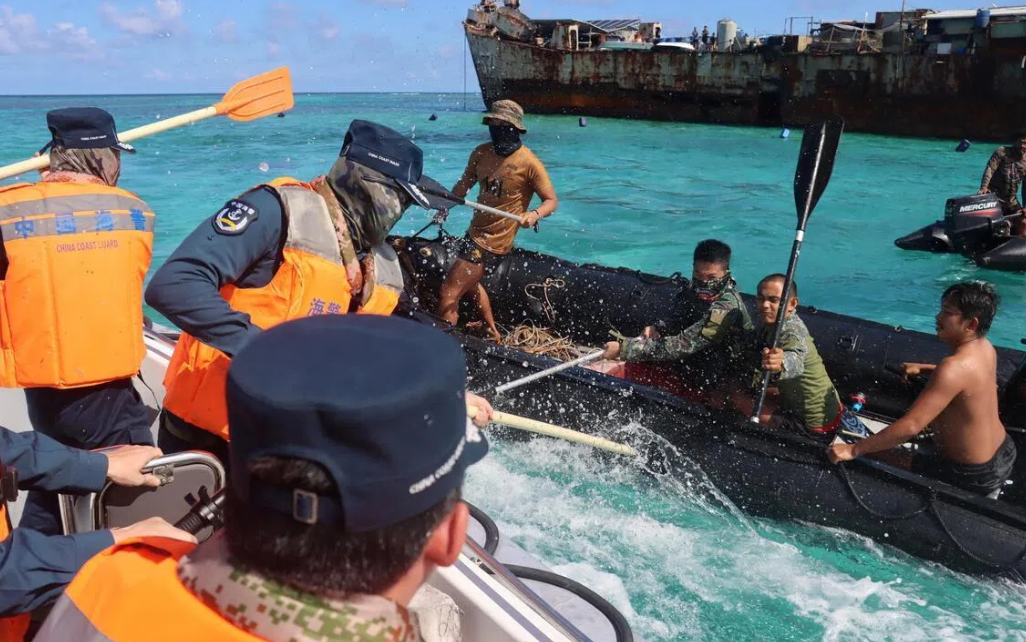
Tensions in the South China Sea simmered anew on Tuesday when Beijing summoned Manila's ambassador to register formal complaints over a maritime incident that has reignited international concern over regional stability. The confrontation, which occurred at Ren'ai Reef—also known internationally as the Second Thomas Shoal—once again spotlighted the competing claims and volatile dynamics that characterise this critical waterway, prompting swift reactions from major powers with vested interests in the region's security architecture.
The Philippines alleged that Chinese Coast Guard personnel used batons to strike a Filipino sailor on Monday as Philippine vessels moved toward a grounded ship that has served as a longstanding military outpost. This account, released by Manila's armed forces, depicted an aggressive response to what Philippine officials characterised as routine operations in their claimed maritime zone. China's foreign ministry, however, inverted the narrative entirely, asserting that the Philippine side initiated the provocative action and subsequently distorted events through what Beijing termed "malicious" amplification.
Beijing maintains expansive territorial assertions across the South China Sea, claiming sovereignty over nearly the entire body of water—a position decisively undermined by an international arbitration ruling that found such claims legally baseless. Despite this judicial determination, China has continued pursuing its strategic interests in waters critical to global commerce, with an estimated US$5 trillion in annual shipping traffic passing through regional chokepoints. Multiple Southeast Asian nations, the Philippines foremost among them, maintain overlapping claims that directly conflict with Beijing's territorial maximalism, creating a persistent flashpoint for naval encounters.
The Second Thomas Shoal represents perhaps the most volatile of these contested areas. The Philippine military maintains a small garrison aboard the BRP Sierra Madre, a deliberately grounded transport vessel positioned to symbolise Manila's continued presence and claims. This ship and the shallow waters surrounding it have become a recurring locus of friction, with regular confrontations between Philippine resupply missions and Chinese maritime forces seeking to prevent or inhibit such operations. Each incident, whether involving water cannons, aggressive maneuvering, or physical altercations as in this case, threatens to escalate tensions beyond the threshold of diplomatic resolution.
The international response proved swift and coordinated, reflecting deep concern among Western-aligned nations about China's increasingly assertive posture. United States Secretary of State Marco Rubio, who arrived in Manila on Tuesday for an Asean summit, condemned Beijing's actions as "dangerous and aggressive," positioning Washington's strategic interests directly alongside those of its regional partners. Australian Foreign Minister Penny Wong similarly attacked China's conduct as "destabilising and dangerous," signalling that concern over South China Sea developments extends well beyond the immediate region.
Rubio's presence at the Asean gathering carries particular significance given that he authored an opinion piece published across Philippine media outlets, explicitly framing the maritime dispute within a broader competition for regional influence. His argument emphasised that control of Southeast Asian waters by powers willing to weaponise trade relationships would fundamentally threaten the sovereignty, security, and economic prospects of both the United States and member states of the Association of Southeast Asian Nations. This formulation, while unnamed, clearly targeted China's economic and political leverage across the region, suggesting Washington views the South China Sea primarily through a zero-sum strategic lens.
The timing of Rubio's Manila visit coincides with the Asean summit, an 11-member gathering that includes several nations with their own South China Sea disputes. This multilateral setting provides opportunity for the Trump administration to reinforce security commitments to the region while building consensus around maritime freedom principles. Significantly, both Rubio and China's Foreign Minister Wang Yi plan to attend, raising possibilities for bilateral discussions though nothing has been publicly scheduled as of the incident's resolution.
Historically, Rubio and Wang have engaged on previous occasions, meeting in Kuala Lumpur last year during an Asean summit and again in Munich in February. These diplomatic contacts suggest that despite rhetorical escalation, channels for high-level communication remain open. However, the gap between such meetings and concrete policy shifts remains substantial, particularly given fundamentally divergent strategic worldviews regarding regional order and the role of external powers.
For Malaysia and other Southeast Asian nations observing these developments, the implications are multifaceted and concerning. The confrontation underscores how external power competition continues to impose risks upon the region, potentially forcing smaller nations to navigate between great power interests while defending their own maritime claims. The Asean consensus-building approach traditionally employed in addressing such disputes has proven inadequate to contain Chinese assertiveness or to generate meaningful constraints on its behaviour.
Moreover, the incident demonstrates how rapidly localised maritime encounters can escalate into significant diplomatic incidents with potential ramifications for regional stability. The injury to a Filipino sailor transformed what might otherwise have been characterised as a routine administrative dispute into a matter of national pride and international concern. Malaysia, which maintains its own South China Sea claims and coastline, can hardly ignore signals suggesting that maritime confrontations may become increasingly physical rather than remaining restricted to bureaucratic posturing.
The Philippines' strategic alliance with Washington, reinforced through Rubio's visit and public rhetorical support, reflects Manila's calculation that only external balancing against China can sustain its position in disputed waters. Yet this approach carries inherent risks, potentially antagonising Beijing further and drawing the region deeper into great power competition. For other Asean members, including Malaysia, balancing between China's economic importance and concerns over regional security remains an enduring policy dilemma without easy resolution.
The underlying dynamic persists unresolved: China continues asserting claims incompatible with international law, the Philippines resists through military presence, the United States reinforces its regional partnerships, and the mechanisms available to Asean for conflict management remain institutionally weak. Until fundamental strategic interests shift or credible enforcement mechanisms emerge, such confrontations will likely recur at irregular intervals, perpetually testing the region's capacity for peaceful dispute resolution.

