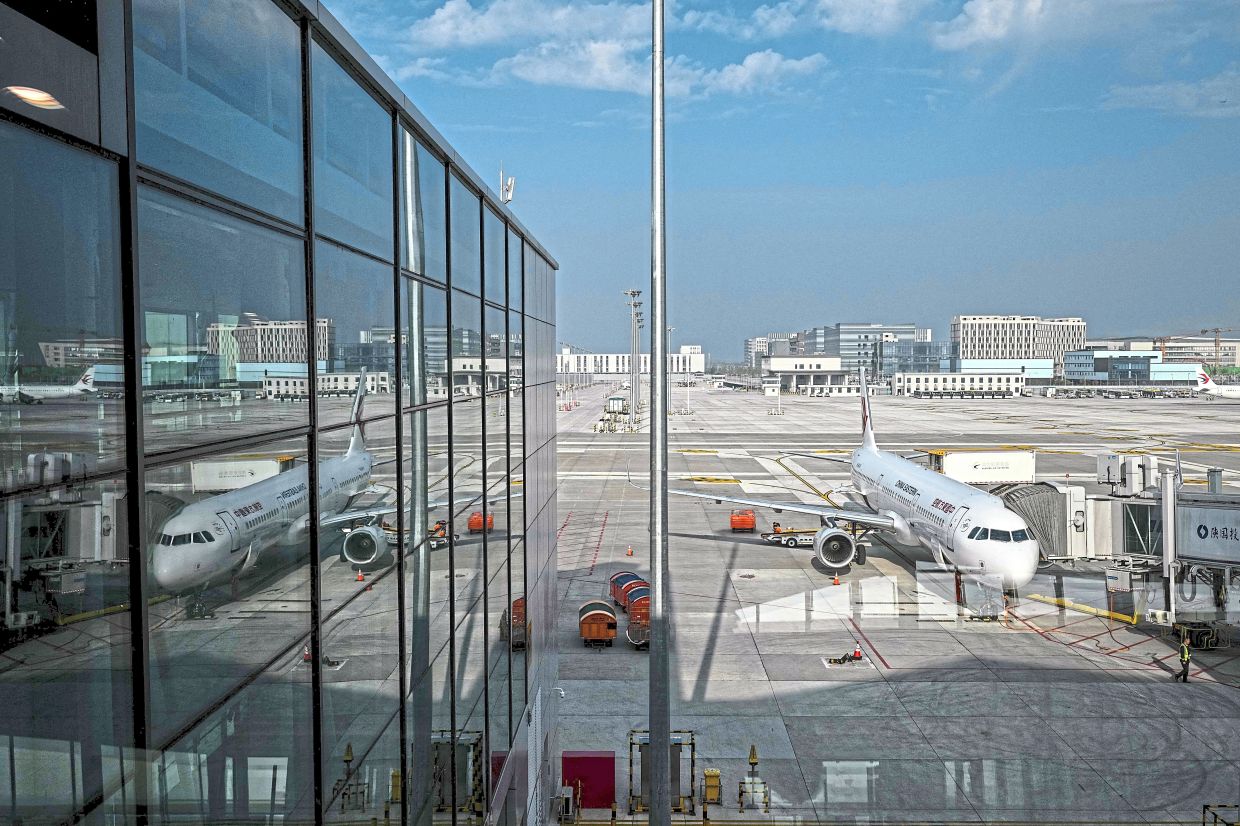
China's aviation sector is facing a deepening crisis as the nation's three dominant state-owned carriers—Air China, China Eastern Airlines and China Southern Airlines—announced combined first-half net losses totaling approximately 8.2 billion yuan, representing a grim milestone as these giants report losses for the seventh year running. The deterioration from their 4.82 billion yuan first-quarter profit underscores how sharply conditions have worsened in the second quarter, with the outlook for the remainder of the year remaining decidedly uncertain amid a sluggish summer season that typically anchors the carriers' annual earnings.
The individual performance figures illustrate the breadth of the challenge facing each carrier. Air China, the nation's flag carrier, reported a net loss of 2.3 billion yuan in the first half, nearly 27 per cent worse than the 1.81 billion yuan loss recorded in the same period a year earlier. China Eastern sustained losses of 2.2 billion yuan, compared with 1.43 billion yuan previously, while China Southern—the worst performer of the three—recorded losses of 3.7 billion yuan against 1.53 billion yuan a year ago. The escalating losses rattled investor confidence immediately, with share prices across the trio declining sharply in both mainland and Hong Kong trading as the results became public.
At the heart of these mounting losses lies a persistent surge in jet fuel costs that the airlines have been largely unable to pass on to passengers or manage through hedging strategies employed by their international competitors. Fuel expenses climbed between 35 and 38 per cent for each carrier during the first half of the year, a trajectory driven fundamentally by the impact of Middle Eastern tensions on global oil markets and supply routes. What distinguishes Chinese carriers from their Asian and European counterparts is their minimal use of fuel hedging instruments, leaving them acutely vulnerable to every fluctuation in petroleum prices. This structural weakness has become catastrophic: China Southern explicitly acknowledged in its regulatory filing that it currently possesses no viable mechanisms to insulate itself from jet fuel price volatility, an admission that reveals the fragile position these carriers occupy.
The geopolitical dimension of the current crisis cannot be overlooked. The disruption of traditional international routes through the Middle East, exacerbated by regional conflict, has forced airlines to reroute aircraft and absorb additional fuel costs while simultaneously reshaping passenger patterns. Paradoxically, this disruption has created opportunities elsewhere: strong demand for European routes has surged as some travellers deliberately bypass compromised Middle Eastern hub airports, providing a genuine silver lining to what is otherwise a bleak picture. This selective strength in long-haul international operations has driven revenue growth across all three carriers, with Air China expanding revenues by 10.5 per cent, China Eastern by 11.1 per cent, and China Southern by 9.7 per cent year-on-year.
Yet revenue expansion has proven entirely insufficient to overcome cost pressures, a reality that exposes the structural vulnerabilities of China's domestic aviation market. Unlike their American counterparts, which have successfully implemented substantial fare increases to offset fuel costs, Chinese carriers operate in a constrained pricing environment where raising ticket prices risks triggering demand destruction. The combination of slowing economic conditions within China and fierce competition from high-speed rail networks and road travel means that passengers possess readily available alternatives if domestic fares climb too steeply. This pricing inflexibility, married with rising costs, creates an impossible arithmetic that has crushed profitability across the sector.
While crude oil prices have retreated from their second-quarter peaks, they remain elevated significantly above pre-conflict baselines, hovering more than 50 per cent above earlier levels and continuing to weigh on operational expenses. The third quarter, which traditionally generates the strongest profits for Chinese carriers, has brought no respite whatsoever. Instead, an unusually severe typhoon season has ravaged domestic operations precisely during the peak summer travel period when carriers depend most heavily on passenger volumes. Meteorological records indicate that 21 typhoons have formed in the northwestern Pacific Ocean and South China Sea thus far in 2026, substantially exceeding the historical average of 12 storms for the corresponding timeframe.
This combination of elevated fuel costs and weather-related disruptions is manifesting directly in projected passenger traffic figures that presage further deterioration ahead. Flight Master, an aviation data analytics firm, forecasts that Chinese carriers will transport 142 million passengers across domestic and international routes during July and August—a decline of 3.6 per cent year-on-year that would constitute the first contraction in these crucial peak months since 2022, when broad lockdowns paralyzed much of China's economy. The implications are severe: what should be the industry's most profitable season is instead shaping up as a period of continued strain.
Looking forward, financial analysts paint an even grimmer picture for the carriers and their shareholders. HSBC strategists project that the Big Three will accumulate combined losses of approximately 16.8 billion yuan throughout 2026, a forecast that contradicts market consensus expectations for a modest combined profit of 1.3 billion yuan. This gap between consensus and professional analysis reflects deepening uncertainty about whether these carriers can stabilize operations. The stock market has rendered its own verdict with brutal clarity: shares of all three carriers have depreciated by at least 36 per cent since the beginning of 2026, and notably, none of the carriers declared interim dividends, signalling management recognition that available capital must be preserved to weather extended losses.
Amidst this deteriorating landscape, the carriers have pursued one strategic bright spot: expansion of their domestic aircraft fleets. China Eastern increased its fleet of narrowbody COMAC C919 jets to 17 aircraft following three deliveries in the first half, while Air China and China Southern each operate 11 C919s after taking two and three deliveries respectively. However, even this modest bright spot has clouded somewhat. China Eastern announced that it now expects to receive 13 fewer C919 deliveries than previously forecast during the 2026-2028 window, a pullback that reflects the financial constraints now limiting carrier capacity investment decisions. Air China maintained its earlier delivery forecast while China Southern declined to disclose revised expectations, leaving uncertainty about the pace of domestic aircraft adoption moving forward.
For Malaysian and Southeast Asian observers, these developments carry significant implications that extend beyond China's borders. The financial distress of China's carriers, combined with their subdued profit outlooks, may ultimately constrain their expansion into regional routes and competitive pricing strategies that have pressured regional carriers in recent years. Conversely, if these carriers attempt to stimulate demand through aggressive discounting on international services as domestic revenue weakens, regional competitors operating on similar routes may face intensified pressure. The sector's struggles also underscore the vulnerability of airlines globally to external shocks such as geopolitical conflicts and climate-related disruptions, lessons pertinent to carriers throughout Asia and beyond.

