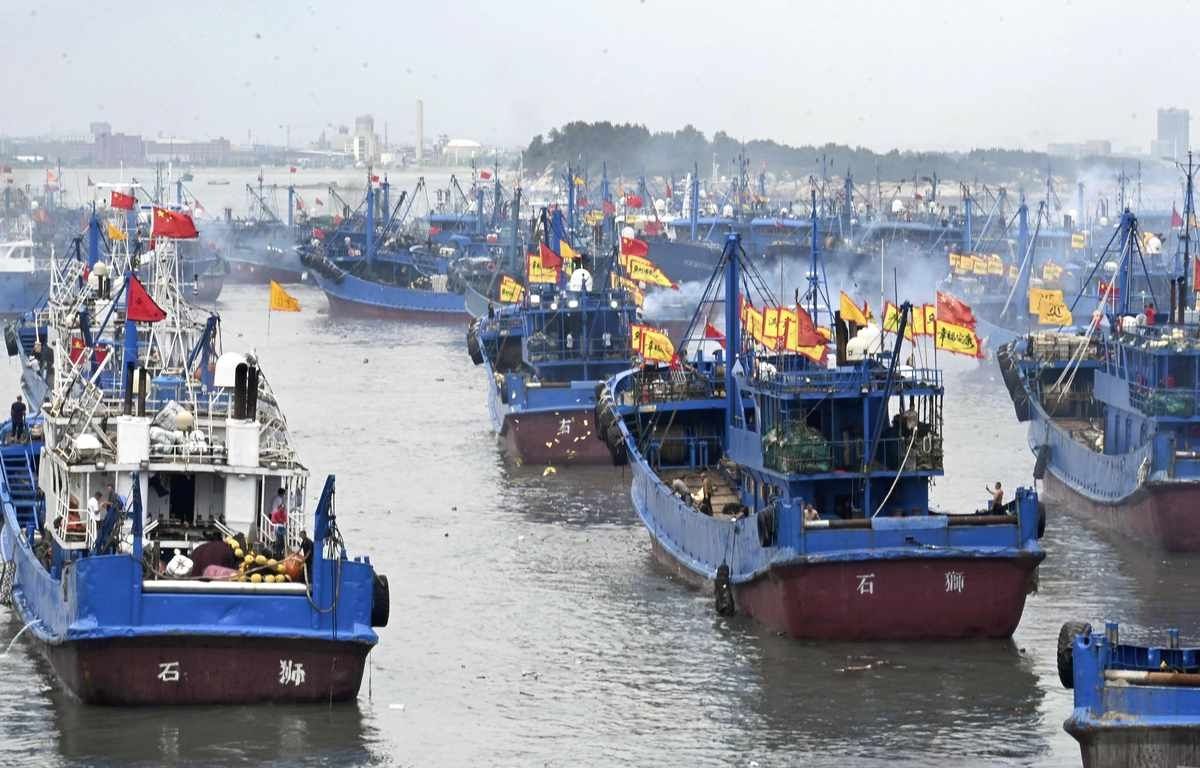
The expiration of China's seasonal fishing moratorium in the East China Sea on August 15 marks a potentially significant shift in maritime tensions in one of Asia's most contested waterways. As dawn broke on August 16, over 650 fishing vessels departed from the port city of Shishi in Fujian Province alone, their crews celebrating with firecrackers and flying the Chinese national flag alongside traditional red and yellow banners symbolizing prosperity and safety. The scale and visibility of this deployment underscores Beijing's message as it reopens access to fishing grounds that have long been a flashpoint between China and Japan, particularly in waters surrounding the Senkaku Islands, which remain disputed between the two nations despite Japan's administrative control.
The resumption of unrestricted fishing activity arrives at a moment when Tokyo-Beijing relations have deteriorated significantly, making Japan's response a closely watched indicator of China's intentions. Historical precedent looms large: in August 2016, hundreds of Chinese fishing vessels, operating in apparent coordination with Chinese Coast Guard ships, flooded the waters around the Senkaku Islands in what many observers interpreted as a calculated show of force. That incident, during which incursions into Japanese territorial waters were recorded, prompted Tokyo to lodge formal protests and highlighted the potential for maritime incidents to spiral into broader diplomatic crises. The timing and coordination of such operations have led regional analysts to view them not merely as fishing expeditions but as expressions of territorial assertion.
China's summer fishing ban, reimposed annually across the East China Sea, Taiwan Strait, and South China Sea, serves multiple purposes beyond resource management. Ostensibly designed to allow fish stocks to regenerate, the measure also provides Beijing with a mechanism to manage maritime activity in sensitive zones. The ban's existence creates a de facto constraint on fishing fleet movements, allowing Chinese authorities to exercise indirect control over which vessels operate where and when. By lifting the ban, Beijing removes this convenient regulatory tool, opening the door for extensive maritime presence in disputed territories. The significance of this timing—during a period of heightened bilateral tension—has not escaped Japanese officials or regional diplomats who view such policy adjustments as potential precursors to escalation.
Yet the situation contains contradictions that complicate straightforward interpretation. Local Chinese government authorities in Quanzhou, which oversees Shishi, issued guidance on August 7 instructing fishermen to strengthen surveillance protocols in sensitive waters, language suggesting continued caution rather than reckless provocation. This reflects a pragmatic calculation: while China wishes to assert presence and rights in disputed zones, it simultaneously recognises that accidents at sea could trigger military responses and further damage already fragile relations. The dramatic decline in Japanese Coast Guard warnings issued to Chinese fishing vessels operating around the Senkaku Islands—from 81 in 2021 to merely four in 2025—suggests that some mechanism of tacit coordination has been operating, with Chinese authorities themselves constraining their fishermen's access to the most sensitive areas.
A telling shift appears in official Chinese government notices accompanying the fishing ban's annual renewal. Previous notices explicitly warned against operations in "sensitive waters such as those of South Korea, North Korea and Japan." The April 30 notice this year, however, omitted Japan from this list, mentioning only the interim measures zone between China and South Korea. This precise editorial choice—the removal of three words—carries outsized diplomatic significance. Diplomatic sources have interpreted the omission not as careless editing but as a subtle signal that China may be loosening restrictions on its own vessels regarding Japanese waters. Whether this constitutes genuine intent to escalate or merely a rhetorical adjustment designed to project confidence remains ambiguous, yet the change itself sends a message that cannot be ignored.
Fishermen themselves navigate this landscape of constraints and opportunities with pragmatic calculation. A fisherman interviewed in Shishi, speaking on condition of anonymity, acknowledged the economic attraction of fishing grounds around the Senkaku Islands, describing them as particularly rich and productive. Yet he also revealed the disciplinary architecture surrounding maritime operations: should fishing boats venture too close to Japanese waters, they risk apprehension not by Japanese authorities but by Chinese surveillance forces. This arrangement effectively outsources enforcement to Beijing itself, allowing China to maintain plausible deniability while constraining fishing activity. The fisherman's comment that "we haven't been told outright not to go there" carries particular weight, suggesting that explicit prohibitions have been softened, potentially opening space for increased activity.
The regional context amplifies these concerns. In July 2016, the Arbitral Tribunal in The Hague issued a landmark ruling rejecting China's expansive maritime claims in the South China Sea, a decision that fundamentally challenged Beijing's assertion of sovereignty in waters claimed by multiple Southeast Asian nations. Japan and many other regional powers urged China to accept this arbitration outcome. Instead, Beijing appeared to respond with the 2016 surge of fishing vessels and coast guard activity around the Senkaku Islands, signalling defiance and reasserting its territorial claims through presence and action. Observers now fear that the lifting of the fishing ban, combined with the linguistic shift in official notices, might presage a repetition of such confrontational tactics, this time potentially more intensive.
For Southeast Asia and the broader Indo-Pacific region, the dynamics unfolding in the East China Sea carry wider implications. China's approach to maritime disputes—combining economic incentives for fishermen with subtle state coordination and calibrated shows of force—establishes a template that may be replicated in other contested zones. The South China Sea, where multiple nations claim overlapping maritime zones, could experience similar strategies. Vietnam, the Philippines, and other regional players watch Japanese responses carefully, understanding that patterns established in the East China Sea may presage developments affecting their own territorial disputes. Japan's monitoring activities thus serve not only bilateral concerns but regional stability interests.
The Japanese government faces a delicate balancing act in responding to the resumed fishing activity. An overly forceful response risks escalation and could provide China with justification for further militarization. Yet passive acceptance might be interpreted as weakness, potentially inviting bolder Chinese actions. Japan Coast Guard vessels will undoubtedly maintain heightened surveillance, ready to document and protest any incursions into Japanese territorial waters around the Senkaku Islands. The question remains whether this year's fishing season will replicate the relative restraint of recent years or revert to the confrontational patterns of 2016. That answer will depend not only on fishermen seeking profitable catches but on calculations made in Beijing's highest policy circles regarding the strategic utility of maritime assertiveness amid deteriorating bilateral relations.

