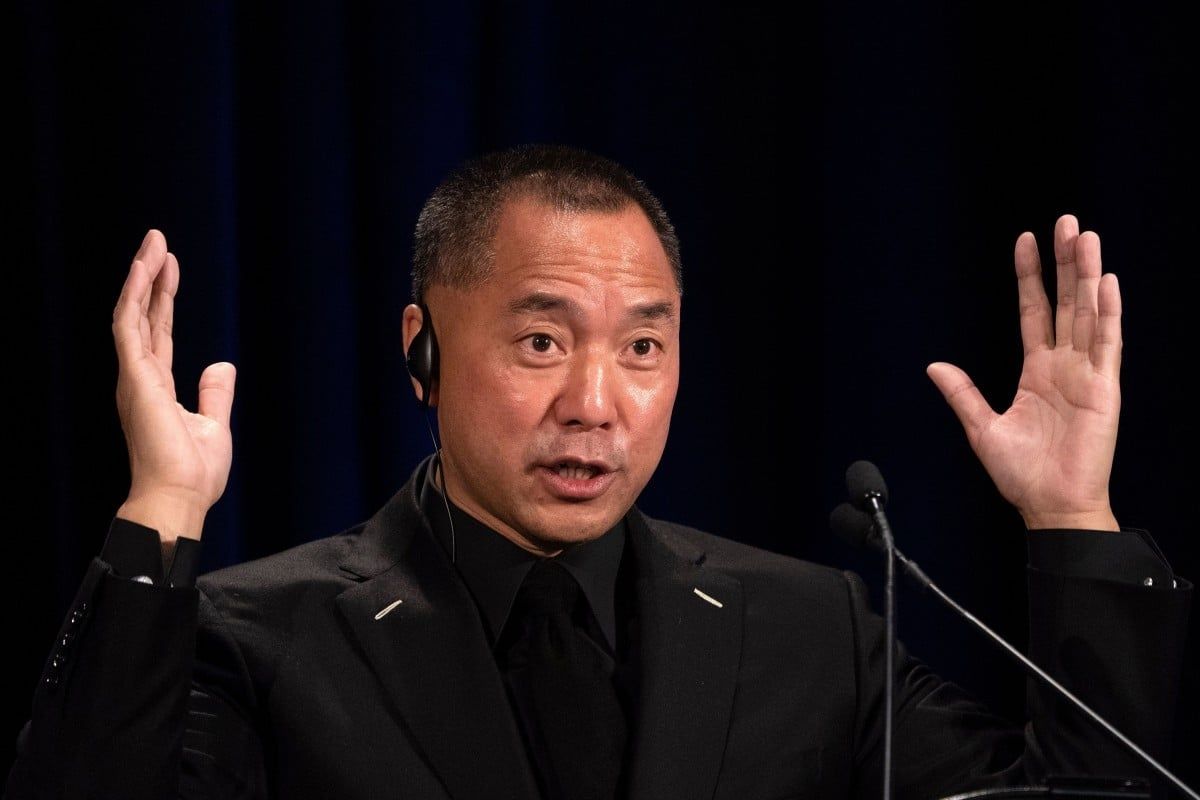
A Chinese business magnate who spent the past decade evading Beijing's reach whilst building a sprawling financial empire in New York has been sentenced to three decades in federal prison for operating what prosecutors described as one of the most brazen investment fraud schemes in recent US history. Guo Wengui, who reinvented himself as a dissident critic of China's Communist Party after fleeing to America, was condemned in a Manhattan courtroom on Monday by Judge Analisa Torres for orchestrating a systematic deception that extracted more than one billion dollars from credulous investors across the globe. The judge found that his scheme claimed over 1,000 victims who collectively lost hundreds of millions in savings, retirement funds, and life investments through entities bearing names like GTV Media Group, the Himalaya Farm Alliance, and the Himalaya Exchange.
During the sentencing hearing, Judge Torres articulated a damning portrait of a man who exploited the hopes and aspirations of those desperate to challenge Communist Party rule in China. She observed that Guo deliberately targeted individuals motivated by democratic ideals, systematically extracting their financial resources to underwrite an extravagant lifestyle characterised by penthouse apartments overlooking Central Park, multiple mansions, luxury yachts, racing vehicles, and designer collections. The judge emphasised that throughout his prosecution, Guo displayed no genuine contrition, instead insisting without credible basis that his conduct had inflicted no financial harm and caused no suffering. Furthermore, she documented a pattern whereby Guo mobilised his remaining supporters to threaten and intimidate victims and witnesses willing to speak publicly about their experiences.
The sentencing represents the culmination of a seven-week trial during which prosecutors methodically dismantled Guo's carefully constructed narrative of political persecution. He was convicted on nine of twelve criminal charges, with the government demonstrating through thousands of pages of documentary evidence and testimony that between 2018 and 2023, Guo engaged in systematic deception, misrepresentation, and embezzlement. Prosecutors portrayed his crimes as having devastated not merely individual finances but entire families psychologically and emotionally, leaving what they characterised as a landscape of financial ruin. The court ordered Guo to forfeit approximately 889 million dollars in restitution, though the likelihood of victims recovering meaningful compensation remains uncertain given the complexity of asset tracing across international jurisdictions.
What particularly distinguishes this case for Southeast Asian observers is the manner in which Guo weaponised sympathies regarding political dissidence and democratic advocacy to conduct sophisticated financial crimes. Prior to his 2023 arrest and detention without bail, Guo had cultivated close relationships with prominent conservative American political operatives, including strategist Steve Bannon, with whom he announced a joint initiative to overthrow China's government in 2020. He gained entry to exclusive American social circles, joining former President Donald Trump's Mar-a-Lago golf club and moving comfortably through financial and political elites who either failed to investigate his background adequately or chose not to question the source of his apparent wealth. This intersection of geopolitical positioning and financial crime underscores vulnerabilities in how Western institutions sometimes assess individuals fleeing authoritarian regimes.
The victim testimony presented during sentencing proceedings conveyed the human devastation wrought by Guo's operations. Wei Chen, one of numerous individuals who recounted their experiences before the court, described how her participation in Guo's schemes had fundamentally destroyed her life and that of her family members. Letters from additional victims, which Judge Torres reviewed before pronouncing sentence, documented patterns of severe anxiety, psychological shame, and familial estrangement arising from investment losses. Many victims had liquidated retirement portfolios, mortgaged properties, or depleted educational savings, investing in enterprises Guo explicitly represented as pathways to building wealth whilst simultaneously advancing anti-Communist political objectives. The fusion of ideological appeal with investment promise created a potent recruitment mechanism that proved devastatingly effective across multiple continents.
Guo's defence strategy largely pivoted on assertions that he represented a political target of the Chinese government rather than an ordinary criminal defendant. His attorneys submitted extensive court filings arguing that the Communist Party had orchestrated a coordinated campaign of persecution against their client, allegedly recruiting elites within American business, entertainment, and political circles to participate in a conspiracy aimed at his elimination. They contended that evidence of physical torture endured during earlier periods in China, corroborated by medical documentation of surgical repairs to injuries sustained between 1993 and 2022, demonstrated his vulnerability to authoritarian persecution rather than his propensity for financial crime. The defence team further characterised the 30-year sentence as disproportionate compared to prison terms typically imposed in comparable fraud cases, which generally range from two to four years, arguing that such severity would validate Beijing's narrative and encourage further suppression of Chinese diaspora activists.
Yet prosecutors and the sentencing judge were unpersuaded by characterisations of Guo as primarily a political fugitive. The government's case rested on granular documentary evidence demonstrating that Guo's wealth accumulation derived not from legitimate political exile activities but from systematic investor deception spanning multiple investment vehicles. Prosecutors emphasised that Guo exploited what they termed lax American asylum laws and immigration procedures that facilitated his transition from Hong Kong to London to New York in 2017, enabling him to establish financial operations whilst remaining beyond Beijing's legal jurisdiction. The prosecution further highlighted that Guo's alleged Chinese government troubles predated his most significant fraud operations, with his primary criminal activities occurring after he had already achieved relative safety and freedom in America, suggesting that financial greed rather than persecution drove his behaviour.
The geopolitical dimensions of this case merit particular attention for Malaysian and broader Southeast Asian readers. Guo's case demonstrates how authoritarian governments and their opponents sometimes converge in creating spaces of deception and criminality that victimise ordinary people internationally. Whilst Beijing's allegations against Guo may or may not be substantively accurate, his proven fraud activities have harmed thousands of investors across multiple nations seeking to support anti-Communist causes. The case exposes how ideological positioning and claims of political persecution can serve as camouflage for sophisticated financial crimes targeting diaspora communities and those sympathetic to dissident causes. This dynamic carries particular relevance across Southeast Asia, where significant Chinese diaspora populations and geopolitical tensions create vulnerability to such manipulation.
China's Ministry of Foreign Affairs formally acknowledged the sentencing, confirming that Guo remains designated as wanted by Beijing with an Interpol Red Notice issued against him. This notice requests law enforcement agencies globally to detain and facilitate extradition of the suspect pending resolution of Chinese criminal charges. The existence of both American conviction for fraud and Chinese warrants for rape, kidnapping, bribery, and other allegations creates an unusual legal circumstance wherein Guo faces competing claims of accountability from multiple jurisdictions. American authorities have taken the position that his prosecution proceeds on purely criminal grounds unrelated to his political activities, distinguishing their case from what might constitute politically motivated persecution.
The investigation into Guo's operations uncovered evidence that he orchestrated his schemes through misleading representations to hundreds of thousands of prospective investors, convincing them to participate in entities bearing quasi-governmental or revolutionary nomenclature. The Himalaya Farm Alliance, for instance, was represented to investors as a vehicle for accumulating wealth whilst simultaneously preparing for political transition in China. In reality, prosecutors demonstrated that investment proceeds flowed primarily toward Guo's personal enrichment rather than toward any stated political or philanthropic objectives. This pattern of systematic misrepresentation across multiple investment vehicles over a five-year period distinguished the case from occasional instances of investment failure or miscalculation, establishing instead a coordinated scheme to defraud.
As Guo departed the Manhattan courtroom following pronouncement of sentence, supporters applauded and called out encouragement, illustrating the continued loyalty maintained by elements within the broader anti-Communist Chinese diaspora despite his criminal conviction. This phenomenon suggests that for certain political constituencies, Guo's identity as an opponent of Beijing's government may continue to overshadow his documented financial crimes in their assessment of his moral standing. This dynamic complicates efforts to protect vulnerable diaspora populations from exploitation by charismatic figures claiming to represent broader political aspirations, as the fusion of geopolitical positioning and criminality renders ordinary investors vulnerable to sophisticated manipulation.
The 30-year sentence stands as a significant judgment within American jurisprudence concerning financial fraud and investor protection, signalling that courts will impose substantial penalties when defendants exploit ideological sympathies to facilitate large-scale deception. For Southeast Asian observers and policymakers, the case underscores the importance of developing robust mechanisms to verify claims of political persecution and to conduct adequate due diligence regarding individuals seeking to mobilise community resources around political causes. The Guo Wengui case demonstrates that geography, geopolitical positioning, and ideological narrative can obscure criminal conduct, and that protection of diaspora communities requires institutional capacity to distinguish genuine persecution from criminal predation disguised in political rhetoric.

