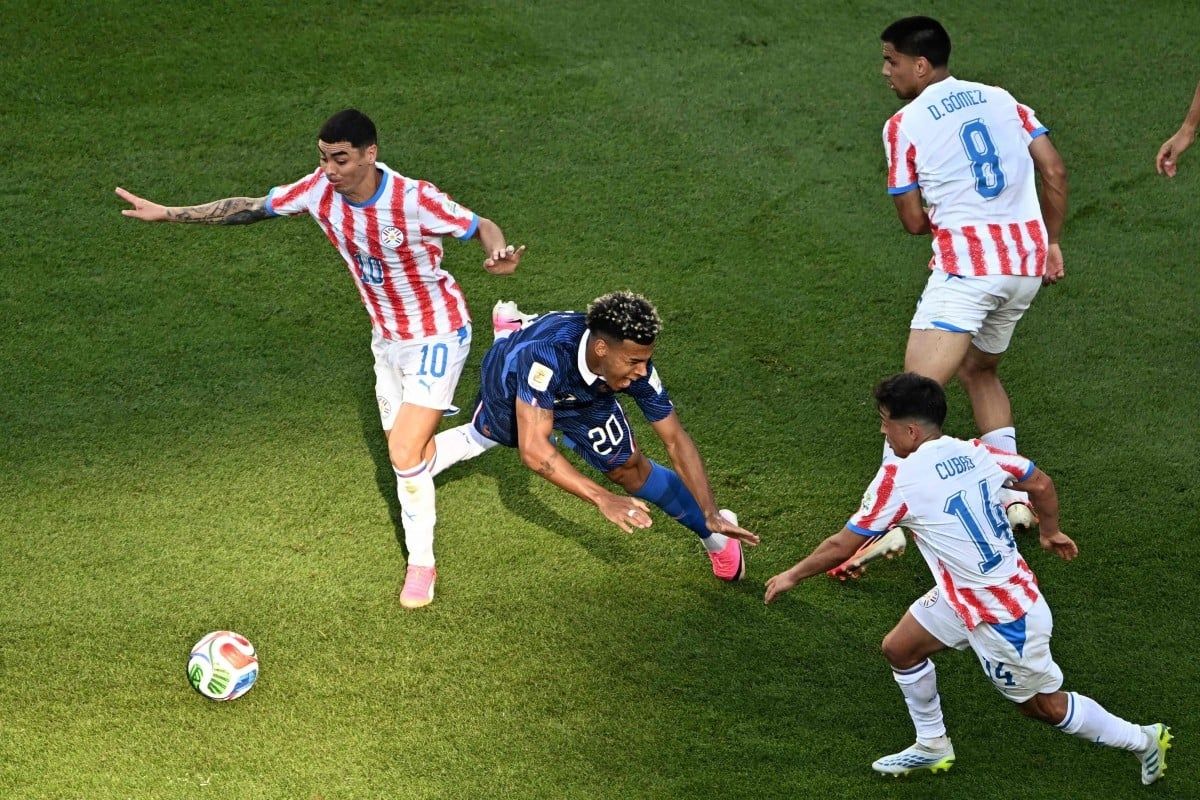
China's football community took to social media with sharp criticism following Paraguay's World Cup last-16 elimination at the hands of France in Philadelphia on Saturday, July 4, with the focus of discussion shifting away from the match outcome to the conduct of both teams and the officiating standard. The South American side's approach centred heavily on physical confrontation with their opponents rather than pursuing attacking opportunities, a tactical choice that sparked considerable debate among Chinese fans observing the encounter.
France secured progression to the quarter-finals through a Kylian Mbappe penalty conversion with 20 minutes remaining, setting up a subsequent matchup against Morocco. However, the relatively straightforward victory allowed Chinese observers to concentrate their commentary on Paraguay's physical intensity and what many perceived as inconsistent decision-making by Uzbekistan referee Ilgiz Tantashev, whose card distribution appeared notably lenient given the match's volatile atmosphere.
Tantashev's management of the encounter proved particularly controversial among Chinese fans accustomed to a different refereeing standard. The official distributed only four cautions throughout the match, with three going to France despite the visitors bearing the brunt of Paraguay's aggressive challenges. This disparity prompted direct comparisons to Ma Ning, the respected Chinese referee known among supporters as the "card master" for his willingness to use disciplinary measures. One observer remarked that if Ma Ning had overseen the contest, Paraguay would have been reduced to a goalkeeper on the pitch. The contrast highlighted a philosophical difference in match officiating between strict enforcement and a more permissive approach to physical play.
Criticism of Tantashev's performance extended beyond simple card counts. Chinese fans and social media users described his display as "very low standard," with some suggesting the Uzbek official had harboured a deliberate agenda against France. Others pointed to Paraguay's previous knockout victory over Germany, questioning whether Tantashev's perceived bias contributed to an unusual result. One commenter suggested that the previous German defeat now appeared questionable given Paraguay's need for constant fouling against France, implying the South Americans had received favourable conditions in their earlier tie.
The broader commentary from Chinese observers reflected frustration with football's divergence from technical excellence. One Weibo user articulated the sentiment that when match discussion centres entirely on the referee rather than player performance, officiating quality has fundamentally failed. This perspective aligned with widespread Chinese football culture, which historically emphasises skill development, tactical sophistication, and positive possession-based play over physical dominance and gamesmanship.
Mbappe emerged as Paraguay's primary target, enduring repeated physical challenges throughout the contest. The French forward demonstrated composure under sustained pressure, subsequently explaining that both he and his team had anticipated the nature of the encounter. His post-match comments acknowledged France's capacity to match Paraguay's intensity, stating that the French side knew how to "get their hands dirty" and play practical football when circumstances required. Mbappe's apparent confidence that France could compete in any style, despite preferring technical excellence, suggested the French squad felt sufficiently superior to operate effectively within Paraguay's chosen framework.
France's coaching staff corroborated assessments of Paraguay's all-encompassing approach to disruption. Manager Didier Deschamps, the 57-year-old former World Cup-winning coach, revealed that unsavoury scenes extended beyond field boundaries to the technical areas and benches. He characterised Paraguay's approach as exploiting "every trick in the book," criticising conduct that detracted from the sport's appeal. Deschamps specifically mentioned verbal abuse from the opposing bench that he considered unnecessary, indicating that hostilities transcended physical contact into personal exchanges.
Incidents at the final whistle further illustrated escalating tensions. Paraguay goalkeeper Orlando Gill was captured on camera throwing a ball at Mbappe's back after the French forward acknowledged his opponent's exit. Gill subsequently attributed the action to momentary frustration in the match's immediate aftermath, yet this explanation failed to gain traction among Chinese online commentators. Social media users dismissed the goalkeeper's justification as unconvincing, viewing the behaviour as emblematic of Paraguay's broader conduct throughout the encounter.
Chinese observers interpreted Paraguay's physical approach as symptomatic of deeper issues within South American football culture. Several commenters suggested that aggressive, contact-heavy tactics represented a characteristic of football across the continent, reflecting both tactical tradition and limited technical refinement. However, this generalisation provoked counter-arguments suggesting that attributing such behaviour to geographical or cultural factors oversimplified football's complexity. The debate highlighted how different regions and national football cultures develop distinct approaches to competition, with consequences for how neutrals perceive sporting conduct and fairness.
The match's aftermath underscored broader conversations within Chinese football communities regarding what constitutes acceptable competitive behaviour. Many observers emphasised that legitimate physical competition differs fundamentally from deliberate provocation, excessive fouling, and intimidation. The distinction between hard but fair play and behaviour designed to frustrate opponents without clear tactical justification emerged as a central point in evaluations. Chinese fans' perspective valued professionalism and respect, viewing Paraguay's conduct as dishonouring the sport rather than representing clever tactical adaptation.
For Malaysian and broader Southeast Asian audiences, the incident illustrated how refereeing standards vary significantly across international football competitions, raising questions about consistency and fairness in major tournaments. The contrast between Tantashev's permissive approach and stricter officials' methods demonstrated the impact individual referees exercise over match flow and outcome. Such variations can disproportionately affect teams from different regions, potentially influencing tournament progression and structural tournament integrity.
The commentary also reflected how global football matches instantaneously generate response and analysis across continental boundaries, with fans in East Asia engaging substantively with World Cup actions. Chinese observers' detailed technical and ethical analysis demonstrated sophisticated football understanding extending beyond their national league, indicating how World Cup tournaments connect worldwide audiences through shared scrutiny of professional conduct and competition standards.

