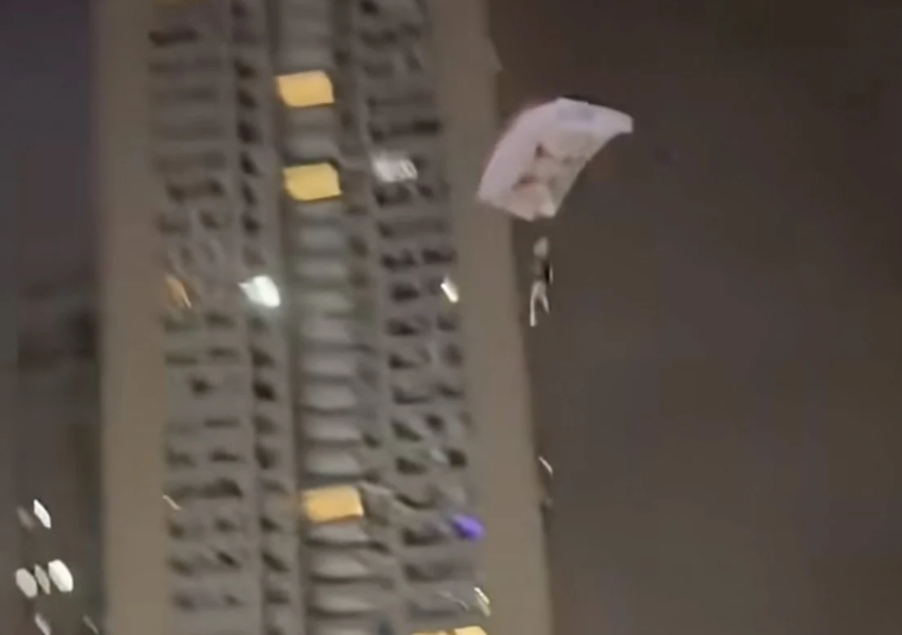
A 23-year-old surnamed Ren has been detained by authorities in southwestern China's Sichuan province following an unauthorised parachute jump from a high-rise residential building. The incident, which occurred on June 30 at 11pm in Chenghua district, was deliberately captured on video and later shared online by Ren in an apparent bid to increase traffic to his social media accounts. The stunt has reignited concerns across mainland China about the lengths to which influencers will go in pursuit of online attention, and has prompted fresh warnings from law enforcement about the dangers of unregulated extreme activities in densely populated urban areas.
Police investigations revealed that Ren, who operated under the social media handle "Parachute Coach Kakaxi" and had accumulated approximately 60,000 followers on a major platform, deliberately orchestrated the jump as a content creation exercise. The video footage captured during the descent showed the parachutist positioned perilously close to residential structures and tree canopies—circumstances that amplified the inherent risks and demonstrated a flagrant disregard for the safety of residents below. Officers noted that the activity's proximity to occupied dwellings and other obstacles transformed what might have been considered a personal risk into a public hazard affecting scores of civilians who had no say in their exposure to danger.
The Chenghua district police authority determined that Ren's conduct constituted a serious disturbance of public order and posed a direct threat to community safety. Consequently, he was subjected to administrative detention lasting up to 15 days under Chinese law. Beyond the detention order, authorities moved to restrict his digital footprint by imposing a comprehensive ban on his social media activities. This multifaceted response underscores the severity with which Chinese law enforcement now treats reckless online stunts that endanger civilian populations in urban settings.
Notably, Ren had claimed to operate as a qualified parachute coach, yet police verification established that he had never obtained the requisite coaching licence. This revelation compounds the legal violation, as it demonstrates that the individual lacked not only the necessary regulatory clearance to conduct skydiving operations but also the official credentials to mentor others in the discipline. The falsehood adds a layer of deception to the incident, suggesting an attempt to lend spurious legitimacy to his high-risk activities for marketing purposes.
What makes this case particularly striking is that video evidence emerged of an earlier parachute jump from another residential building in May 2024, indicating a pattern of repeated violations rather than an isolated lapse in judgment. This serial misconduct strengthens the case that Ren was deliberately exploiting loopholes and underestimating enforcement capacity in order to build his online brand through progressively dangerous stunts. The escalating nature of such activity mirrors a troubling trend among content creators who incrementally raise stakes to maintain audience engagement.
Chinese law stipulates that skydiving operations may be conducted exclusively with formal approval from relevant authorities and only at specially designated locations. Residential buildings, urban centres, bridges, and other high-density population areas are explicitly prohibited as jump sites. The regulations reflect hard-earned lessons about the catastrophic consequences when uncontrolled aerial activities intersect with civilian spaces. Police issued a formal reminder to the public that violations of these protocols would incur severe penalties, signalling a tougher enforcement stance going forward.
Public reaction on mainland social media platforms has been largely supportive of the authorities' action. One commentator highlighted the existential threat posed by the activity, noting that the stunt jeopardised not only the jumper's own life but also those of unsuspecting residents below. Another user condemned the reckless prioritisation of online engagement metrics over community welfare, while a third observer called for extended detention periods to serve as a sufficient deterrent against copycat behaviour by other would-be influencers. This consensus reflects growing frustration with the external costs imposed on society by content creators pursuing viral moments.
The detention of Ren reflects a broader pattern of dangerous influencer conduct in China that has escalated in recent years. In June 2024, police in Zhejiang province apprehended a driver who filmed himself travelling at 152 kilometres per hour on an expressway—well above legal speed limits—whilst simultaneously operating a mobile phone to record the footage. The offender received a penalty of nine points against his annual 12-point driving licence quota and a fine of 250 yuan, approximately US$35. Such incidents demonstrate that traffic violations undertaken for content creation are now treated as serious matters warranting coordinated law enforcement responses.
The most sobering precedent in this context involves Wu Yongning, a prominent blogger who died in 2017 from exhaustion whilst live-streaming an ascent of a 260-metre building in Hunan province. Wu had previously earned substantial online attention for scaling towering structures without safety equipment, ostensibly to raise funds for his mother's medical treatment. His death crystallised the lethal trajectory that extreme influencer culture can follow when boundaries between entertainment and self-destruction blur. The incident prompted soul-searching within China's digital ecosystem about the responsibility platforms bear for encouraging increasingly dangerous content.
For Malaysian and Southeast Asian observers, the Ren case offers instructive lessons about regulatory gaps that can emerge when influencer culture evolves faster than legal frameworks. While Malaysia and other regional nations have developed social media guidelines and cybercrime legislation, the specific challenge of policing dangerous stunts performed for online engagement remains relatively underexplored. As digital content creation becomes an increasingly viable income source for young people across Southeast Asia, similar incidents are likely to emerge in this region unless preventive measures are implemented now.
The coordination between Chinese police authorities, social media platforms, and public communication channels in response to Ren's actions illustrates one approach to managing the intersection of digital freedom and public safety. By combining administrative detention, platform removal, and public education about regulatory requirements, Chinese authorities have signalled that dangerous content creation will not be tolerated regardless of the creator's follower count or claimed professional status. This approach may serve as a template for other governments grappling with how to protect communities from harm whilst respecting individual expression rights in the digital sphere.

