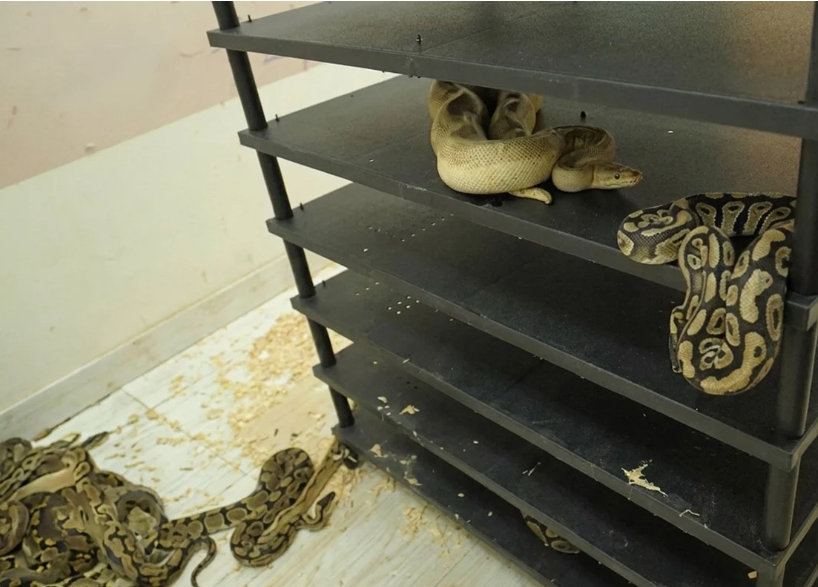
A man in Zhejiang province has been convicted and imprisoned for running an illegal breeding operation housing more than 300 pythons in his residential flat, a case that underscores the sophisticated detective work required to uncover wildlife trafficking networks in urban China. The operation came to light in late June when state broadcaster CCTV reported on what authorities classified as a "serious" violation of laws protecting endangered species, revealing the extent to which one individual had transformed his home into a clandestine reptile farm.
The investigation began unexpectedly when a senior citizen in Taizhou, Zhejiang province, discovered a large python near a local mountain in March 2024. The elderly resident, unfamiliar with the species and struck by the unusual sight of such a substantial serpent in the region, reported the finding to authorities. Police officers initially theorized that the reptile had escaped from captivity, noting that pythons are not native to the area and that wild snakes typically remain dormant during the March season, making an active sighting highly anomalous.
The breakthrough came from an unconventional angle. When police consulted a professional snake handler about the find, the expert explained that pythons require constant warmth and humidity to thrive, necessitating artificial heating systems that would consume significant amounts of electricity. Officers in Taizhou then reviewed local electricity consumption records, looking for residential customers whose usage patterns seemed disproportionately high for a single household. This methodical analysis led them to identify a man surnamed Guo as a prime suspect.
Guo's profile fitted the investigation perfectly. Living alone, unmarried, and without formal employment, he had no obvious reason for the elevated power bills recorded at his address. Police observation revealed that another individual named Di made frequent visits to Guo's flat, systematically collecting parcels from courier stations. Investigators traced these packages to online purchases of thousands of small white mice—standard feeder animals for reptile enthusiasts. Online vendors confirmed to police that such bulk purchases of mice typically indicated commercial reptile breeding rather than casual pet keeping.
Further digital evidence emerged through social media. Guo had been sharing photographs of snakes on online platforms and made cryptic references to selling pythons to interested parties. Transaction records showed that Di had sold two pythons to another buyer for 1,000 yuan, suggesting a deliberate profit-making operation rather than hobby-scale activity. Armed with this accumulation of circumstantial and direct evidence, police moved to arrest both Guo and Di.
When officers entered Guo's apartment, they encountered a scene that shocked even experienced investigators. The entire flat had been reorganized into a python facility, with Guo confining himself to a single bedroom while dedicating the two remaining bedrooms and living room entirely to housing his snakes. Hundreds of plastic containers stacked throughout the space each held individual pythons, creating a complex ecosystem of captive reptiles. The seizure operation ultimately recovered 309 pythons from Guo's residence alone, all of which were subsequently transferred to a local zoo for care and rehabilitation.
Guo's personal motivation for the operation revealed itself during questioning. He harbored a long-standing fascination with snakes dating back a decade, having purchased his first four pythons in 2014. Over the following years, he had methodically researched breeding techniques and developed expertise in cultivating pythons of various color morphs. During his statement, Guo expressed no fear of his animals and demonstrated what appeared to be genuine enthusiasm for his work, describing himself as akin to a "creature creator" in his ability to produce snakes with specific genetic traits.
The conspiracy extended beyond Guo's household. Police identified Di's role in the distribution network, establishing that the two men had successfully sold approximately 80 pythons through their underground operation. A third individual, Deng, who operated a shop and had sold Guo his initial four pythons in 2014, also faced arrest. Officers conducting a search of Deng's residence discovered an additional 47 pythons, indicating that Deng had gradually moved from retail supplier to breeder himself. The combined investigation ultimately uncovered 436 pythons across all three locations, with authorities valuing the entire breeding stock at over 30 million yuan—approximately US$4.4 million.
The legal consequences reflected the severity of wildlife protection violations in China. Pythons hold Grade Two protected status under Chinese wildlife law, making their unauthorized breeding, sale, and transport serious criminal offenses. A local Taizhou court sentenced Guo, Di, and Deng to imprisonment, though the specific lengths of their sentences were not disclosed in official reports. Under China's Criminal Law framework, violations involving Grade Two protected animals carry potential sentences of up to five years imprisonment, with courts able to impose additional fines and asset forfeitures depending on the scale and profitability of the operation.
For Southeast Asian readers and regional observers, this case illustrates the increasing sophistication of law enforcement approaches to wildlife crime in China. The deployment of electricity consumption data as an investigative tool demonstrates how authorities are leveraging modern utilities infrastructure and digital records to identify illegal activities that might otherwise remain hidden in urban environments. The operation also highlights the persistent demand for exotic reptiles in Asian markets, where color-morphed pythons command premium prices among collectors willing to circumvent protective regulations. As breeding operations become more technically advanced and geographically distributed, regional cooperation between ASEAN nations and China will likely become essential for disrupting trafficking networks that supply illegal exotic pet markets across Southeast Asia.