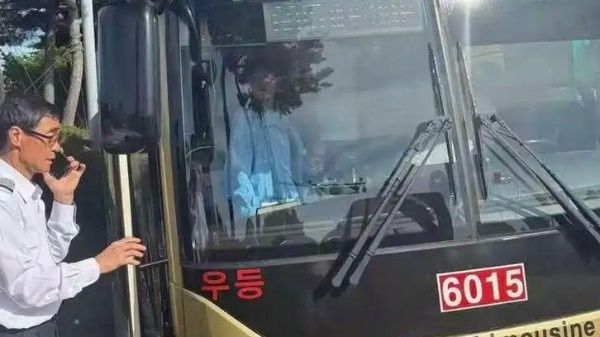
A group of Chinese women tourists has earned widespread praise across East Asia for their composed response to a medical emergency aboard a passenger bus heading to Seoul's Incheon International Airport on Saturday afternoon. When the driver of the No 6015 airport bus suddenly lost consciousness while traveling on the highway, the tourists sprang into action, collectively managing to stabilise the vehicle and potentially preventing a catastrophic multi-vehicle collision that could have endangered dozens of lives.
The bus, which was carrying more than a dozen passengers primarily from China, began veering dangerously across its lane after the driver's sudden collapse. Sun Qian, a 35-year-old visitor from Nanjing, Jiangsu province, was positioned in the second row immediately behind the driver's seat. Working in China's healthcare sector and visiting Seoul to study a local health programme, Sun possessed the proximity and instinctive awareness to recognise the danger instantly. She described observing the vehicle scraping against a roadside guardrail as it lost directional control, prompting her immediate intervention.
Without hesitation, Sun rushed forward and seized the large steering wheel, attempting to correct the bus's trajectory and prevent further contact with the roadside barrier. Simultaneously, another passenger recognised the need to locate and engage the braking system. The coordination between these two critical actions—steering and braking—occurred within seconds, demonstrating the kind of intuitive teamwork that characterises genuine emergency response. Sun later recounted her anxiety about managing the oversized steering mechanism, an unfamiliar piece of equipment in a crisis scenario where milliseconds determine outcomes.
Du He, 33, Sun's friend also from Nanjing, positioned herself beside Sun and attempted traditional first-aid measures. She initially sought to apply pressure to the driver's philtrum, a classical acupuncture-adjacent emergency technique taught in some Chinese medical training contexts. However, Du quickly recognised more serious signs when she observed the driver's respiratory failure and the darkening discolouration spreading across his face, indicating severe circulatory compromise. This observation shifted the intervention from first aid to resuscitation protocols.
The passenger group then organised an impromptu CPR effort, with multiple individuals rotating through chest compressions as Sun, who is fluent in Korean, used the driver's mobile phone to alert emergency services in the local language. The coordinated resuscitation continued for several minutes as the bus remained stationary on the highway. Both women acknowledged that despite their best collective efforts, the driver's condition had deteriorated beyond recovery, suggesting the collapse may have resulted from acute cardiac failure rather than a reversible condition.
According to South Korea's Yonhap News Agency, emergency responders discovered the driver in cardiac arrest upon arrival and transported him to the nearest hospital, where he succumbed to his condition after approximately two hours of intensive care intervention. Police launched an investigation into the precise medical cause, though the symptoms described are consistent with sudden cardiac death, a condition that often occurs with minimal warning. The tragedy underscores the unpredictability of medical events affecting commercial vehicle operators, an occupational hazard that transit authorities across the region must continually address through health screening protocols and emergency response training.
The passengers' quick thinking likely prevented a secondary disaster. Du emphasised that the highway traffic density at that particular afternoon hour was unusually light, meaning the uncontrolled bus did not collide with other vehicles. Had the incident occurred during peak travel periods, the consequences could have multiplied exponentially, with dozens potentially injured or killed in a chain-reaction collision. The tourists, who were collectively heading to the airport for their onward journey, subsequently flagged down an alternative bus to continue to Incheon International Airport.
Both women expressed genuine sorrow regarding the driver's death and spoke candidly about the psychological aftermath of the experience. Du described an emotional numbness that persisted through their airport arrival, only to transform into acute fear once the adrenaline subsided. Sun similarly reflected on the surreal, almost cinematic quality of events that unfolded so rapidly that conscious deliberation was impossible. Their delayed emotional processing is a recognised psychological phenomenon in high-stress emergency situations, where cognitive function prioritises immediate action over emotional awareness.
When asked about the extensive social media attention across both Chinese and South Korean platforms, both women demonstrated remarkable humility. Du stated simply that such action represented the natural response of any capable person confronting a crisis, suggesting that similar intervention would have occurred regardless of her personal involvement. She emphasised collective human values around solidarity and mutual assistance, characterising the response as reflecting fundamental Chinese cultural principles of community support. Sun reinforced this perspective by highlighting the distributed nature of the rescue effort, noting that success depended on multiple passengers contributing specific actions—braking, steering, CPR, communication—rather than any individual heroic gesture.
The incident has generated significant online commentary across regional platforms, with South Korean social media users particularly noting the impressive composure and rapid decision-making displayed by foreigners operating under language barriers and unfamiliar circumstances. Chinese netizens sharing the story on Xiaohongshu, a popular domestic platform, expressed broad admiration for the demonstration of humanitarian instinct and cross-cultural cooperation. The narrative resonates particularly strongly in Southeast Asia, where many communities maintain significant Chinese diaspora populations and value similar emphasis on collective responsibility during emergencies.
The episode raises broader questions about crisis preparedness and the role of informed bystanders in emergency situations. While medical training certainly enhances response capacity, the tourists' actions demonstrate that situational awareness, rapid cognitive flexibility, and willingness to act decisively can compensate for lack of formal credentials when lives hang in immediate balance. Transit authorities across the region may draw lessons regarding passenger education about emergency procedures and the importance of clear signage identifying brake mechanisms and communication devices.
The story ultimately transcends the specific tragedy of one driver's death to illuminate human capacity for collective action under extreme duress. The Chinese tourists' response stands as a reminder that emergency preparedness extends beyond institutional systems to encompass the behaviour of ordinary individuals who maintain presence of mind when seconds determine whether an incident remains a close call or transforms into a public catastrophe. Their actions prevented what could have been a significantly larger human tragedy on a Seoul highway.

