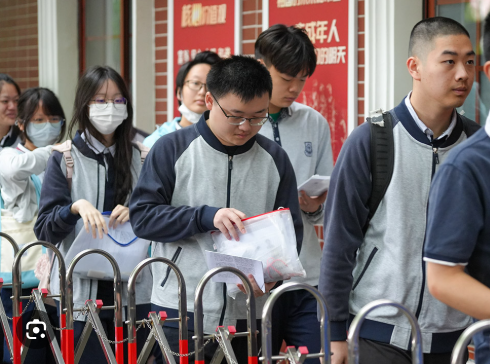
Academic integrity has become a critical concern across China's higher education system as universities move to eliminate sophisticated technological cheating methods from their examination halls. South China Agricultural University in Guangdong province took the lead on July 1 by issuing a comprehensive notice prohibiting all smart electronic devices, from wireless earbuds to fitness trackers, after discovering multiple instances of students attempting to gain unfair examination advantages through technology. The move reflects a broader institutional response to what education administrators view as an escalating problem that threatens the credibility of academic assessments and the fairness of the examination process for honest students.
The scope of banned devices extends far beyond traditional mobile phones. Universities now explicitly prohibit smart glasses, smartwatches, Bluetooth earbuds, and invisible earpieces—essentially any wearable or portable device capable of communication, data storage, image capture, or wireless transmission. The regulations are unambiguous: simply bringing such devices into an examination room constitutes cheating, regardless of whether the device remains switched off or is never activated. The consequences are severe and multifaceted, ranging from automatic zero scores for the affected subject to formal demits that can prevent students from receiving scholarships, academic awards, or pursuing Communist Party membership—a significant career consideration in mainland China.
The crackdown extends across multiple provinces and institutions, suggesting this is not an isolated problem but rather a systemic challenge facing Chinese higher education. Xuchang University in Henan province reported in late June that five students had attempted various forms of technological cheating, including bringing devices with pre-loaded examination materials and using communication-capable gadgets to receive real-time answers. Similarly, Hubei University of Technology documented a student who attempted to smuggle an electronic device containing study materials into an English final examination, resulting in a ten-month disciplinary period. Zhongnan University of Economics and Law specifically warned students against using smart glasses capable of wireless transmission and content storage, highlighting how these devices can simultaneously photograph examination papers while displaying answers transmitted by accomplices outside the testing venue.
The sophistication of available technology has fundamentally altered the landscape of examination dishonesty. Recent research conducted by the Hong Kong University of Science and Technology demonstrated the practical feasibility of these cheating methods when researchers modified commercially available smart glasses by integrating them with advanced language models. In a controlled test scenario, a wearer wearing these modified glasses completed a Computer Network Principles examination in merely thirty minutes while scoring 92.5 per cent—a performance that would be virtually impossible without technological assistance. This proof-of-concept illustrates why education authorities and university administrators have shifted from viewing high-tech cheating as a theoretical possibility to treating it as an urgent practical reality requiring immediate institutional response.
Industry insiders have provided crucial perspective on why detection remains challenging for examination proctors. Lin Che, a product manager with extensive experience in smart eyewear manufacturing, explained that educational institutions struggle to keep regulatory frameworks aligned with the rapid pace of technological innovation in wearable devices. More problematically, as smart glasses become increasingly miniaturized and aesthetically indistinguishable from ordinary prescription eyewear, visual detection becomes progressively more difficult for human proctors. The arms race between cheating methods and detection capabilities has clearly tilted towards the cheaters, at least temporarily, which explains the growing urgency of university responses.
In response to these challenges, universities have begun deploying advanced technological countermeasures. South China Agricultural University has implemented an artificial intelligence-powered proctoring system that monitors examination halls continuously in real time, utilizing computer vision and behavioral analysis to identify suspicious activities. The system flags concerning patterns including students carrying unidentified objects, covert item exchanges between test-takers, frequent head movements that might indicate glancing at hidden devices or receiving non-verbal signals, and hands positioned beneath desks where communication devices might be concealed. This technological response to technological cheating represents an escalation in the cat-and-mouse game between institutions seeking to maintain assessment integrity and students seeking unauthorized advantages.
The Chinese Ministry of Education has reinforced institutional efforts through explicit national guidelines that establish clear parameters for examination conduct. Under the ministry's official regulations governing misconduct in national education examinations, any attempt to bring communication-capable devices into testing venues constitutes cheating by definition, regardless of the student's stated intentions or whether the device is ultimately used. Perhaps most significantly, the ministry issued a specific warning in early June ahead of the 2026 national college entrance examination—the gaokao—reminding candidates that bringing smart devices to examination venues constitutes cheating under all circumstances. This sweeping prohibition reflects official recognition that technological cheating has evolved beyond marginal concerns to represent a systemic threat to examination validity.
The implications of this crackdown extend beyond the Chinese higher education system itself, particularly for Southeast Asian policymakers and university administrators monitoring regional educational trends. As wearable technology becomes increasingly sophisticated and affordable across the region, examination integrity challenges that currently plague Chinese universities may soon emerge in Malaysian, Singaporean, Thai, and other regional institutions. The technological capabilities that enable cheating—AI integration, wireless transmission, miniaturization—are not geographically contained and will inevitably reach global markets where they could be deployed in examination halls throughout Asia-Pacific universities.
Manufacturers of smart devices bear partial responsibility for the proliferation of cheating methods, according to technology experts like Lin Che. He has advocated for industry-wide adoption of more visible design features that explicitly signal the presence of recording or communication capabilities, such as conspicuous camera indicators that make devices easily identifiable to proctors. This suggestion acknowledges that purely regulatory approaches by educational institutions may prove insufficient without parallel efforts from the technology sector to design devices with detection and deterrence in mind. The challenge lies in balancing legitimate uses of wearable technology for health monitoring and productivity enhancement against the malicious applications that undermine educational assessment integrity.
The broader context reveals deep anxieties within Chinese education about the reliability of examination systems that serve as gatekeepers for prestigious university admissions and postgraduate programs. When students feel compelled to risk severe disciplinary consequences by attempting technological cheating, and when institutions must invest in artificial intelligence surveillance systems to maintain assessment credibility, it suggests fundamental pressures within the educational ecosystem. The gaokao, in particular, carries enormous consequences for student futures, potentially motivating desperate measures among candidates seeking competitive advantages. Universities implementing these stricter standards hope that comprehensive bans, clear consequences, and technological surveillance will deter students from attempting cheating while signaling commitment to fair evaluation principles.
Looking forward, the challenge will be whether technological detection and regulatory prohibition can effectively address problems rooted in educational pressures and student desperation. The measures announced by Chinese universities represent a necessary response to immediate threats, but they may ultimately prove temporary solutions to more fundamental issues driving cheating behavior. Industry cooperation, continued technological development of detection systems, and potentially broader educational reforms addressing assessment anxiety may prove necessary for sustainable reduction in technological examination fraud across the region.

