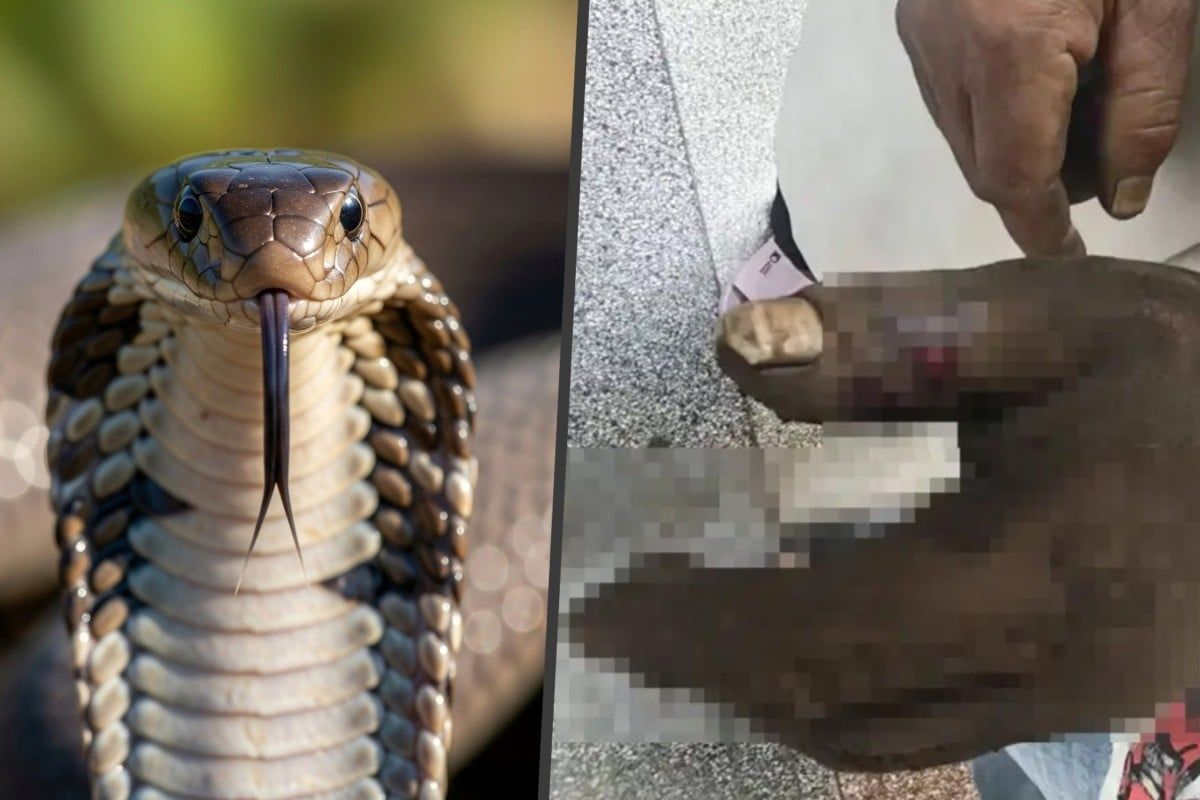
A well-intentioned rescue attempt in Yunnan province has become a cautionary tale about the dangers of relying on popular television depictions for medical emergencies. When a farmer working in his field in Yuanyang county was bitten on the finger by a cobra, his wife's immediate response—drawing out the venom directly from the wound with her mouth—seemed like a logical act of desperation. What she did not realise was that this method, commonly portrayed in action films and dramas, would expose her own body to the same poison that threatened her husband's life.
The farmer began showing classic signs of envenomation within minutes of the bite. His finger swelled dramatically, and he experienced dizziness and weakness as the cobra's neurotoxin entered his bloodstream. His wife, operating on instinct and influenced by scenes she had witnessed on television, made the split-second decision to apply oral suction to the wound. She had no protective barriers, no medical training, and no understanding of how snake venom actually travels through the human body. Within hours of her husband's admission to hospital, her own symptoms began to manifest. Numbness crept through her mouth, tongue, face, and limbs. By the following day, the fatigue had become so severe that her family rushed her to seek emergency care.
At Honghe Prefecture No 3 People's Hospital in Yunnan, medical staff diagnosed both patients with envenomation from a local cobra species. The couple received injections of antivenom serum and underwent supportive medical treatment to counteract the venom's effects. Fortunately, their conditions stabilised within days, and they were discharged in good health. However, the incident prompted medical professionals at the hospital to publicly explain why the suction method—one of the most persistent myths in first-aid folklore—is fundamentally ineffective and dangerous.
Doctors emphasised that the mouth is among the worst possible entry points for removing venom because the oral mucosa contains an exceptionally rich network of blood capillaries. When venom comes into contact with these tiny vessels, it bypasses the protective barriers of the skin and enters the rescuer's bloodstream with remarkable speed. Within minutes, the toxins can begin affecting the nervous system, heart, and respiratory function. The physics of snakebite wounds further undermines the suction theory: cobra fangs typically create wounds resembling tiny pinholes rather than deep gashes. Venom disperses rapidly into subcutaneous tissues and the bloodstream almost instantaneously, making it virtually impossible for any amount of sucking to retrieve a meaningful quantity before it has already infiltrated the body's systems.
Beyond the suction myth, hospital staff identified another widespread misconception that has caused harm in snakebite emergencies. Many people believe that cutting the wound to allow bleeding will help flush out the venom. This approach is dangerously counterproductive. Incising a snakebite wound can cause excessive blood loss in an already compromised patient, introduces infection through an open laceration, and actually accelerates venom distribution into deeper tissues rather than limiting it. Similarly, applying heat to the bite or attempting to treat it with ice can cause additional tissue damage or shock, further complicating the clinical picture.
Instead, medical professionals have established evidence-based protocols for snakebite management. The moment a person realises they have been bitten, they should immediately contact emergency medical services by dialling the medical emergency hotline. Movement should be minimised, as physical activity accelerates the circulation of venom throughout the body. Remaining as still as possible can slow the progression of symptoms and buy precious time for hospital treatment. If the snake is still visible or can be safely observed, attempting to remember or photograph its appearance—noting colour, patterns, head shape, and size—provides critical information that helps doctors select the appropriate antivenom serum. China's diverse cobra subspecies and other venomous reptiles mean that correct identification can be the difference between rapid recovery and life-threatening complications.
The Yunnan incident reflects a broader pattern in China's engagement with snakebite emergencies on social media and in popular culture. These cases generate substantial online discussion, partly because they highlight the gap between what entertainment media portrays and what actually occurs during medical crises. A case from May 2024 in Guangdong province involved a 14-year-old student bitten by an unidentified snake on his school campus. The boy initially felt no pain and did not realise the severity of his situation. Only hours later, when numbness spread through his limbs and his vision blurred, did he report the incident to teachers. Upon arrival at hospital, doctors who administered antivenom treatment warned that a delay of just one to two more hours would have proven fatal, as the venom would have paralysed his respiratory muscles entirely.
The Yunnan couple's experience has resonated online, with social media users reflecting on the disconnect between television narratives and reality. One observer noted that the case demonstrated how drama productions often present methods that have no basis in medical science, leading viewers to internalise dangerous misconceptions. Other commentators have noted the devotion demonstrated by the wife's immediate, if misguided, attempt to save her husband's life. This human element—the willingness to risk oneself for a loved one—adds emotional depth to what is ultimately a medical education moment.
For Malaysian and Southeast Asian audiences, the implications are significant. The region's tropical climate and dense vegetation create environments where encounters with venomous snakes are not uncommon. Public awareness of proper snakebite response protocols remains inconsistent across the region. Too many people still believe in folklore remedies, suction techniques, or wound-cutting methods that medical authorities have thoroughly debunked. The Yunnan case serves as a powerful reminder that when facing a snakebite emergency, the most effective intervention is not improvisation based on entertainment media, but rather rapid access to professional medical care and antivenom treatment. Knowledge of this distinction could mean the difference between recovery and tragedy.

