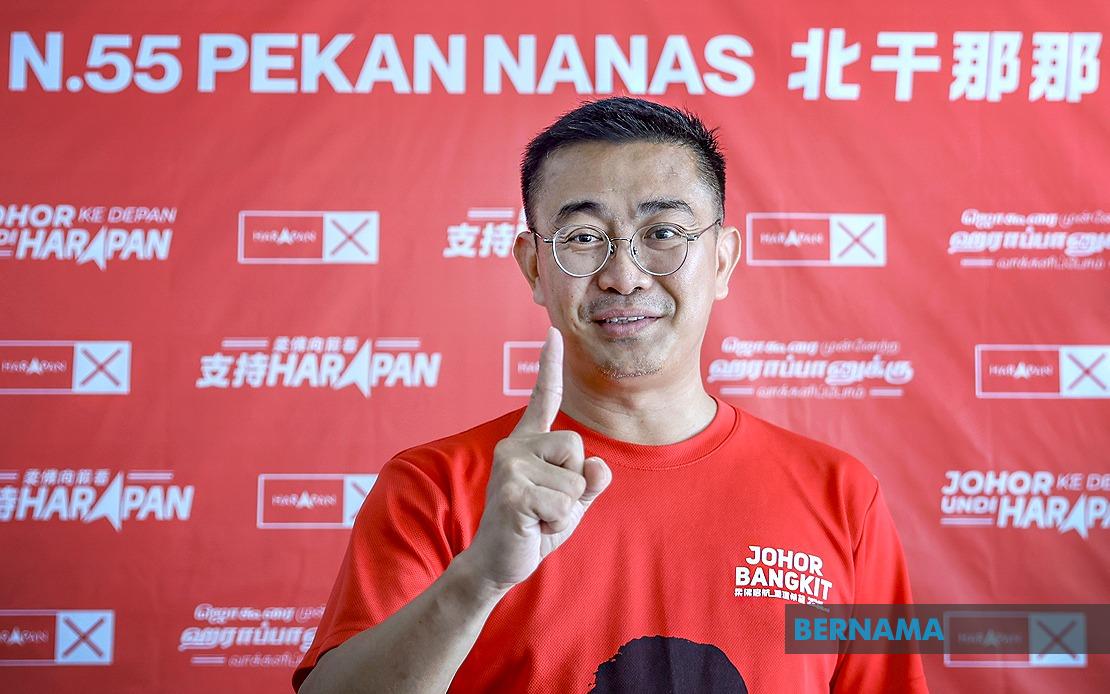
Yeo Tung Siong, the Pakatan Harapan candidate contesting the Pekan Nanas state seat, has raised serious questions about the prolonged delay affecting the proposed bypass connecting Jalan Sawah in Pekan Nanas to Ulu Choh. Known widely as Cikgu Yeo, the political figure contends that the Johor state government has repeatedly deferred this infrastructure initiative in favour of other development priorities, leaving a critical traffic bottleneck unresolved in the constituency.
The bypass project carries particular significance for Pekan Nanas residents, who have endured chronic traffic congestion that disrupts daily life and impedes economic activity. Cikgu Yeo argues that the infrastructure gap has become intolerable, with heavy vehicles including sand lorries forced to navigate Jalan Sawah due to the absence of an alternative route. This concentration of traffic has compounded congestion problems and created public safety concerns that residents have raised repeatedly with local authorities.
During his previous tenure as Pekan Nanas assemblyman between 2018 and 2022, Cikgu Yeo championed the bypass proposal through multiple sittings of the Johor State Legislative Assembly, building political momentum for the project. His persistence yielded results when the initiative secured inclusion in the Johor Budget 2021 as part of a broader infrastructure package dedicated to road and bridge construction across the state. Following this budgetary allocation, the land acquisition phase commenced, suggesting the project had moved beyond the planning stage into practical implementation.
However, the project's trajectory shifted dramatically. According to official state government responses tabled in the State Assembly during 2024, the bypass initiative was postponed in both 2023 and 2024. The state administration attributed these deferrals to escalating construction expenses, the necessity to revise the project cost ceiling upward, and competing claims on state resources from other designated development schemes. These explanations reflect budget pressures that have become increasingly evident across Malaysian state governments facing inflationary construction costs.
Cikgu Yeo's current challenge to the state government carries particular weight given Johor's demonstrated fiscal capacity. The state recorded a fiscal surplus of RM95.38 million during 2024, a figure that appears to contradict official reasoning that budget constraints necessitated the bypass postponement. This apparent contradiction has fuelled Cikgu Yeo's argument that the delay represents a matter of political prioritisation rather than genuine financial limitation. The fiscal surplus suggests available capital that could theoretically address infrastructure gaps like the Pekan Nanas bypass without requiring dramatic budget restructuring.
The timing of this criticism is strategically significant, occurring as the Pekan Nanas constituency prepares for a direct contest between Cikgu Yeo and the incumbent Tan Eng Meng of Barisan Nasional in the forthcoming Johor state election. For Cikgu Yeo, the stalled bypass project represents concrete evidence that can be presented to voters regarding his commitment to local infrastructure development and his capacity to advocate effectively for constituent needs. The project embodies the type of tangible, locally-focused governance that often resonates with voters in state-level elections.
For the broader Pekan Nanas electorate, the bypass delay illustrates tensions that frequently emerge between local priorities and state-level resource allocation decisions. Many Malaysian constituencies experience similar patterns where projects gain budgetary approval but face repeated postponement as state governments navigate competing demands from multiple constituencies and overarching development agendas. The Pekan Nanas situation exemplifies how infrastructure gaps can persist despite apparent budgetary provision, frustrating residents who expect approved projects to progress toward completion.
The state government's rationale regarding rising construction costs carries legitimate weight in Malaysia's contemporary economic environment. Construction sector inflation has significantly impacted project viability across multiple states, forcing difficult decisions about which initiatives proceed and which face revision or delay. However, this explanation becomes more contested when the same government simultaneously reports fiscal surpluses, prompting questions about whether postponement reflects genuine incapacity or reflects alternative spending priorities that may not align with local priorities.
Cikgu Yeo's campaign positioning frames the bypass as both an immediate practical necessity and a barometer of government responsiveness to constituent concerns. By highlighting the project's inclusion in the 2021 budget and subsequent stalling, he constructs a narrative suggesting that voter support for his candidacy offers the best prospect for project revival and completion. This framing appeals particularly to residents experiencing daily congestion and to those viewing the delay as evidence of incumbent government inattentiveness to local infrastructure deficits.
The Pekan Nanas electoral contest occurs within the broader context of the 16th Johor state election, where 172 candidates compete across 56 seats for the support of 2,727,926 eligible voters. Individual races like Pekan Nanas often turn on constituency-specific issues that resonate with local voters, and infrastructure projects represent precisely this type of tangible concern. The bypass delay thus functions as both a genuine development issue and a political campaign focal point, with implications for how voters assess the competing claims of Cikgu Yeo and Tan Eng Meng regarding their ability to deliver local benefits.
Looking forward, the Pekan Nanas bypass question will likely feature prominently in local campaign discourse, with both candidates staking claims regarding their capacity to either advance or protect the project's interests. For Cikgu Yeo, the delayed bypass embodies his argument that new representation is necessary to overcome state government obstruction of local priorities. For the incumbent camp, the challenge involves either justifying the postponement or announcing project revival plans that demonstrate continued commitment to the constituency's infrastructure needs. The project's fate may ultimately depend on the electoral outcome and the political leverage that either candidate can subsequently deploy at the state government level.

