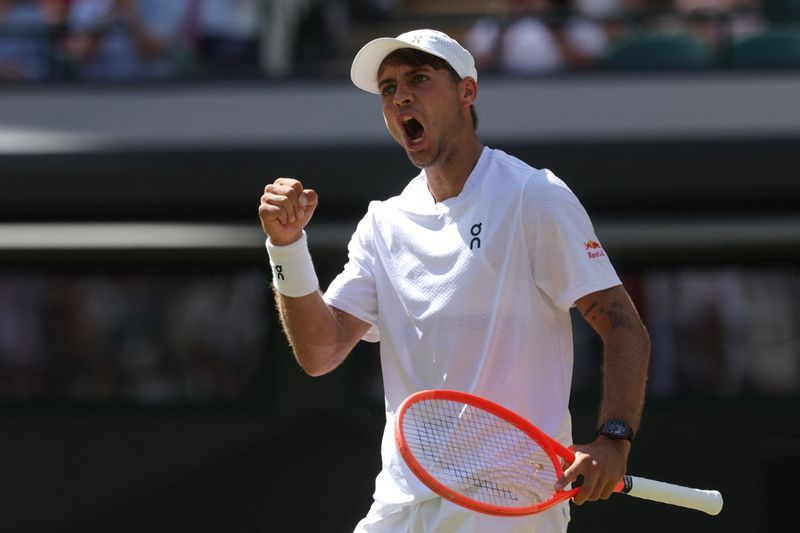
Flavio Cobolli stamped his authority on the grass courts of the All England Club on Monday, dismantling Australian fifth seed Alex de Minaur across three sets to advance to the Wimbledon quarter-finals. The Italian ninth seed's 7-5 7-6(4) 6-3 victory on Court One represents a significant statement of intent from a player whose trajectory has accelerated dramatically in recent weeks, culminating in his unexpected French Open final appearance earlier this summer. The breakthrough performance also confirms that Cobolli's resurgence is not merely a flash of fortune, as he returns to the Wimbledon last eight for a second successive year, underlining his growing credentials among tennis's emerging elite.
The 24-year-old from Italy controlled the contest through intelligent court positioning and well-timed aggression, forcing De Minaur into critical errors when the pressure mounted. Cobolli engineered his breakthrough in the opening set by capitalising on a backhand mistake in the 11th game, seizing the set in 50 minutes through methodical, rather than spectacular, tennis. His composed approach reflected maturity beyond his years, particularly given the intensity expected in a clash between top-10 players. The early dominance provided psychological momentum that would prove decisive in subsequent exchanges, as Cobolli built a foundation of confidence upon which the remainder of his victory rested.
Searing heat at the All England Club tested both competitors and spectators alike during the second set encounter. Stoppages in play became necessary when a fan suffered heat exhaustion in the crowd, forcing officials to pause proceedings and tend to the affected supporter. De Minaur and Cobolli exchanged courtesies during the break, with the Australian warning his opponent to expect further disruptions given the oppressive conditions. Despite these interruptions, Cobolli demonstrated composure and mental resilience, rallying from 2-5 down to force a tiebreak that he eventually won 7-4, extending his advantage to two sets against a player who was seeded fifth. The tiebreak conversion proved pivotal, as it prevented De Minaur from gathering momentum and forced the Australian into an increasingly defensive posture.
The third set unfolded as a procession toward inevitable conclusion, though De Minaur demonstrated characteristic fighting spirit by pushing back when Cobolli faltered briefly. Starting the set with a 0-2 deficit might have rattled a less experienced player, yet the Italian responded by unleashing the aggressive strokeplay that had characterised his earlier moments of control. When De Minaur broke back in the sixth game to temporarily restore competitive balance, Cobolli simply reset his tactical approach and sustained the pressure that eventually overwhelmed his opponent. The manner of his dominance suggested a player operating well within his capabilities, managing energy expenditure across three sets while maintaining sufficient reserve for the challenges ahead.
Cobolli's reflections after victory highlighted the physical toll of tournament tennis during an unusually warm European summer. The Italian acknowledged fatigue accumulated across the circuit as a lingering concern, making the efficient three-set victory particularly satisfying from a recovery perspective. His appreciation for the crowd's resilience in enduring the heat reflected genuine warmth toward supporters who remained despite uncomfortable conditions, a sentiment that hinted at the personality beyond the player. The semi-philosophical acknowledgment that conserving energy for subsequent matches takes priority over dominant performance demonstrates the strategic mindset required to navigate Grand Slam tournaments successfully.
Cobolli's path through the quarter-finals presents an intriguing potential matchup that could significantly alter his championship trajectory. His next opponent emerges from a fourth-round encounter between British prospect Arthur Fery and Bulgarian veteran Grigor Dimitrov, both players capable of dictating terms on grass courts. Fery represents the domestic challenge to Grand Slam progression, while Dimitrov brings experience and a history of success at Wimbledon accumulated across his lengthy career. Whichever player advances would present Cobolli with a demanding examination, yet the Italian approaches the prospect with justified confidence given his recent form and the momentum generated through successive week-long competitions at the sport's highest level.
The trajectory of Cobolli's season has captured the attention of tennis analysts and casual followers alike, as the Italian has overturned previous expectations regarding the timeline of his breakthrough. Reaching French Open finals typically presages sustained success at subsequent competitions, a pattern Cobolli now follows. His capacity to replicate performance across different surfaces and tournament conditions underscores the versatility that distinguishes elite performers from mid-tier professionals. Wimbledon success, should it extend further, would establish conclusively that the French Open final was no anomalous achievement but rather a signal of sustained competitive excellence.
Respect between the finalists animated their interaction throughout the contest and reflected contemporary tennis culture emphasising sportsmanship alongside competitive intensity. Cobolli's articulation of admiration for De Minaur's playing style, coupled with regret at facing him under match conditions, exemplified the professional courtesy that increasingly characterises elite tennis. Such exchanges, often invisible to television audiences, contribute to the collegial atmosphere among top players who navigate intense competition whilst maintaining genuine personal regard. De Minaur's warning about heat-related disruptions illustrated this culture, as players actively consider opponents' welfare even amidst championship battles.
Cobolli's immediate post-match plans proved characteristically mundane despite the championship-calibre setting. Rather than scrutinising video footage of potential opponents, the Italian opted for ice cream consumption and traditional Italian cuisine prepared by his father, reflecting priorities that extend beyond tennis analysis into essential life balance. His casual reference to potential World Cup viewing between Spain and Portugal highlighted the broader sporting landscape that captures global attention even during tennis's premier events. Such grounded perspective, maintaining connection to family and broader cultural interests despite professional demands, may contribute to psychological resilience that sustains extended tournament participation.
For Malaysian and Southeast Asian tennis enthusiasts, Cobolli's emergence as a Grand Slam contender represents continued evolution of professional tennis beyond its traditional European centres. His youthful trajectory follows patterns established by predecessors yet reflects contemporary globalisation of elite tennis development. The Italian's success validates investment in young players' development through extended tournament participation and exposure to varied conditions, lessons applicable to regional talent development programmes. Cobolli's demonstration that sustained excellence remains achievable through disciplined preparation and psychological maturity offers encouragement to emerging players across the region navigating similar pathways toward international competitiveness.

