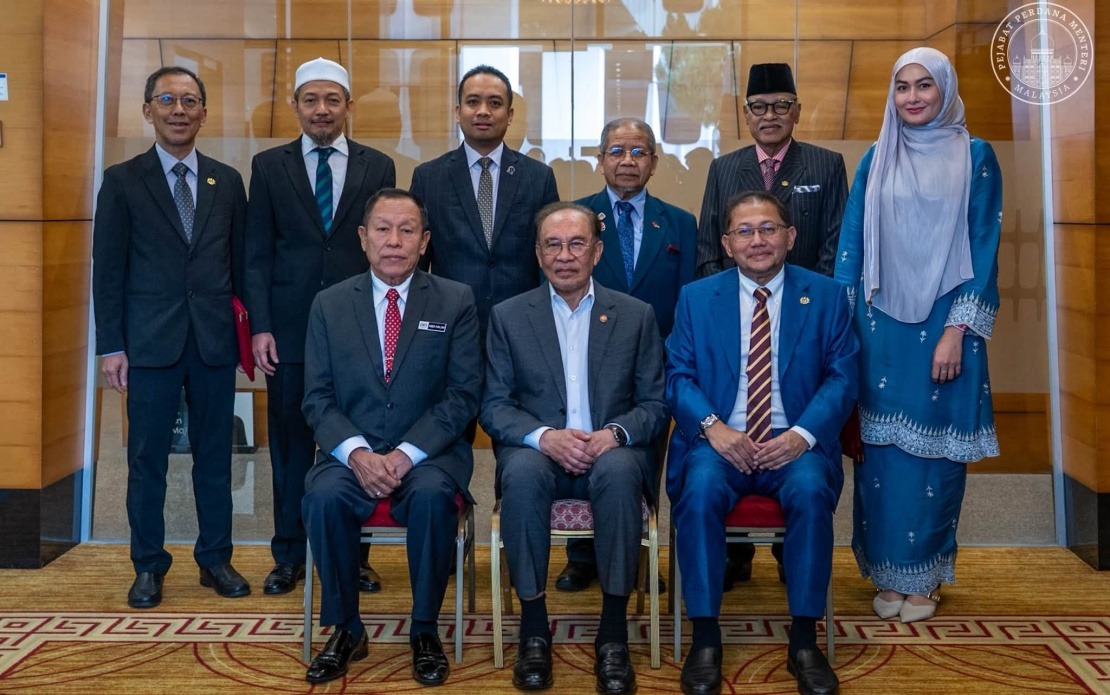
Prime Minister Datuk Seri Anwar Ibrahim has underscored the necessity for a comprehensive, multi-stakeholder approach to combating corruption, rejecting the notion that any single institution can shoulder this responsibility independently. Speaking after presenting appointment instruments to newly constituted committees in Parliament, he articulated a vision of anti-corruption efforts that transcends traditional enforcement boundaries and encompasses the entire Malaysian society.
The Prime Minister's remarks came as he formally introduced fresh members to two critical oversight bodies: the Special Committee on Corruption (JKMR) and the Anti-Corruption Advisory Board (LPPR). Both organisations function as institutional checks within Malaysia's anti-corruption architecture, their independence and critical perspective intended to validate and enhance the efficacy of ongoing enforcement operations. By elevating these bodies and their new membership at a parliamentary forum, the administration signals serious commitment to institutionalising anti-corruption mechanisms beyond temporary political initiatives.
The JKMR operates under the statutory framework of the Malaysian Anti-Corruption Commission Act 2009, specifically Section 14, with its membership composition deliberately structured to reflect Malaysia's political landscape. Members are appointed by the Yang di-Pertuan Agong from representatives serving in the Senate and Dewan Rakyat, with explicit inclusion of parliamentarians from both government and opposition benches. This architectural design acknowledges that corruption transcends partisan lines and that meaningful oversight requires voices from across the political spectrum to maintain credibility and prevent capture by any single political faction.
Parallel to this parliamentary dimension, the LPPR was established under Section 13 of the same legislation, drawing its membership from individuals of proven integrity who have demonstrated exceptional service to the public or achieved eminence within their professions. This distinction between the two bodies is instructive: while JKMR brings political representation and parliamentary accountability, LPPR injects expertise, professional credibility, and civil society perspectives into anti-corruption deliberations. Together, they create a layered oversight system less vulnerable to political manipulation or narrow institutional interests.
Anwar's emphasis on collective responsibility extends beyond these formal committees to encompass enforcement agencies, the public service, private enterprise, and ordinary citizens. This framing represents a significant reorientation from approaches that concentrate anti-corruption authority within a single enforcement body, regardless of its operational competence. The Prime Minister appears to recognise that corruption patterns in Malaysia—spanning procurement irregularities, licensing abuses, and illicit financial flows—involve actors across governmental hierarchies and private sectors, rendering siloed enforcement strategies inherently limited.
The appointment of new committee members carries particular significance within Malaysia's contemporary political context. The country has navigated multiple cycles of anti-corruption campaigns, some more successfully sustained than others, and public scepticism regarding the consistency and impartiality of such efforts remains considerable. By securing royal consent for appointments and conducting formal parliamentary presentations, the administration seeks to bestow institutional legitimacy and constitutional grounding on these bodies, distancing them from perceptions of political instrumentalisation that have occasionally shadowed previous anti-corruption campaigns.
Malaysia's private sector, often implicated in corruption schemes through bribery, kickbacks, and collusive tendering, constitutes an essential component of Anwar's proposed collective approach. Business associations, industry regulators, and corporate governance bodies possess intimate knowledge of sectoral vulnerabilities and can implement preventive mechanisms more rapidly than government enforcement. Engaging private actors in anti-corruption frameworks also acknowledges that voluntary compliance and internal corporate controls frequently prove more cost-effective than reactive prosecution.
The civil society element carries equal weight in the Prime Minister's formulation. Citizens serving as whistleblowers, journalists exposing irregularities, and non-governmental organisations monitoring governmental compliance all generate pressure that formal institutions alone cannot exert. Malaysian society has demonstrated capacity for civic mobilisation around transparency issues, as evidenced by parliamentary pressures and public discourse surrounding various procurement and licensing controversies. Channelling such energy through structured mechanisms rather than ad-hoc campaigns could yield more sustained anti-corruption momentum.
The heterogeneous backgrounds of newly appointed committee members, as Anwar noted, underscore the necessity for diverse perspectives within anti-corruption architecture. Members drawn from academic, business, judicial, civil service, and political domains bring distinct analytical frameworks and institutional insights. A corruption case involving military procurement, for instance, benefits from perspectives that only individuals with defence sector experience can provide, while financial crime demands expertise in banking regulation and forensic accounting.
Sustainability of anti-corruption efforts in Malaysia requires institutional mechanisms that survive changes in political leadership and public attention cycles. The JKMR and LPPR, by virtue of their statutory basis and parliamentary oversight, possess greater durability than task forces or ad-hoc committees dependent on executive discretion. Their continued relevance depends on adequate resourcing, genuine operational independence, and demonstrated impact in either strengthening enforcement or preventing corruption proliferation.
The challenge facing Malaysia's anti-corruption architecture extends beyond institutional design to cultural transformation. A genuine whole-of-society approach demands that business leaders view compliance as competitive advantage rather than regulatory burden, that public servants internalise integrity as professional identity, and that citizens normalise reporting irregularities rather than tolerating them. Such shifts occur incrementally through leadership messaging, institutional consistency, and visible consequences for violation.
Regionally, Malaysia's approach merits attention from neighbouring Southeast Asian economies grappling with similar challenges. While corruption manifests differently across the region—from Thailand's military procurement issues to Indonesia's subnational governance complications—the underlying principle that isolated enforcement agencies cannot succeed independently carries universal relevance. Anwar's articulation of collective responsibility provides a conceptual framework that regional counterparts might adapt to their particular contexts and political systems.
The substantive test of this inclusive approach will manifest through measurable outcomes: corruption conviction rates, prosecution timelines, prevention of major fraud cases, and restoration of public confidence in institutional integrity. Mere rhetorical endorsement of collective effort, without corresponding resource allocation and political support for independent committees willing to challenge powerful actors, would constitute merely another cycle in Malaysia's long engagement with anti-corruption rhetoric. The newly appointed members now carry responsibility for translating the Prime Minister's vision into operational reality through principled, rigorous, and impartial performance of their oversight mandates.

