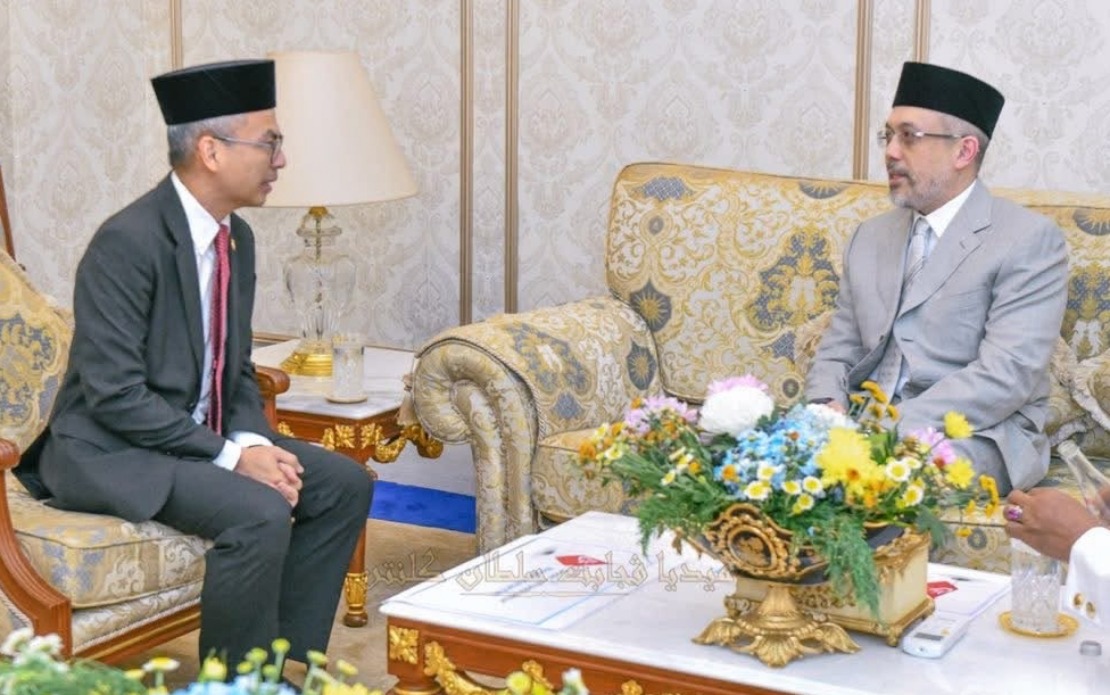
The Communications Minister, Datuk Fahmi Fadzil, held an audience with the Regent of Kelantan, Tengku Muhammad Fakhry Petra, at Kota Lama Palace in Kota Bharu on June 16 to update the royal leadership on the ministry's current operational landscape and emerging challenges in the digital sphere. The hour-long session, which commenced at 5 pm, represented a formal briefing mechanism through which the federal communications authority sought to keep regional institutional leadership informed of developments affecting the kingdom's information ecosystem.
The meeting focused substantially on what has become an increasingly acute challenge for Malaysian authorities: the proliferation of fraudulent social media accounts engaged in the systematic dissemination of misinformation. According to the Kelantan Sultan's Media Office, this phenomenon extends beyond generic false information to encompass specifically targeted disinformation campaigns that undermine public confidence in and respect for the Malaysian Royal Institution. Such attacks represent not merely commercial or reputational threats, but strike at foundational elements of Malaysia's constitutional monarchy and institutional integrity.
The digital environment across Southeast Asia has become markedly more hostile in recent years, with organized networks of inauthentic accounts weaponizing social platforms to amplify divisive narratives and erode institutional legitimacy. Malaysia has not proven immune to these trends. The problem manifests across multiple platforms simultaneously, creating coordination challenges for regulatory bodies and making detection and removal efforts perpetually reactive rather than anticipatory. For a constitutional monarchy like Malaysia, where institutional respect carries constitutional significance, such campaigns present particular concern.
Fahmi's decision to personally brief the Kelantan Regent signals the seriousness with which the Communications Ministry regards both the technical dimensions of the problem and its political implications. Regional rulers maintain formal jurisdictional authority over matters affecting their respective states, and keeping them apprised of developments—particularly those touching on institutional dignity—reflects appropriate governmental protocol and respect for traditional authority structures. The Regent's willingness to receive the minister underscores the collaborative approach that regional and federal authorities have adopted toward addressing digital governance challenges.
The ministry has been progressively developing frameworks to address inauthentic account networks, though enforcement remains complicated by jurisdictional questions, platform cooperation, and the sheer volume of content flowing through social media daily. The fake account problem intersects with broader questions about content moderation standards, free expression protections, and institutional accountability. Malaysia's approach has increasingly emphasized cooperation with social media platforms to remove violative content, while simultaneously exploring legislative mechanisms to establish clearer responsibility allocations between platforms and users.
The phenomenon of false news targeting the Royal Institution carries historical weight in Malaysian politics. Institutional stability and respect for the monarchy have long constituted pillars of Malaysian constitutional order, and deliberate campaigns to undermine such respect trigger particular governmental concern. The Communications Ministry's emphasis on briefing regional leadership reflects understanding that institutional threats require coordinated response across governmental levels and structures. Palace offices maintaining their own media capabilities further indicates institutional recognition of the strategic importance of information management.
Fahmi arrived accompanied by his Senior Private Secretary, MohamadAsif Afifi Mohd Yusof, his accompanying officer Ahmad Afifi Hamdan Tuan Aziz, and relevant office staff, while the Kelantan Sultan's Office dispatched senior officers to receive the delegation. This formal composition suggests the meeting transcended routine administrative courtesy to constitute a substantive policy engagement. The presentation of a memento from the minister to the Regent followed customary protocols befitting high-level official interactions within Malaysia's institutional hierarchy.
From a Malaysian perspective, the meeting highlights how digital governance challenges have increasingly demanded engagement at the highest governmental and institutional levels. Fake accounts and coordinated misinformation campaigns no longer constitute merely technical problems for social media platforms or communications specialists—they have become matters requiring attention from ministerial leadership and regional institutions. This elevation reflects the stakes involved: when disinformation targeting fundamental institutions spreads widely, it potentially affects public confidence, political stability, and social cohesion.
The timing of this briefing also merits consideration within Malaysia's broader information security context. Social media has become integral to political communication, commercial activity, and civic engagement, making the integrity of these platforms increasingly consequential. For Southeast Asian nations generally, the challenge of distinguishing authentic from inauthentic accounts while protecting legitimate expression remains unresolved. Malaysia's approach—combining platform engagement, regulatory development, and institutional awareness-raising—reflects pragmatic recognition that no single mechanism will suffice to address the multifaceted problem.
Looking forward, the Communications Ministry faces sustained pressure to develop more sophisticated detection and removal capabilities, to encourage greater platform accountability, and to maintain public awareness of misinformation tactics. Engaging regional leadership in these conversations ensures that anti-misinformation efforts proceed with proper recognition of the political and institutional contexts within which they operate. For Malaysian communications policy, such engagements establish frameworks through which federal authorities can coordinate with regional institutions in addressing digital challenges that increasingly transcend administrative boundaries.