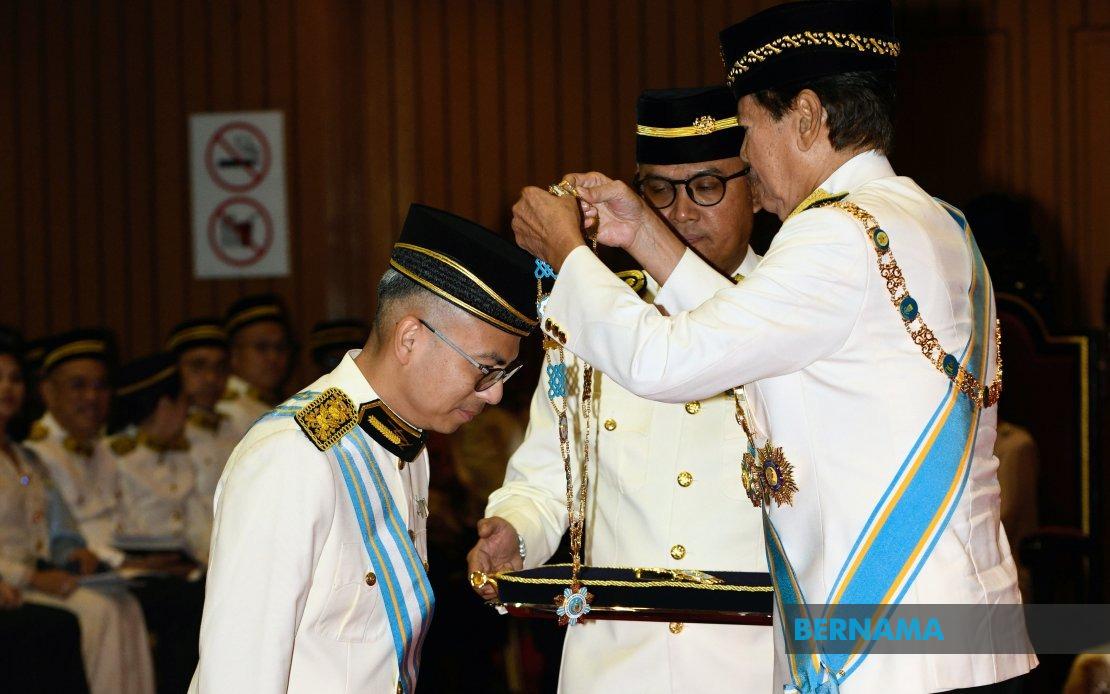
Communications Minister Datuk Fahmi Fadzil has received the Darjah Panglima Pangkuan Negeri (DPPN) award, elevating him to the rank of Datuk Seri, as part of Penang's state honours ceremony celebrating the 85th birthday of Governor Tun Ramli Ngah Talib. The honour distinguishes Fahmi as the sole recipient of this prestigious award in the state's 2026 investiture cycle, recognising his dual roles as head of the MADANI Government's communications portfolio and government spokesperson.
Fahmi's elevation stands out within a broader recognition programme that encompasses 230 recipients across various honour categories during the multi-day ceremony held at Dewan Sri Pinang in George Town. The conferment reflects the government's acknowledgement of his contributions to national communications and his public-facing role in articulating the administration's policies and positions. This recognition carries particular symbolic weight given the visibility of the spokesperson position within Malaysia's political landscape, where effective communication directly influences public perception and governance outcomes.
Beyond Fahmi's individual honour, the investiture ceremony demonstrates Penang's commitment to recognising excellence across multiple sectors of society. A cohort of 19 individuals also received the Darjah Gemilang Pangkuan Negeri (DGPN), similarly carrying the Datuk Seri title. Among this group are significant figures such as Datuk Abdul Halim Mohammad, chairman of MARA Incorporated Sdn Bhd, the government-linked corporation responsible for supporting Bumiputera economic participation, and Datuk Loo Lee Lian, chief executive of Invest Penang, the investment promotion agency driving the state's economic development agenda.
The ceremony's scope extends through progressively lower honour ranks, reflecting a tiered system of recognition that reaches deep into society. Nine individuals were conferred the Darjah Yang Mulia Pangkuan Negeri (DMPN), with former Penang police chief Datuk Azizee Ismail among the recipients. This tier recognises substantial contributions from security and administrative leaders who have shaped the state's governance and safety.
A substantially larger cohort of 72 individuals received the Darjah Setia Pangkuan Negeri (DSPN), the most widely distributed honour category carrying the Datuk rank. This group includes nationally significant figures and institutions. The late Nordin Ahmad, celebrated filmmaker, director, and scriptwriter with Cathay-Keris Film Productions, received a posthumous award, honouring his decades-long contribution to Malaysian cinema and cultural expression. Meor Ismail Meor Akim, director-general of the National Disaster Management Agency (NADMA), was recognised for his leadership in coordinating national emergency response and disaster preparedness. Datuk Mohd Irwan Mohd Mubarak, chairman of Bank Rakyat, received recognition for his stewardship of Malaysia's largest cooperative bank, which serves the financial needs of ordinary Malaysians and plays a crucial role in financial inclusion.
The investiture ceremony, extending across four consecutive days from July 11 through July 15, represents one of Penang's major state occasions. Governor Tun Ramli Ngah Talib and his wife, Toh Puan Raja Noora Ashikin Raja Abdullah, officiated the proceedings, lending ceremonial gravitas to the honour conferment process. The prominence of the governor's personal attendance underscores the significance Penang places on recognising contributions to the state's development and governance.
The scale of the honouring programme reveals the breadth of recognition extended across society. Beyond the 101 individuals receiving formal state honours across the various ranks, an additional 1,120 recipients were awarded medals and honorary decorations, creating a comprehensive recognition framework that spans from the most senior state honours to community-level acknowledgements. This multi-tiered approach ensures that contributions at different levels of public and private service receive appropriate recognition.
Fahmi's appointment as Communications Minister and government spokesperson places him at the intersection of media relations, policy communication, and public diplomacy. His elevation to Datuk Seri within Penang reflects broader patterns of recognising federal office-holders at state level, particularly when they maintain strong connections to their home state or when their national roles have significant implications for state development. The award suggests recognition of how effective government communications contribute to national and state-level governance objectives.
The timing of these honours, coinciding with the governor's 85th birthday celebration, reflects a tradition within Malaysian governance of using significant personal milestones to conduct major state ceremonies. Such occasions provide opportunities for comprehensive recognition programmes that might otherwise be fragmented. The convergence of Tun Ramli's birthday with the investiture ceremony creates a single, well-attended event that maximises the symbolic impact of honouring multiple recipients.
For Malaysian readers, particularly those in Penang and the broader business, government, and cultural sectors, these honours carry practical significance beyond ceremonial value. Recognition through state honours affects social standing, business relationships, and professional credibility. For institutions like MARA, Bank Rakyat, and Invest Penang, having leadership recognised through Datuk Seri titles reinforces their legitimacy and standing within Malaysia's institutional hierarchy. This interconnection between honours and institutional effectiveness demonstrates how Malaysia's traditional recognition systems integrate with modern governance and economic structures.

