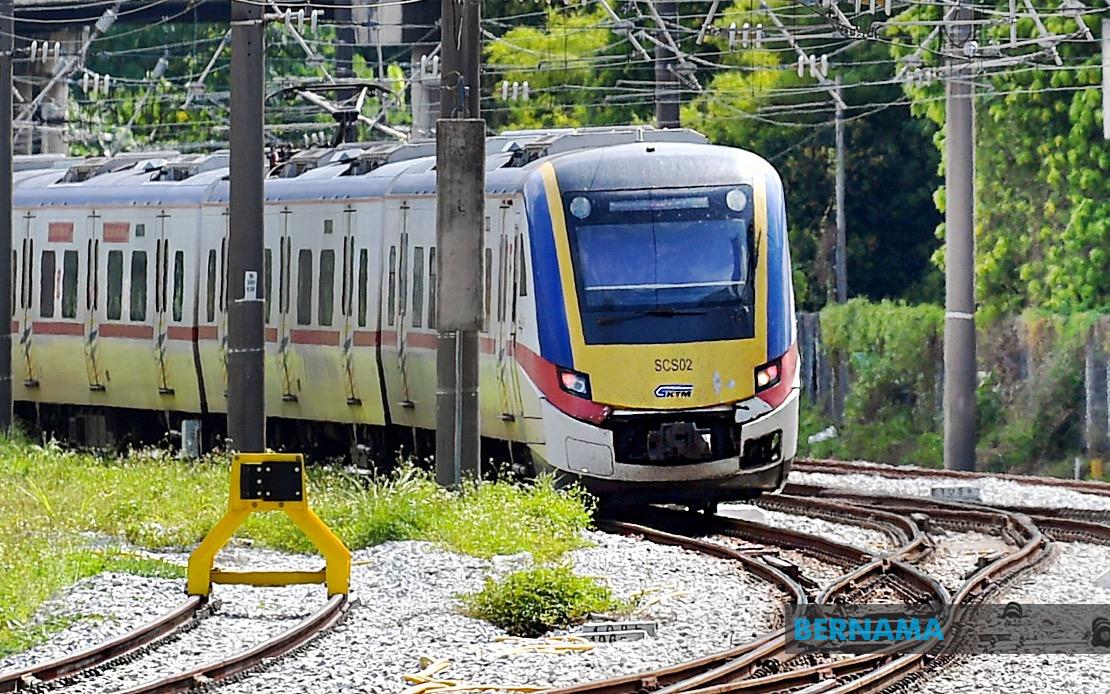
Major rail disruptions struck the Klang Valley on July 23 when a wooden construction structure collapsed onto the railway line near Batang Benar, severing the overhead power supply and forcing Keretapi Tanah Melayu Berhad (KTMB) to suspend services across a critical section of its network. The incident, which exposed serious safety lapses at a third-party worksite, paralysed commuter movement along one of Malaysia's busiest rail corridors and illustrated the operational fragility that persists when contractors operate in proximity to essential transport infrastructure.
The structure struck the overhead line system spanning between Batang Benar and Labu stations, immediately cutting electrical power to the affected stretch. KTMB responded by implementing service truncations, reducing KTM Komuter operations from Pulau Sebang to terminate at Seremban Station rather than extending to KL Sentral. Services running towards the capital or Batu Caves were redirected to originate from Bangi Station instead, effectively severing rail connectivity for the approximately 110-kilometre segment from Bangi to Seremban. The blanket suspension of all KTM Komuter operations within this zone left commuters stranded and forced passengers already in transit to seek alternative arrangements.
To mitigate the impact on affected commuters, KTMB activated emergency protocols by deploying shuttle bus services connecting Seremban, Tiroi, Batang Benar, Labu and Bangi stations. The rail operator also arranged seven additional shuttle buses at major terminals including KL Sentral, Bandar Tasik Selatan, Kajang and Seremban to accommodate Electric Train Service passengers. Recognising that some travellers would abandon their journeys entirely, KTMB announced full refund entitlements for ETS passengers who elected not to proceed from their departure points—a gesture aimed at minimising passenger frustration during the service breakdown.
KTMB's preliminary investigation revealed that the Public Works Department (JKR) contractor undertaking the wayleave project had fundamentally failed to observe mandatory safety protocols. The contractor neglected to furnish a comprehensive work schedule to KTMB and critically failed to communicate the actual timing of bridge construction operations scheduled for the incident date. This communication breakdown proved catastrophic, as it prevented KTMB from deploying adequate on-site oversight and coordination. Under the Site Entry Permit Standard Operating Procedure, KTMB is required to station three technical representatives from its Regional Engineer, Signalling and Communications, and Electrification departments whenever construction activities commence near the railway corridor. The contractor's failure to notify KTMB meant this mandatory supervision was absent when the structure fell.
The incident underscores persistent vulnerabilities in contractor management and safety enforcement within Malaysia's rail infrastructure ecosystem. Despite established Standard Operating Procedures that mandate formal notification, comprehensive documentation and continuous technical monitoring, the contractor proceeded with bridge construction work without adhering to these foundational requirements. This operational gap highlights whether current enforcement mechanisms possess sufficient teeth to compel contractor compliance, or whether penalties for non-adherence remain insufficiently deterrent. The fact that such a serious breach occurred at a government-contracted site raises questions about procurement standards and contractual oversight that KTMB and the Public Works Department will likely face in coming weeks.
For Malaysian commuters, the disruption served as an unwelcome reminder of the cascading consequences when transport infrastructure sustains damage. The Klang Valley corridor experiences some of the nation's heaviest passenger volumes, with tens of thousands relying daily on integrated KTM Komuter and ETS services to access employment, education and essential services across the metropolitan region. A single-point failure affecting overhead electrification can rapidly degrade the entire network's capacity and create congestion ripples across alternative transport modes. Bus operators, taxi services and private vehicle usage would have surged to absorb displaced rail demand, adding pressure to road networks already strained by peak-hour congestion.
The timing of the incident during daylight hours provided some operational advantage, as KTMB's technical teams could immediately assess damage and devise remediation strategies. The rail operator mobilised repair efforts aimed at restoring the damaged overhead line system, though no specific timeline for full service restoration was communicated in initial statements. For commuters depending on schedule predictability, the uncertainty surrounding service resumption created additional hardship, particularly for those with fixed work schedules or connecting transport arrangements dependent on precise arrival times.
The incident carries broader implications for Southeast Asian rail operators grappling with parallel challenges around contractor safety and infrastructure protection. As rapid urbanisation drives expanded construction activity across cities throughout the region, the intersection between active construction sites and functioning transport networks becomes increasingly congested and accident-prone. Malaysia's experience here offers a cautionary template: robust contractual language and procedural documentation prove ineffective unless accompanied by rigorous monitoring, meaningful financial penalties for breaches, and swift regulatory action against non-compliant contractors.
KTMB's public apology acknowledged the disruption and reiterated that passenger safety and operational reliability constitute the organisation's paramount concern. However, such assurances ring hollow without concrete evidence of strengthened enforcement mechanisms and contractor accountability systems. The rail operator faces pressure to demonstrate whether this incident catalyses meaningful operational reforms or becomes merely another disruption absorbed into commuter experience. Moving forward, KTMB must clarify whether it will implement enhanced pre-approval site inspections, surprise compliance audits, or escalated penalties that would make future contractor violations commercially prohibitive.
Passengers seeking real-time updates were directed towards KTMB's social media platforms and station staff, reflecting the modern reality that official channels now serve as primary information distribution mechanisms during service disruptions. The deployment of this communication strategy, while necessary, simultaneously exposed the challenge of ensuring consistent and timely information reaches all affected passengers, particularly elderly commuters or those with limited digital access. For a transport operator managing millions of daily journeys, such disruptions demand not only rapid physical recovery but equally sophisticated communication infrastructure.
The Batang Benar incident ultimately exemplifies how Malaysia's ageing rail infrastructure remains vulnerable to external shocks when overlapping construction activities proceed without adequate coordination. As the Klang Valley continues expanding and infrastructure renewal projects multiply, KTMB and government agencies must strengthen governance frameworks that position contractor oversight as non-negotiable rather than aspirational. Without such evolution, future disruptions remain inevitable, with the inconvenience and economic costs distributed across hundreds of thousands of commuters whose daily mobility depends on seamless rail operations.

