Cuban President Miguel Díaz-Canel delivered a scathing critique of recently imposed American sanctions during remarks made on July 18, characterising the Trump administration's moves as part of a broader ideological campaign that resurrects Cold War hostilities. Speaking through social media, the Cuban leader accused Washington of orchestrating what he termed a "new and more dangerous version of McCarthyism," drawing explicit parallels to 1950s anti-communist purges that targeted alleged sympathisers of leftist causes across American society.
The comparison to McCarthyism carries particular weight in the Cuban context, where such historical references underscore longstanding grievances about American foreign policy. By invoking Senator Joseph McCarthy's infamous campaigns, Díaz-Canel positioned current US actions as fundamentally continuous with mid-twentieth century persecution tactics, suggesting that ideological targeting of progressive movements represents an enduring feature of American statecraft rather than a passing political moment. This rhetorical framing resonates throughout Latin America, where memories of Cold War intervention remain deeply embedded in national consciousness.
Díaz-Canel extended his critique beyond mere sanctions, alleging that the United States and its allies actively promote "transnational far-right alliances" that echo historical fascism. He drew comparisons to both Nazi-era ideology and Operation Condor, the notorious 1970s and 1980s covert programme through which the US allegedly coordinated with regional military dictatorships to suppress leftist movements across South America. These parallels, whether historically precise or rhetorically amplified, serve to position Cuba as victim rather than aggressor, a crucial framing for domestic audience consumption and international solidarity-building among non-aligned nations.
The Cuban president further questioned whether allegations targeting the political left function primarily as pretexts for justifying expanded military and economic aggression. This line of argumentation suggests that American accusations of authoritarian governance or human rights violations mask deeper geopolitical objectives—namely, the preservation of hemispheric dominance and the prevention of leftist alternatives to market-oriented governance models. For Malaysian and Southeast Asian observers, such disputes between Cuba and the United States illuminate ongoing tensions between state sovereignty claims and external pressure regarding internal governance standards.
Díaz-Canel characterised the fundamental threat to global stability not as leftist ideology but rather as what he termed the "philosophy of dispossession" guiding transnational far-right movements. This inversion of typical Western security narratives reframes the ideological struggle in explicitly economic terms, suggesting that right-wing ascendancy threatens material welfare and equitable resource distribution worldwide. He attributed to Washington and its partners responsibility for multiple humanitarian catastrophes, including the Gaza conflict, undocumented migrant deaths, and Iranian school bombings, constructing a comprehensive indictment of American-aligned geopolitical conduct.
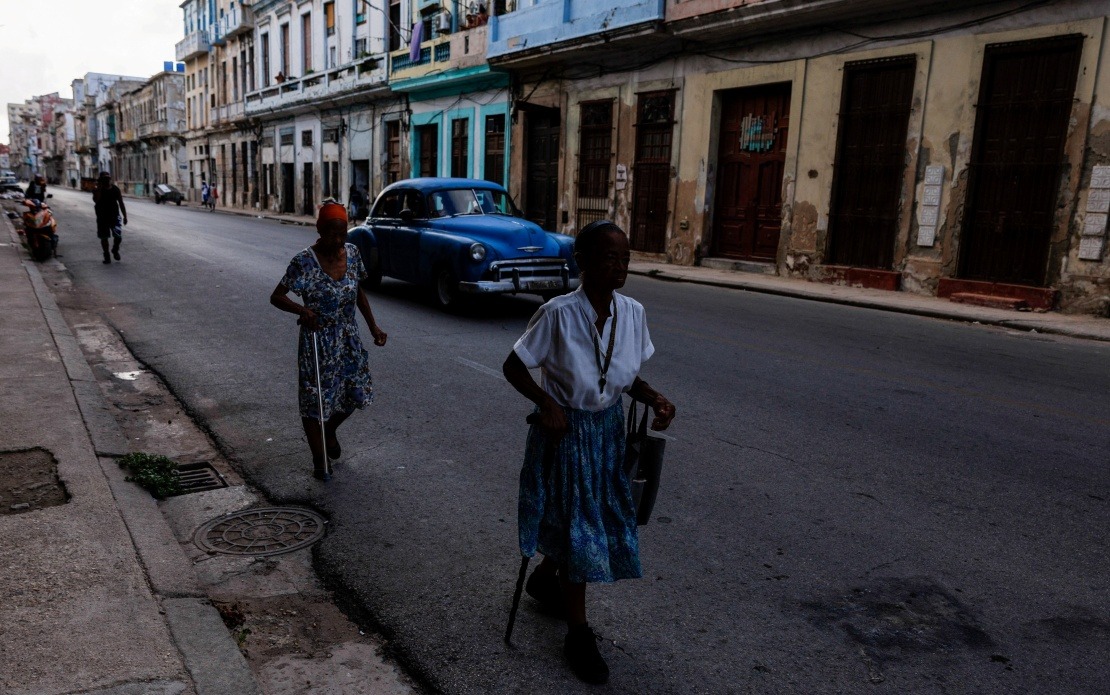
The substantive context for these accusations involves Cuba's catastrophic economic deterioration, which officials attribute substantially to tightened American measures. The island nation currently experiences its most severe economic contraction in decades, characterised by acute fuel shortages, widespread power failures, and infrastructure collapse. During the first half of 2026, average daily blackouts reached twenty hours while electricity deficits climbed to approximately 1,955 megawatts, crippling productive capacity and ordinary citizens' daily functioning. These statistics underscore the tangible human costs underlying Cuba's diplomatic rhetoric.
American sanctions escalated significantly under the Trump administration's second term. President Donald Trump signed an executive order on May 1 implementing additional sanctions targeting Cuban officials and state entities, justified through claims of regime repression and threats to American national security. Furthermore, in January Trump established an emergency declaration mechanism enabling tariff imposition against countries supplying or selling petroleum to Cuba, dramatically expanding economic pressure beyond direct bilateral measures. These actions represent systematic efforts to isolate Cuba from global energy markets and international financial systems.
Cuban authorities systematically blame Washington for engineering their economic crisis through multiple channels beyond formal sanctions. Officials contend that the United States pressures international companies to cease business relationships with Cuba, restricts the island's access to international credit markets, and actively disrupts petroleum supply chains that constitute Cuba's economic lifeblood. These grievances, whether fully accurate or partially exaggerated, reflect genuine vulnerabilities inherent to small island economies dependent on global trade and vulnerable to great power economic coercion.
For Southeast Asian policymakers and observers, the Cuba-US standoff illustrates enduring tensions between powerful nations' willingness to employ economic tools for geopolitical objectives and smaller countries' capacity to resist or accommodate such pressure. Malaysia and ASEAN nations maintain complex relationships with both American and Chinese power, requiring careful navigation between competing ideological systems and economic partnerships. Cuba's experience demonstrates the substantial costs of sustained confrontation with dominant regional or global powers, offering cautionary lessons about the limits of confrontational diplomacy.
The dispute also highlights how ideological framings—whether McCarthyism, fascism, or authoritarian governance—become contested terrain in international relations. Cuban accusations of American McCarthyism mirror earlier Cold War rhetorical patterns but now occur within transformed global contexts where leftist movements compete with diverse governance models rather than commanding unified ideological allegiance. The Cuban government's sustained historical grievances coexist with contemporary economic failures that transcend sanctions effects, complicating straightforward narratives of victimisation or culpability.
Moreover, Díaz-Canel's comprehensive indictment of Western foreign policy—encompassing Gaza, migrant persecution, and Iranian targeting—reflects how Cuba strategically constructs international coalitions through shared opposition to American-aligned geopolitical actions. This approach seeks solidarity among nations and movements contesting liberal-democratic hegemony, potentially resonating in developing regions sceptical of Western institutional leadership. Yet such coalition-building remains constrained by Cuba's limited economic and military resources compared to alternative great power alternatives like China or Russia.
Looking forward, the trajectory of US-Cuban relations under continued Trump administration policies remains uncertain, though escalation appears likely absent significant diplomatic shifts. Cuba's economic crisis shows no signs of resolution without either sanctions relief or successful economic restructuring—both scenarios appear distant given current trajectories. The ideological stakes Díaz-Canel articulates—framing the conflict as fundamentally about economic justice and sovereignty against hegemonic imposition—will likely persist regardless of immediate diplomatic developments, anchoring Cuban politics and regional Latin American alignments for years ahead.

