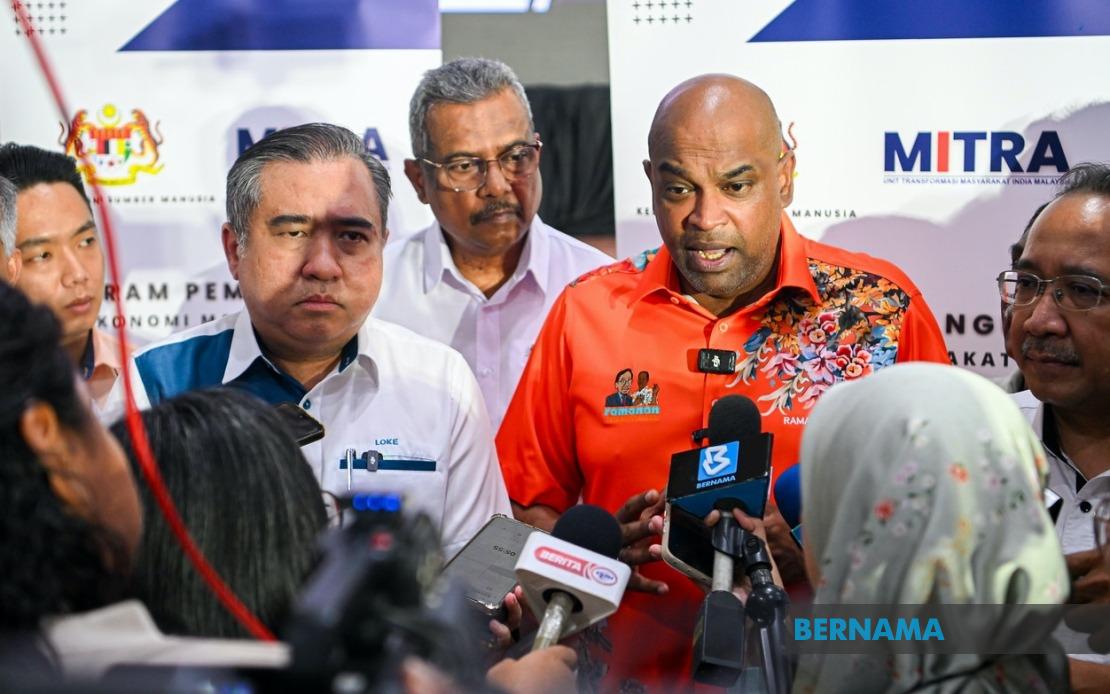
Responding to persistent criticism that the Democratic Action Party exercises undue influence over Pakatan Harapan's governance, Transport Minister Anthony Loke has firmly pushed back against what he characterises as a recycled political attack. Speaking in Seremban on July 7, the DAP secretary-general argued that both federal and state-level decisions emerge from a collaborative process involving multiple parties rather than stemming from the directives of any single coalition member.
Loke's intervention represents another effort by the government to counter a narrative that has gained traction among opposition voices and some commentators, who have questioned the distribution of power within the Pakatan Harapan alliance. The claim that DAP, as the coalition's most urbanised and administratively experienced component, exerts disproportionate control has periodically surfaced in political discourse since the coalition's formation. By addressing these accusations directly, Loke appears keen to demonstrate that internal governance mechanisms function transparently and equitably among partner parties.
The Transport Minister emphasised that within the federal government structure, all three major components—DAP, UMNO, and PKR—participate equally in policy formation. According to Loke's account, each party has the opportunity to present its perspective before Prime Minister Datuk Seri Anwar Ibrahim renders final decisions. This arrangement, he suggested, reflects the nature of coalition governance, where dialogue and consensus-building precede major administrative choices. The characterisation of the decision-making process as distributed rather than centralised within one party's hands serves Loke's broader objective of portraying Pakatan Harapan as a genuinely collaborative enterprise.
Critically, Loke distinguished between parties having a voice in proceedings and any single party holding decisive authority. He acknowledged that component partners naturally articulate their interests and policy preferences, describing this as an inevitable and appropriate aspect of multiparty governance. However, he argued that voicing views does not equate to dictating outcomes. The Prime Minister, in this framing, acts as the ultimate arbiter—a structural arrangement that theoretically prevents any coalition member from achieving unilateral control. For Malaysian readers familiar with the complexities of coalition politics, this distinction between participation and dominance carries particular significance given the Pakatan Harapan's history of internal tensions.
Loke extended his explanation to state-level governance, pointing to Negeri Sembilan as a case study in collegiate administration. He noted that Menteri Besar Datuk Seri Aminuddin Harun similarly consults component parties before finalising decisions, suggesting that the collaborative model operates consistently across administrative levels. This parallel invocation of state-level practice attempts to reinforce the credibility of Loke's assertion by demonstrating that the approach is systematic rather than exceptional.
Beyond addressing the specific allegation concerning DAP's influence, Loke tackled a related contention that has circulated within certain political quarters—namely, that Malay interests face erosion under Pakatan Harapan administration. He dismissed this claim as an outdated tactical approach, arguing that substantive evidence contradicts such assertions. The Negeri Sembilan government continues to be headed by a Malay Menteri Besar, and state policies ostensibly maintain protections for all communities, including Malays. For Malaysian observers, this defence carries weight given the centrality of Malay-Muslim concerns in domestic political messaging.
The Transport Minister's framing suggests that opposition forces lack substantive grounds for criticism and resort instead to familiar rhetorical devices. By characterising these attacks as tired repetitions, Loke implies that critics operate from ideological positioning rather than factual analysis. This rhetorical move, common in Malaysian political discourse, attempts to shift debate away from specific policy disagreements toward meta-commentary about the nature of opposition arguments themselves.
For the broader Southeast Asian context, Loke's intervention illuminates the challenges multiparty coalitions face in maintaining cohesion while managing public perceptions of internal power distribution. The Pakatan Harapan's experience—spanning different ethnic and ideological components attempting to function as a unified government—resonates with governance challenges across the region where coalition governments are increasingly common. The necessity for leaders to simultaneously assert party autonomy and coalition solidarity creates inherent tensions that critics exploit.
Loke's remarks also reflect the particular sensitivities surrounding DAP within Malaysian politics. As a predominantly non-Malay, non-Muslim party operating in a system where Malay-Muslim interests occupy constitutionally protected prominence, DAP's participation in government continues to generate suspicion among constituencies concerned about communal representation. The Transport Minister's effort to neutralise such concerns through reassurance about institutional mechanisms suggests these anxieties persist despite years of Pakatan Harapan governance.
Looking forward, whether Loke's clarifications substantially alter public perception remains uncertain. Coalition governments inherently involve complex power-sharing arrangements that resist simple explanation, and opposition narratives regarding DAP's influence have proven durable. The government's repeated need to address these accusations suggests they resonate with meaningful constituencies, even if officials dispute their empirical foundation. For Malaysian political observers tracking coalition stability and interparty dynamics, the persistence of these debates indicates deeper structural questions about how multiethnic, multiparty governments can build broader trust in their decision-making processes.

