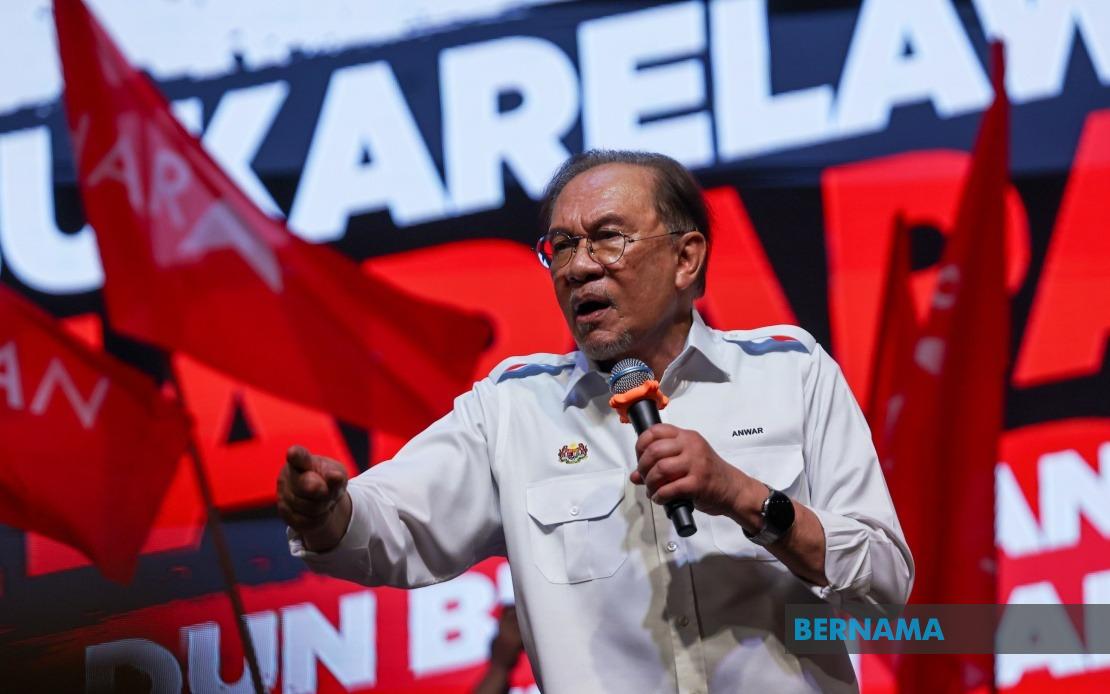
Prime Minister Datuk Seri Anwar Ibrahim has moved to counter narratives portraying the Democratic Action Party as hostile to Malay interests, asserting during a campaign event in Muar that the party has consistently respected constitutionally guaranteed Malay and Bumiputera rights. Speaking as chairman of Pakatan Harapan and leader of the Unity Government, Anwar presented the DAP's tacit endorsement of a proposal to gazette 20.23 hectares in Bandar Malaysia as Malay Reserve Land as concrete proof of the party's commitment to honouring these protections, effectively rebutting what he characterised as a deliberate misrepresentation by certain political quarters.
The Prime Minister's remarks underscore a persistent tension within Malaysia's multi-ethnic political landscape, where opposition figures and certain segments of the Malay-Muslim community have repeatedly questioned whether the DAP, a party with a predominantly Chinese base, genuinely supports constitutional provisions for Malays and indigenous peoples. Anwar's intervention suggests the ruling coalition recognises this narrative as a political vulnerability that could undermine support in crucial elections, particularly in Malay-majority constituencies where trust remains fragile. By highlighting DAP's lack of objection to Malay Reserve Land initiatives, Anwar seeks to demonstrate that intercommunal governance does not require compromising fundamental protections or entitlements.
Central to Anwar's broader messaging is the framing of government responsibility as an obligation to serve all racial communities fairly rather than advance the interests of particular groups. He articulated this principle through concrete examples, noting that the administration continues developing programmes targeting Bumiputeras and increasing budget allocations to entities such as PUNB without encountering resistance from DAP. This approach attempts to normalise the idea that supporting targeted Bumiputera initiatives and pursuing multiracial development programmes are compatible objectives within a single governance framework, rather than zero-sum competition for state resources.
The Prime Minister's emphasis on parity in government programmes reflects a deliberate strategy to present the Unity Government as genuinely committed to inclusive development. He stressed that while initiatives benefiting the Malay and Bumiputera community proceed without impediment, equivalent support for disadvantaged Chinese and Indian communities must also continue unobstructed. This framing challenges the opposition's portrayal of the government as either capitulating to DAP demands or marginalising Bumiputera interests, instead positioning multiracial support systems as complementary rather than contradictory.
Beyond communal sensitivities, Anwar pivoted to the broader distributional question facing Malaysia's economy. He contended that despite the country's current economic expansion, the benefits of growth have not equitably reached all segments of society, and that economic success should translate into tangible improvements in living standards across the population. This argument implicitly critiques both the previous administration's economic management and contemporary inequality, suggesting that the Unity Government's legitimacy ultimately depends on demonstrating that prosperity benefits ordinary Malaysians rather than concentrating wealth among political and business elites.
The Prime Minister's invocation of improved housing, market stalls, basic infrastructure, and educational quality as benchmarks for economic success reflects recognition of bread-and-butter concerns that resonate particularly among lower and lower-middle income households. By anchoring his governance vision to these material standards, Anwar shifts focus away from abstract constitutional debates toward concrete delivery metrics. This approach may prove strategically valuable in the Johor state election context, where voters can assess government performance against such tangible criteria.
Anwar's comments regarding the relationship between political power and public service represent an attempt to reframe Malaysian politics around principles of accountability and trusteeship. His statement that "power is a trust to be used, not to enrich yourself" and that "politics is about service" directly challenges a widespread perception that elected office primarily serves as a vehicle for personal accumulation. This ethical framing, whether or not it reflects actual governance priorities, responds to public cynicism about political corruption and self-dealing that has shaped Malaysian electoral behaviour in recent years.
The timing of these remarks during the Johor state election campaign, in which 172 candidates compete across 56 assembly seats, suggests the government views DAP's racial credentials as a significant electoral issue in this particular contest. Johor, traditionally viewed as a Bumiputera stronghold and a crucial battleground, requires messaging that reassures Malay-Muslim voters about the government's commitment to their interests while simultaneously defending multiracial coalition governance. Anwar's careful calibration of these messages indicates awareness that the coalition's viability depends on maintaining support across diverse constituencies with competing priorities and sensitivities.
The policing of political narratives around race remains a perennial challenge for Malaysia's Unity Government, which simultaneously claims to champion both Bumiputera rights and multiracial development. Anwar's intervention attempts to stabilise this equilibrium by providing evidence that DAP participation in governance does not require abandoning such protections. Whether such assurances prove persuasive to Johor voters, particularly in contests where Bumiputera sentiment runs deep, will become apparent when polling occurs on July 11, with early voting scheduled for July 7.
The broader implication of Anwar's messaging extends beyond immediate electoral calculations. By defending the DAP and reaffirming commitment to Bumiputera rights simultaneously, the Prime Minister signals that Malaysia's political future may depend on building institutional arrangements and governance practices that accommodate multiple, sometimes competing communal interests without requiring either capitulation or domination. This approach represents both a departure from pre-2018 governance models and a rejection of opposition framings that treat such accommodation as inherently unstable or threatening to particular communities.

