The political landscape in Negeri Sembilan is set for a complex electoral battle as the state heads toward its 16th assembly election, with nominations officially closed and candidate lineups now confirmed. Siaw Meow Keong, the DAP's treasurer in Negeri Sembilan and current Rahang assemblyman, has been fielded by the Pakatan Harapan coalition to retain his seat against a diverse field of challengers spanning the political spectrum. His quest to defend the constituency will prove considerably more difficult than his initial breakthrough in 2023, given the multiplication of contenders vying for voter attention in what promises to be a closely watched contest.
The nomination process concluded today with all candidates formally registered, revealing the highly fragmented nature of electoral competition in several key seats. Siaw submitted his nomination papers at 9.12 am, placing him third among the four Rahang aspirants. He faces competition from Yap Siok Moy, the Rasah MCA Wanita chief representing Barisan Nasional who filed at 9.13 am, S. Thinagaran of Parti Sosialis Malaysia who submitted at 9.06 am, and Tang Jay San of Bersatu who registered at 9.10 am. The tight clustering of submission times underscores the competitive intensity surrounding this particular seat.
Yap Siok Moy's candidacy represents BN's traditional attempt to reclaim ground in urban areas where MCA has historically maintained organizational presence. As a women's wing leader, her nomination reflects broader efforts by the coalition to enhance female representation in legislative contests. However, the presence of PSM and Bersatu candidates suggests that Rahang voters will face a genuine ideological choice between centrist coalition politics, socialism, conservative Islamic-oriented governance, and DAP's Chinese-focused opposition approach. This configuration creates unpredictable dynamics where no single faction can assume automatic support consolidation.
In contrast to Rahang's complexity, other constituencies display markedly different competitive patterns. In Bukit Kepayang, incumbent DAP Wanita chief Nicole Tan Lee Koon faces a bilateral showdown against Lee Boon Shian of Perikatan Nasional, presenting a clearer choice for voters between opposition and PN-aligned governance. This straight fight suggests both parties view the seat as strategically significant enough to concentrate resources. Meanwhile, three additional constituencies—Labu, Mambau, and Seremban Jaya—present three-way contests that will demand sophisticated electoral coalition-building among opposition, BN, and PN factions.
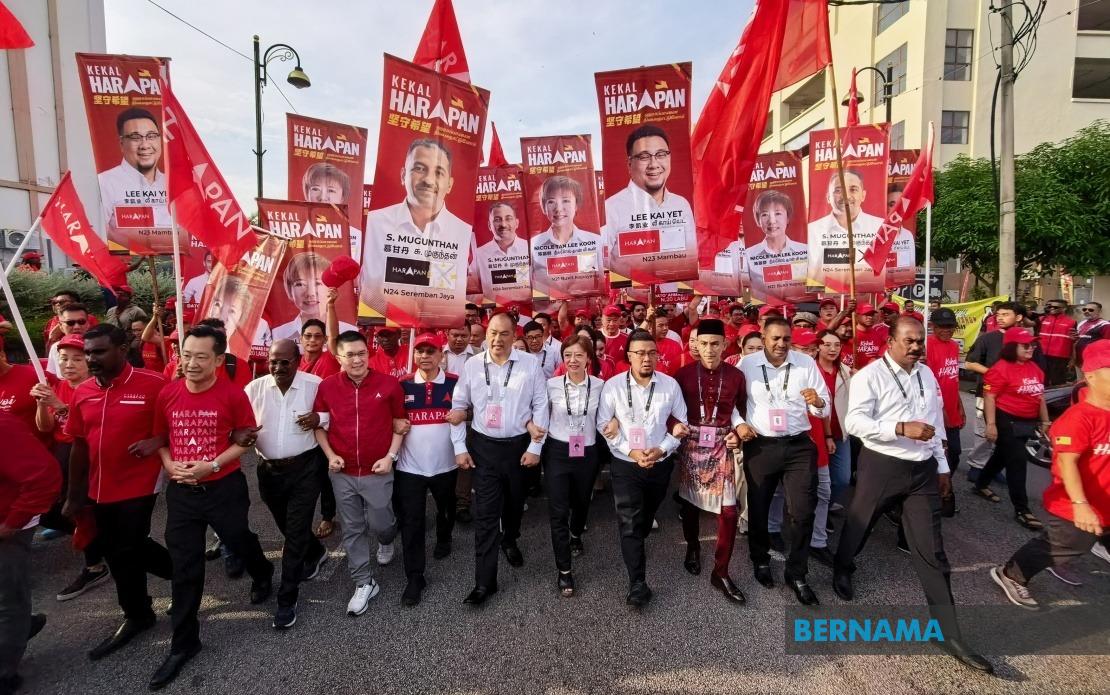
In Labu, the triangular contest pits PH's Datuk Ahmad Faez Abdul Razak, currently favoured as the incumbent's candidate, against Bersatu's Mohamad Hanifah Abu Baker and BN's Siti Nur Umaira Hasim. The presence of a female BN candidate suggests targeted efforts to appeal to women voters in this demographic. Mambau presents another three-way affair with PH's Lee Kai Yet, Bersatu's N. Sarawanan, and PN candidate Eric Michael all competing. The fragmentation across these constituencies indicates that no single coalition can count on automatic voter compliance; instead, local personalities, constituency-level grievances, and community-specific issues will likely prove decisive.
Seremban Jaya's three-cornered contest between PH's S. Mugunthan, BN's Datuk T. R. Thinalan, and Bersatu's R. Mahendran demonstrates how the state election has become increasingly multipolar. The presence of Bersatu across multiple constituencies—Rahang, Labu, Mambau, and Seremban Jaya—suggests the party views Negeri Sembilan as a potential expansion ground. This represents a strategic shift from earlier cycles when Bersatu's peninsular focus remained limited, though the party's actual electoral capacity in Negeri Sembilan remains untested at state level.
The electoral calendar now moves toward the final stages of the campaign. The Election Commission has designated July 28 as the early voting date, offering flexibility for those unable to cast ballots on the main election day. August 1 marks the official polling day, providing voters with a compressed campaign window of approximately two weeks from today. This timeframe compresses candidate visibility opportunities and forces parties to make strategic choices about where to concentrate messaging, advertising resources, and leadership campaign appearances.
For DAP, retaining Rahang becomes particularly symbolically important given Siaw's dual role as state treasurer. A loss would undermine party organizational credibility while potentially signalling broader weakness in Negeri Sembilan. Conversely, holding the seat would validate DAP's organizational capacity and urban appeal despite Bersatu's challenge. For BN, Rahang represents an opportunity to recapture territory lost in 2023, though Yap's newcomer status as a candidate presents both advantages and potential vulnerabilities compared to Siaw's incumbency advantage.
The multi-directional competition characteristic of this election reflects larger regional political fragmentation where traditional binary BN-opposition dynamics have dissolved into more complex multipolar contests. Bersatu's positioning as a third force competing alongside both coalitions introduces genuine uncertainty into seat-by-seat predictions. This structural complexity means that micro-level campaign execution, candidate appeal, and community networking often matter more than broader national political narratives in determining outcomes.
For Malaysian electoral observers and Southeast Asian political analysts, Negeri Sembilan's state election offers valuable insights into how Malaysia's voting populations respond to expanded political choice. The state's relatively small electorate and clear administrative boundaries provide an ideal testing ground for understanding voter behaviour when multiple ideological orientations compete for support. Results from August 1 will likely reverberate beyond Negeri Sembilan, informing calculations about electoral viability for competing coalitions and potentially reshaping strategic considerations for upcoming parliamentary contests.

