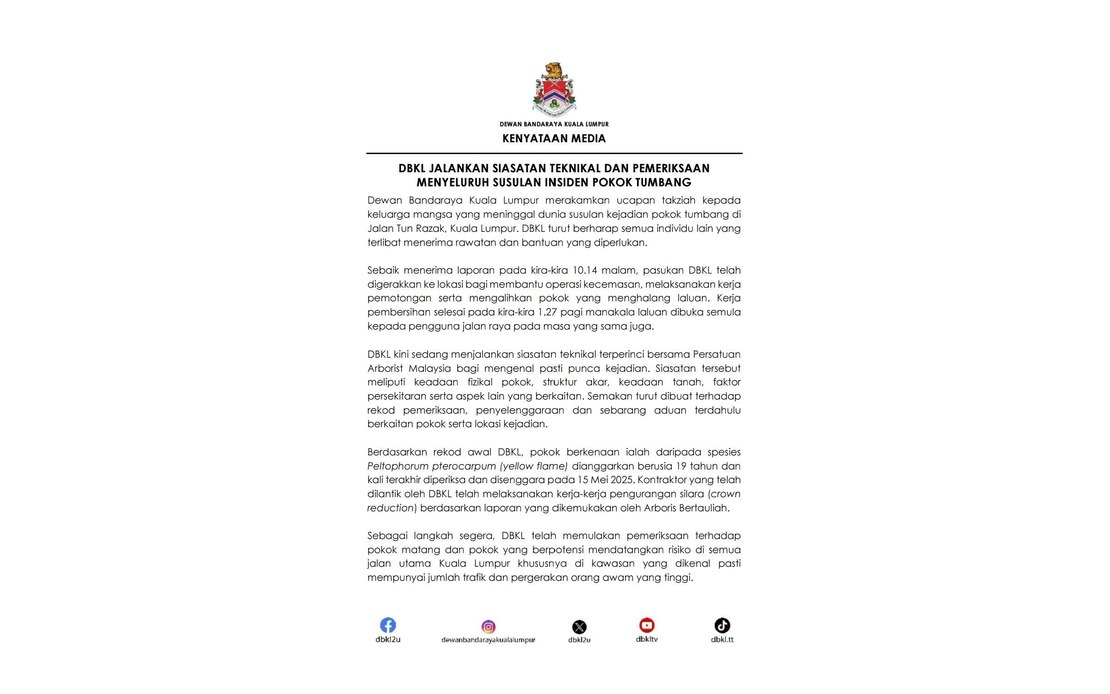
A 19-year-old Yellow Flame tree collapsed on Jalan Tun Razak late on July 18, resulting in the death of a man and triggering an urgent investigation by Kuala Lumpur City Hall (DBKL) into the circumstances surrounding the incident. The tragedy has prompted the municipal authority to establish a comprehensive technical inquiry, conducted jointly with the Malaysian Society of Arborist, to understand what led to the tree's sudden failure and prevent similar occurrences across the capital.
The collaborative investigation encompasses multiple dimensions of the tree's condition and history. Researchers are examining the physical integrity of the trunk and branches, analyzing the root system's strength and spread, assessing soil composition and stability at the site, and evaluating broader environmental factors that may have contributed to the collapse. Additionally, investigators are reviewing all previous inspection records, maintenance logs, and any complaints or concerns that residents or authorities had raised about the tree or the surrounding area. This methodical approach reflects growing recognition that tree failures rarely result from a single cause but rather from a combination of structural, environmental, and management factors.
DBKL responded swiftly to the emergency, dispatching teams to the scene following notification at 10:14 pm on the night of the incident. Crews worked through the early morning hours to safely fell the remaining sections of the tree and clear debris from the roadway, reopening Jalan Tun Razak to traffic by 1:27 am. The rapid response underscores the city council's capacity to manage infrastructure crises, though the incident raises questions about preventive maintenance and early warning systems that might have identified the tree's vulnerability before catastrophic failure occurred.
Records indicate that the Peltophorum pterocarpum specimen had undergone professional assessment and crown reduction work by a certified arborist at the behest of DBKL's contractor. The most recent inspection and maintenance had taken place on May 15, approximately two months before the collapse. While documented maintenance activity might suggest adequate oversight, the interval between that May servicing and the July failure suggests either that unforeseen conditions developed rapidly or that the inspection protocols failed to detect signals of instability. This gap has prompted scrutiny of how frequently mature trees in high-traffic areas should be assessed, particularly during monsoon seasons when heavy rainfall and soil saturation can compromise root anchoring.
In response to the tragedy, DBKL has initiated an immediate citywide programme to scrutinize mature and potentially hazardous trees along all major arterial roads in Kuala Lumpur. Priority zones include routes with substantial vehicular and pedestrian traffic where a tree failure poses the greatest risk to human life. Initial inspections are concentrating on Jalan Ampang, Jalan Sultan Ismail, Jalan Raja Laut, Jalan Datuk Keramat, and portions of Jalan Tun Razak itself. The authority anticipates completing these visual assessments within ten weeks through the deployment of eight inspection teams, five of which include certified arborists capable of evaluating structural soundness and disease indicators.
Beyond the immediate inspection surge, DBKL is pursuing longer-term technological solutions to enhance tree safety monitoring across the metropolitan area. The council has submitted a proposal to SIRIM, the Standards and Industrial Research Institute of Malaysia, for approval to deploy 400 sophisticated tree sensors at strategically identified high-risk locations. These devices represent a significant advancement in urban forestry management, as they would continuously collect data on multiple indicators of tree health and stability rather than relying solely on periodic human inspection. The sensors would track soil moisture and composition, detect structural movement in the trunk and major branches, monitor environmental stresses including wind loads, and register the impacts of extreme weather phenomena such as intense rainfall and flooding that can destabilize root systems.
The initial phase of sensor deployment is planned for four critical locations deemed to have elevated risk profiles: Jalan Bangsar, Dataran Merdeka, Jalan Ampang, and Jalan Raja Chulan. These sites likely represent areas with high concentrations of mature trees, substantial foot traffic, or particular vulnerability to environmental stress factors. Once operational, the sensors would provide early warning of deteriorating conditions, theoretically allowing DBKL to intervene with targeted maintenance, crown reduction, or removal before catastrophic failure occurs. Such technology could fundamentally transform how cities like Kuala Lumpur manage aging urban tree populations.
The incident and subsequent response carry broader implications for Southeast Asian cities grappling with rapid urbanization and climate variability. Kuala Lumpur's experience demonstrates that even relatively recent trees in documented inventory can fail unexpectedly, suggesting that conventional inspection intervals and maintenance practices may be insufficient under contemporary conditions. Rising temperatures, shifting precipitation patterns, and increased frequency of extreme weather events may accelerate the deterioration of tree health and stability across the region. Municipalities throughout Southeast Asia are likely to scrutinize their own tree management protocols in light of this fatal collapse.
DBKL has expressed condolences to the victim's family and committed to full cooperation with police and other relevant agencies in completing the investigation. This formal undertaking signals the authority's recognition of both the human tragedy involved and the public accountability dimensions of the incident. The investigation outcomes will likely inform revisions to tree inspection standards, maintenance schedules, and removal protocols across the capital. For residents and commuters in Kuala Lumpur, the next weeks will reveal whether the city's arboricultural practices can be sufficiently strengthened to prevent recurrence of such preventable disasters.

