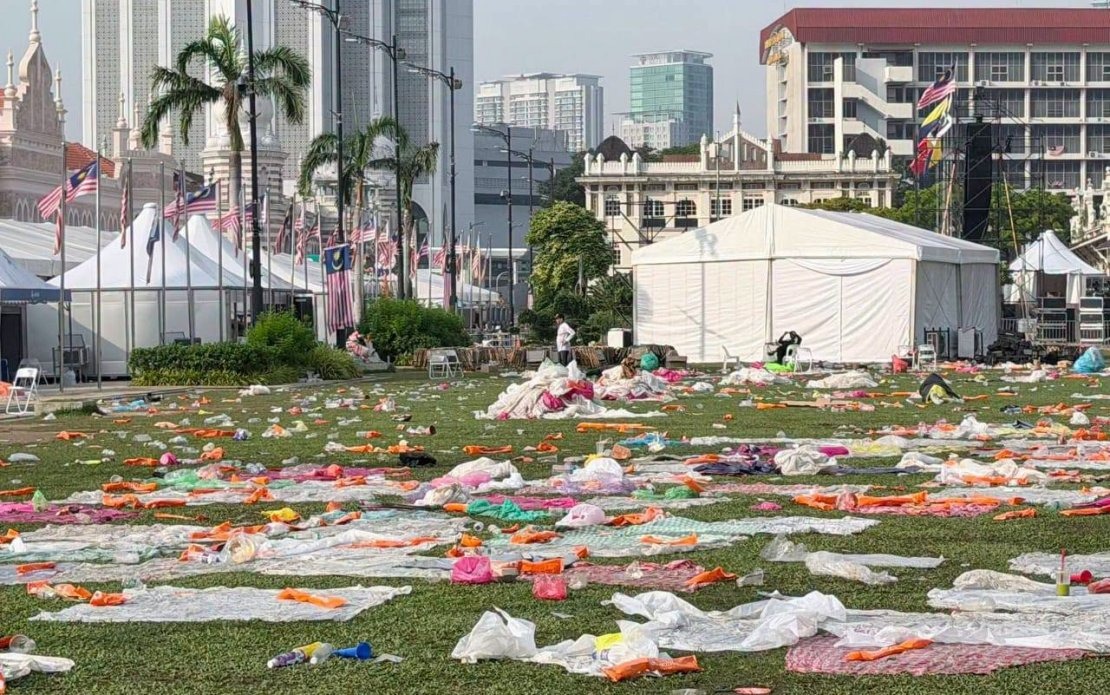
Kuala Lumpur City Hall (DBKL) has initiated a comprehensive clean-up operation at Dataran Merdeka after the iconic location was left strewn with waste following an early morning gathering of thousands of football enthusiasts who had assembled to watch the live transmission of the 2026 FIFA World Cup final between Spain and Argentina. The scale of the event, which drew more than 25,000 spectators to the open-air venue, left the historic grounds in a considerably compromised state, prompting swift action from municipal authorities.
In a statement posted across social media platforms, DBKL acknowledged the situation while simultaneously placing emphasis on a broader message regarding civic responsibility. The authority noted that although dedicated cleaning personnel would be deployed to restore the grounds to an acceptable condition, the municipality should not bear the sole burden of remediation following public gatherings. This rhetorical positioning reflects a growing tension between event management and public accountability in urban spaces throughout Malaysia's capital.
The tone adopted by DBKL in its official communication conveyed a mixture of frustration and educational intent. Officials expressed dismay at the contrast between the celebratory atmosphere that had characterised the evening and the deteriorated condition that remained once the excitement had subsided. The statement reflected on the thousands who had congregated to express their passion for football, share in collective enthusiasm, and participate in a moment of cultural celebration—yet appeared to have departed without consideration for the aftermath they were leaving behind.
Central to DBKL's message was a deliberate framing of Dataran Merdeka as more than merely a public gathering space. The authority underscored the venue's significance as a symbol of national heritage and civic pride, arguing that the manner in which citizens treat shared landmarks directly reflects their broader values and respect for the nation's identity. This positioning transforms a cleanliness issue into a conversation about national consciousness and collective stewardship of culturally significant locations.
The municipality's statement articulated a nuanced argument regarding the relationship between freedom and responsibility. Officials acknowledged that public celebration and sporting enthusiasm are legitimate expressions of collective joy, but challenged the implicit assumption that such freedom extends to imposing the costs of clean-up onto municipal services and taxpayers. The phrasing suggested that genuine civic freedom requires corresponding accountability—an increasingly relevant message in metropolitan contexts where public space usage has become contested terrain.
During the early hours of the morning, Dataran Merdeka effectively transformed into an informal open-air stadium, its dimensions constrained by the volume of attendees seeking to experience the World Cup final transmission. The fixture itself was decisive, with Spain emerging victorious through a single goal against Argentina, a result that presumably intensified the emotional investment and engagement of supporters who had made the journey to the venue.
DBKL's appeal extends beyond the immediate situation to establish a framework for future public events held at municipal spaces. The authority emphasised that a city's international standing and livability quotient are determined not solely by the numbers and enthusiasm of those who utilise public facilities, but equally by the state in which those spaces are left following such usage. This metric-based approach to urban dignity suggests DBKL is attempting to establish preventive standards for future gatherings.
The clean-up initiative carries implications for how Malaysian municipalities manage large-scale public events and broadcasting experiences. As sporting events and live-streamed global occasions increasingly draw mass gatherings to urban centres, questions of infrastructure, planning, and public behaviour become more pressing. The incident at Dataran Merdeka highlights the logistical and philosophical challenges city administrators face when balancing community engagement with environmental stewardship.
From a broader Southeast Asian perspective, this episode reflects patterns observed across the region where rapid urbanisation and growing middle-class participation in global entertainment create flashpoints around shared space management. Cities throughout the region grapple with similar tensions between enabling public enjoyment and maintaining civic standards, with varying approaches to enforcement and public messaging.
DBKL's emphasis on collective responsibility rather than punitive measures suggests an orientation toward educational intervention and cultural appeal. By framing cleanliness as a marker of national character rather than simply an administrative requirement, the authority attempts to reframe littering as a personal and civic failure rather than a minor transgression. Whether such messaging proves effective in altering behaviour patterns at future events remains an open question, particularly given the spontaneous nature of large public gatherings centred on sporting events.
The invitation for residents to regard Kuala Lumpur as a shared home requiring collective care represents an aspirational vision of urban citizenship. Such rhetoric, however, requires corresponding institutional reinforcement through infrastructure, waste management facilities, and perhaps most importantly, clear signage and communication at venues where large gatherings are anticipated. The success of DBKL's clean-up operation and subsequent appeal will likely serve as a case study for how other Malaysian municipalities address similar challenges in managing public space during high-profile international events.
Moving forward, the incident underscores the necessity for event planners and municipal authorities to establish clearer guidelines and expectations for public gatherings, particularly those centred on entertainment broadcasts that generate spontaneous attendance. Increased bin placement, visible waste management protocols, and public messaging about civic responsibility delivered before rather than after such events could prove instrumental in preventing recurrence of similar situations at Malaysia's most symbolically significant public spaces.

