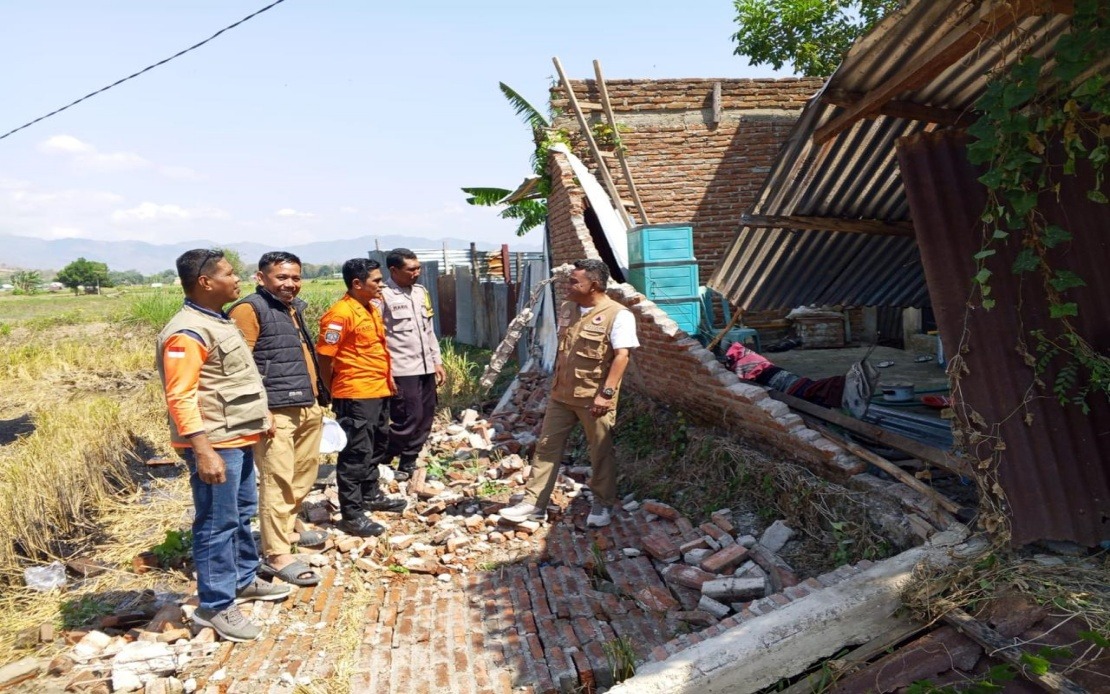
A catastrophic earthquake has devastated Indonesia's Flores Island in East Nusa Tenggara, claiming at least 38 lives as emergency responders work frantically to locate residents buried beneath the rubble of collapsed buildings. The tremor, which measured magnitude 7.7, struck at 4.58 am local time on Saturday with its epicentre located approximately 30 kilometres offshore from Mbay at a relatively shallow depth of 15 kilometres, amplifying the destruction across the island.
According to Suharyanto, chief of Indonesia's National Disaster Management Agency (BNPB), the initial casualty assessment conducted by early afternoon revealed two individuals in critical condition and eleven others with injuries ranging from moderate to minor. The agency's spokesperson emphasised that these figures represented preliminary counts from the opening hours of the disaster response, with authorities expecting both casualty and damage assessments to shift significantly as rescue operations deepened and assessment teams gained fuller access to affected communities. An estimated 2,000 residents had already self-evacuated from danger zones by the time official emergency protocols were activated.
The earthquake's destructive impact extended across critical infrastructure and residential areas throughout the affected region. Dozens of homes lay in ruins, whilst several community health facilities sustained severe structural damage that would hamper medical response capabilities during the emergency period. Landslides triggered by the initial tremor and subsequent aftershocks blocked multiple arterial roads, complicating both rescue access and the distribution of emergency supplies. Infrastructure at both the regional airport and two port facilities showed significant damage, though authorities confirmed that runway operations remained viable—a crucial advantage for incoming relief flights and evacuation sorties.
An immediate tsunami alert issued following the earthquake prompted precautionary evacuations along coastal settlements. However, Indonesian meteorological authorities lifted the warning at 7.31 am after marine monitoring stations detected no substantial elevation in sea levels beyond normal variation, allowing coastal communities to return to their properties and freeing naval and coast guard assets to redirect attention toward inland search and rescue efforts. This rapid assessment prevented a dual-front emergency that could have overwhelmed response capabilities.
The Indonesian National Search and Rescue Agency, known locally as Basarnas, mobilised personnel alongside military and police units to penetrate damaged areas and extract trapped survivors. These coordination efforts reflected standard Indonesian disaster protocol, which leverages military logistical capacity alongside civilian rescue specialists. Officials prioritised locating residents believed to be entombed within collapsed structures, as survival prospects diminish sharply beyond the critical first 24 to 48 hours following structural failure. The initial rescue phase would determine whether authorities could salvage lives from what appeared to be a high-mortality incident.
Government response mechanisms moved swiftly to restore connectivity and mobility across Flores Island. The Public Works Ministry deployed personnel and heavy equipment to clear landslide-blocked highways, recognising that isolation would compound the humanitarian emergency by preventing aid delivery and patient evacuations. These road clearance operations proceeded simultaneously with search activities, reflecting an integrated emergency management approach designed to prevent secondary casualties from medical supply shortages or delayed hospitalisation.
The National Disaster Management Agency deployed two helicopter assets and a fixed-wing transport aircraft to support evacuation operations and accelerate the movement of relief supplies into affected zones. Relief operations included distributions of food provisions, drinking water, water purification equipment, temporary shelter tents, electrical generators, and other essential supplies to displaced populations. This logistical apparatus, though substantial, faced the classic challenge of natural disasters in maritime Southeast Asia: the difficulty of rapidly scaling assistance across a dispersed, island-based population.
For Malaysian observers, the Flores earthquake underscores the seismic vulnerability that defines the broader Southeast Asian region. Indonesia sits astride the Pacific Ring of Fire, experiencing regular high-magnitude seismic events that demand sophisticated disaster preparedness infrastructure. The rapid casualty accumulation and infrastructure damage illustrate how quickly large earthquakes—particularly those striking at shallow depths with high magnitude ratings—can overwhelm even well-resourced national emergency systems. Malaysian authorities maintain similar disaster response protocols with comparable limitations, suggesting that similar catastrophes in Malaysia's earthquake-prone eastern regions would present comparable challenges.
The incident also highlights the humanitarian coordination challenges that typify major disasters in archipelagic Southeast Asia. Flores Island's geographic position, whilst strategically important, meant that relief operations required maritime logistics and aviation assets rather than simple overland deployment from national capitals. This geographic friction—the reality that distances and water barriers delay response—remains a persistent vulnerability across Malaysia's own island territories and maritime zones. International disaster relief partnerships with neighbouring nations, including Malaysia, often activate during such crises, though bureaucratic clearances and logistics coordination typically consume precious hours during critical response windows.
Indonesia's disaster management establishment has evolved considerably following the devastating 2004 Indian Ocean tsunami, which killed approximately 170,000 Indonesians and exposed profound gaps in early warning systems and inter-agency coordination. The relatively swift lifting of the tsunami warning on Saturday and the rapid mobilisation of multiple government agencies reflected institutional learning from that tragedy. However, Saturday's earthquake would again test whether those improvements translated into reduced mortality in practice, particularly for vulnerable populations in remote areas with limited medical facilities and access routes.

