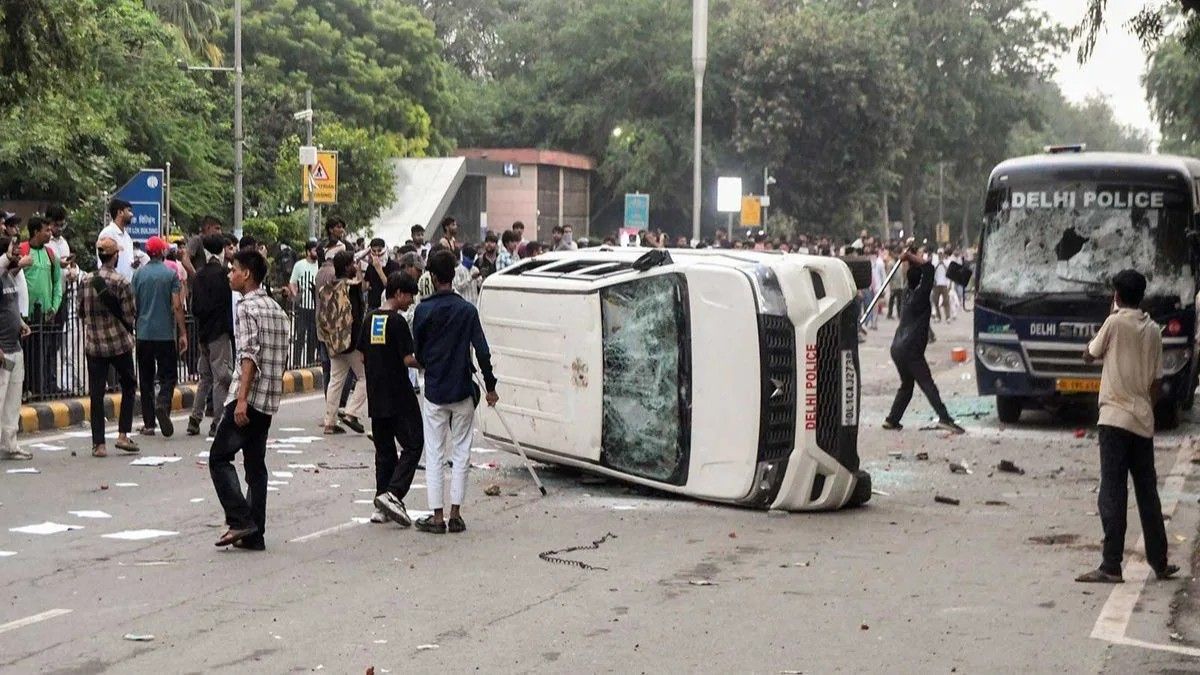
Delhi Police have opened investigations into ten separate cases stemming from demonstrations connected to the Cockroach Janta Party's "Sansad Chalo" march towards Parliament, though authorities insist that contrary to claims circulating online, no fresh violence erupted during Tuesday's continuation of the sit-in at Jantar Mantar. The filing of multiple first information reports underscores the escalating tensions surrounding the protests, which centred on demands that Union Education Minister Dharmendra Pradhan step down over alleged irregularities in national examinations.
Through social media posts, the Deputy Commissioner of Police for New Delhi explicitly contradicted accounts shared by various users claiming stone-pelting and police intervention occurred at the protest venue on Tuesday. Officials characterised these circulating videos as "false and misleading," emphasizing that no such incidents materialised on that day. The police statement underscores growing concerns about viral misinformation during politically sensitive demonstrations and reflects broader challenges law enforcement faces in countering unverified footage that can inflame public sentiment.
The ten cases have been distributed across multiple police stations within the New Delhi district, with Parliament Street police station handling four of them, Connaught Place police station registering three, and individual cases filed at Mandir Marg, Barakhamba Road, and Kartavya Path police stations. This geographic spread indicates that disturbances occurred at various locations throughout the march route rather than concentrating at a single point. The scope of charges reflects the complexity of crowd management during large-scale political mobilisations in India's capital.
Investigators are pursuing charges encompassing conspiracy, obstruction of government functioning, physical assault against police officers, and destruction of public infrastructure. Legal provisions invoked include the Bharatiya Nyaya Sanhita, India's recently codified criminal statute, alongside the Arms Act and the Prevention of Damage to Public Property Act. One particularly serious complaint concerns an alleged life-threatening assault on a Rapid Action Force personnel during Monday's march, whilst another addresses the unauthorised operation of a drone within the New Delhi district during Parliament's sitting, raising national security considerations.
Monday's confrontations appear to have been the primary trigger for formal police action, with authorities asserting that demonstrators engaged in "unruly, aggressive and violent behaviour" despite explicit warnings and existing prohibitory orders. Footage released by Delhi Police showed stone-pelting in the Connaught Place vicinity, providing visual documentation of the incidents that prompted the criminal cases. The police deployment of more than 250 video recordings for identification purposes suggests a systematic investigative approach aimed at determining individual culpability and establishing whether the violence followed a coordinated plan rather than emerging organically from crowd tensions.
The protest movement itself demonstrates no signs of abating. Following the removal of demonstration structures and tents by security personnel, participants reconvened at Jantar Mantar on Tuesday with renewed determination to press their claims. Cockroach Janta Party spokesperson Ashutosh Ranka stated unequivocally that the agitation would persist until the party secured Dharmendra Pradhan's resignation, suggesting that the underlying political pressure remains intense. The sustained nature of the sit-in indicates that initial police action failed to disperse the movement entirely.
Parallel to official investigations, allegations have emerged regarding protester treatment during the Monday incidents. Ranka contended that multiple demonstrators, including students and volunteer organisers, sustained injuries during the clashes. He further claimed that female participants endured mistreatment, citing specifically Geetanjali J. Angmo, spouse of prominent activist Sonam Wangchuk, as having experienced inappropriate conduct. These assertions introduce a human rights dimension to the confrontation, though Delhi Police have neither confirmed nor substantively addressed such claims in their official statements.
The contradiction between protester narratives and police denials over Tuesday's events reflects broader tensions characterising India's political environment. The proliferation of unverified videos on social media platforms, coupled with the authorities' emphatic rejection of their authenticity, highlights how digital communication simultaneously enables rapid information dissemination and facilitates rapid-fire misinformation campaigns. For Malaysian observers and regional analysts, the Delhi situation exemplifies challenges facing democracies managing large-scale public mobilisations whilst maintaining public order and combating false narratives in an age of instantaneous digital communication.
Delli Police have appealed directly to the public to refrain from sharing unverified visual content on social media platforms, requesting reliance instead on official statements and credentialed news sources. This appeal reflects institutional anxiety about narrative control during politically charged episodes and acknowledgment that unverified content can motivate counter-mobilisations or escalate existing tensions. The police strategy thus encompasses both investigation and information management, attempting to contain not only the physical protests but also their digital representation and interpretation.
The underlying catalyst—alleged examination irregularities—carries significant implications throughout India's education sector and potentially influences recruitment processes dependent on examination outcomes. Dharmendra Pradhan's portfolio encompasses higher education governance, making examination administration conduct a matter of direct ministerial responsibility. The persistence of protester demands despite police action suggests that public confidence in the minister's stewardship may face deeper structural challenges extending beyond the immediate demonstration.
Regionally, this episode serves as a cautionary narrative for Southeast Asian nations managing similar tensions between protest rights and public order maintenance. The deployment of extensive video surveillance and analysis, combined with digital misinformation challenges, presents governance dilemmas applicable across the region. Malaysia's own experience with political demonstrations and the proliferation of unverified social media content during contentious periods provides relevant parallels worth examining as authorities contemplate appropriate responses to coordinated crowd management and digital narrative disputes.

