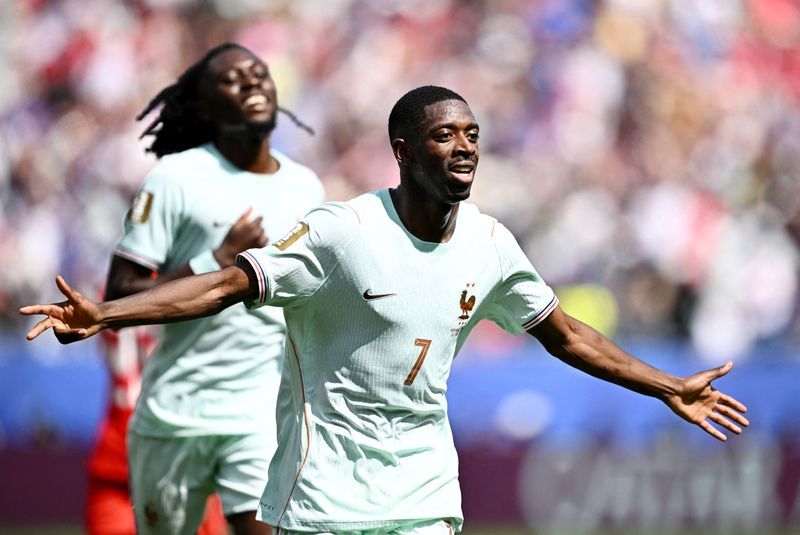
Ousmane Dembele produced a masterclass in clinical finishing as France dismantled a second-string Norway outfit 4-1 on Friday in Foxborough, Massachusetts, to claim top spot in World Cup Group I. The Paris Saint-Germain winger's three goals came in a devastating 25-minute spell during the opening half, demonstrating the gulf in class between two sides preparing for the knockout rounds in contrasting circumstances. The emphatic victory delivered a statement of intent from the defending runners-up and 2018 champions, who remain among the tournament favourites despite the personal absence of head coach Didier Deschamps, who had returned home to attend his mother's funeral.
The France squad had publicly committed to pursuing victory as a mark of respect to their absent coach, and they executed that pledge with absolute ruthlessness from kickoff. Kylian Mbappé nearly opened the scoring within 20 seconds, his angled effort rattling the crossbar as Norway goalkeeper Egil Selvik scrambled across his line. The early warning sign presaged what would become an onslaught, with France's attacking prowess completely overwhelming a depleted Norwegian defence.
Dembele broke through in the sixth minute when Mbappé delivered a superb cross-field pass that the winger converted with a flourish, cutting inside and outside his marker before firing past Selvik at an acute angle. The opening goal seemed to release something in the French attack, with patterns of play becoming crisper and more incisive as Norway struggled to establish any coherent defensive shape. By the 20th minute, Dembele had his second when Mbappé again provided the creative spark, with the striker finding space to curl a dipping effort beyond Selvik's reach.
Norway's response was momentary—Thelo Aasgaard pulled one back almost immediately—but any hope of a comeback evaporated when Dembele completed his hat-trick in the 32nd minute. His low finish into the bottom corner made him only the third France player to achieve the feat at a World Cup, joining Just Fontaine and Mbappé himself in an exclusive club. The timing was particularly historic: Dembele's treble came after just 27 minutes, making it the second-fastest hat-trick in World Cup history, behind only Erich Probst of Austria, who managed the feat in 24 minutes against Czechoslovakia in 1954.
Norway coach Stale Solbakken's decision to rest nearly all his starting eleven from the earlier encounter with Senegal—notably absent were Erling Haaland and captain Martin Odegaard—meant the Scandinavian nation faced an uphill battle from the outset. With qualification to the Round of 32 already assured, Solbakken's gamble prioritised rest and recovery over group seeding, a calculation that looked increasingly flawed as France's supremacy became apparent. The absence of Haaland, who remains in contention for the Golden Boot award alongside Mbappé, significantly weakened Norway's attacking threat and left them vulnerable to the rhythmic waves of French pressure.
Although France had also confirmed their passage before the match kicked off, they recognised that topping the group offered tangible advantages within the tournament's complex scheduling demands. The North American criss-crossing route map means that group winners and runners-up face materially different travel itineraries, making the pursuit of top spot a logical strategic priority rather than mere vanity. By securing first place, France positioned themselves for a theoretically favourable path through the knockout rounds, where fixture sequencing and fatigue management become increasingly crucial factors.
Norway mounted some sporadic resistance in the second period, with Jørgen Strand Larsen squandering a significant opportunity when his soft penalty was saved by France goalkeeper Mike Maignan. Winger Oscar Bobb subsequently forced another save from the French custodian as the Norwegians briefly exposed some gaps in the opposing back line, suggesting they possessed enough quality to trouble their opponents on another occasion. However, France's fourth goal through Désirée Daoué, who nodded home from a Bradley Barcola cross in the closing stages, essentially put the contest beyond any realistic doubt.
The final standings mean France will likely encounter Sweden in the Round of 32 knockout contest, having secured the superior seeding. Norway, by contrast, faces Ivory Coast as runners-up from Group I. These pairings represent notably different challenges: the Nordic nation faces a disciplined African side with a storied international pedigree, while France confronts a Swedish team with technical qualities and organised defensive structures. The victory margin may ultimately prove less significant than the manner in which France demonstrated their attacking potency and cohesion despite the internal distraction surrounding Deschamps' absence.
For Southeast Asian audiences following the tournament, this match exemplified how elite teams at World Cup level can calibrate their intensity based on preparation stage and priority objectives. France's performance showcased the precision required to convert dominance into decisive scorelines, a lesson relevant across football cultures globally. Meanwhile, Dembele's performance reminded observers that while Mbappé commands significant attention as a generational talent, French depth in attacking positions remains formidable—a factor that may prove decisive in knockout football where matches become more tightly contested and the margin between progression and elimination narrows considerably.

