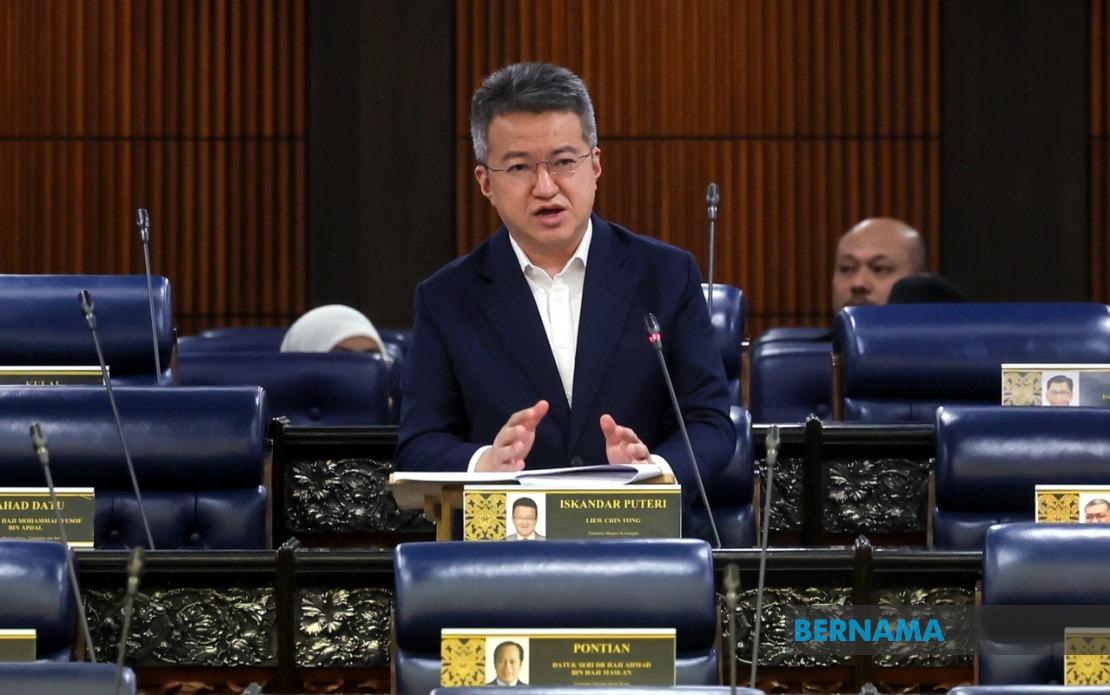
Deputy Finance Minister Liew Chin Tong has firmly rejected allegations that fugitive businessman Low Taek Jho—better known as Jho Low—slipped into Malaysia last year as part of a Chinese delegation to conduct confidential negotiations regarding the sprawling 1Malaysia Development Berhad scandal. During parliamentary Question Time, Liew offered a stark rebuttal to supplementary questions raised by MUDA Member of Parliament Syed Saddiq Syed Abdul Rahman, dismissing the claims without elaboration.
The controversy centres on media reports suggesting that Jho Low had participated in clandestine talks with Malaysian officials in the final months of last year to discuss a potential settlement framework for recovering funds siphoned from 1MDB. These allegations raise fresh questions about the government's coordination on one of the nation's most significant financial crimes, particularly given Jho Low's status as a fugitive and the sensitivity surrounding negotiations with Beijing. The reported involvement of a Chinese delegation adds another diplomatic layer to what was already an extraordinarily complex affair.
In responding to substantive parliamentary questions from Democratic Action Party legislator Chong Chieng Jen regarding 1MDB's outstanding liabilities and asset recovery strategies, Liew outlined the comprehensive legal architecture the government has constructed to pursue compensation. He emphasised that authorities continue to pursue both criminal and civil actions designed to recoup misappropriated wealth, with particular focus on individuals believed to orchestrate the fund's collapse.
A significant milestone in these efforts arrived on December 26, 2025, when the High Court convicted former Prime Minister Datuk Seri Najib Tun Razak on twenty-five charges encompassing money laundering and the abuse of executive authority to solicit bribes connected to 1MDB. The court imposed a prison sentence of fifteen years and levied a financial penalty totalling RM11.38 billion, representing one of Malaysia's most consequential judicial judgments in a white-collar crime case. Najib's conviction provides legal validation for the government's assertion that a systematic criminal conspiracy occurred at the apex of the previous administration.
Beyond Najib's prosecution, the government has also pursued Datin Seri Rosmah Mansor through civil litigation, seeking damages valued at approximately US$380 million, or roughly RM1.56 billion, to address allegations that 1MDB funds financed acquisitions of premium luxury items such as high-end handbags and jewellery. This civil action represents a distinct enforcement mechanism, allowing the state to recover assets without requiring the same evidentiary threshold as criminal prosecution. The pursuit of Rosmah's assets demonstrates the government's determination to hold individuals in Najib's inner circle accountable for their involvement in the financial misappropriation.
Regarding Jho Low himself—widely considered the mastermind orchestrating the 1MDB theft—the government has initiated parallel criminal and civil proceedings with dramatically elevated stakes. The civil claim against the fugitive businessman reaches US$3.78 billion, approximately RM15.4 billion, making it one of the largest civil recovery actions ever pursued by Malaysia against an individual. Despite Jho Low's successful evasion of apprehension and refuge in jurisdictions without extradition treaties with Kuala Lumpur, the legal machinery continues grinding forward, seeking to attach assets wherever they may be located globally.
The 1MDB scandal fundamentally restructured Malaysia's economic and political landscape, leaving destruction across multiple dimensions. Liew characterised the fallout across four distinct categories: direct financial losses representing funds that simply evaporated from state coffers; opportunity costs encompassing forgone development investments and economic growth that might have materialised had those resources remained available; irrecoverable losses reflecting assets that cannot be retrieved even through aggressive legal action; and perhaps most significantly, profound reputational damage to Malaysia's standing within the international community. This multifaceted harm extended far beyond simple accounting ledgers, affecting investor confidence, diplomatic relationships, and Malaysia's credibility as a stable financial hub.
The timing and substance of Liew's parliamentary response merit careful analysis. His terse denial, offered without elaboration or contextual discussion, contrasts sharply with the detailed exposition of recovery efforts provided in response to other questions. This circumspection may reflect diplomatic sensitivity surrounding any engagement between Malaysian authorities and representatives of the Chinese government, particularly if negotiations genuinely occurred. Malaysia maintains complex relationships with Beijing on matters ranging from trade to investment flows, and admitting to secret talks about 1MDB settlements could invite scrutiny regarding the terms being discussed and whether Malaysia negotiated from a position of strength.
For Malaysian observers, these developments underscore the institutional capacity of the judiciary and prosecution authorities to pursue cases of enormous complexity and international scope. The successful conviction of a former prime minister demonstrates that no individual remains insulated from accountability, a principle central to Malaysia's constitutional framework. However, the apparent difficulty in apprehending Jho Low highlights persistent challenges in coordinating international enforcement action against fugitives with sophisticated resources and networks spanning multiple continents.
The ongoing saga also illuminates how 1MDB continues casting shadows over Malaysian politics and governance years after its initial exposure. Each parliamentary inquiry, each court verdict, and each rumoured negotiation signals that the scandal's resolution remains incomplete. For Malaysian policymakers and citizens alike, the full accounting of what transpired, and how systemically embedded the corruption proved, remains an unfinished chapter in the nation's institutional history.
Moving forward, the government's demonstrated commitment to pursuing all available legal remedies—whether through conviction of prominent figures like Najib or through massive civil claims against masterminds like Jho Low—establishes a template for confronting large-scale financial crime. Nevertheless, the parallel track of reported diplomatic negotiations suggests that practical considerations of recovery, diplomatic relations, and the sheer logistical challenges of global asset tracing may ultimately necessitate settlements that satisfy neither justice nor complete financial restitution. This tension between legal accountability and pragmatic resolution continues defining how Malaysia processes its most infamous financial scandal.

