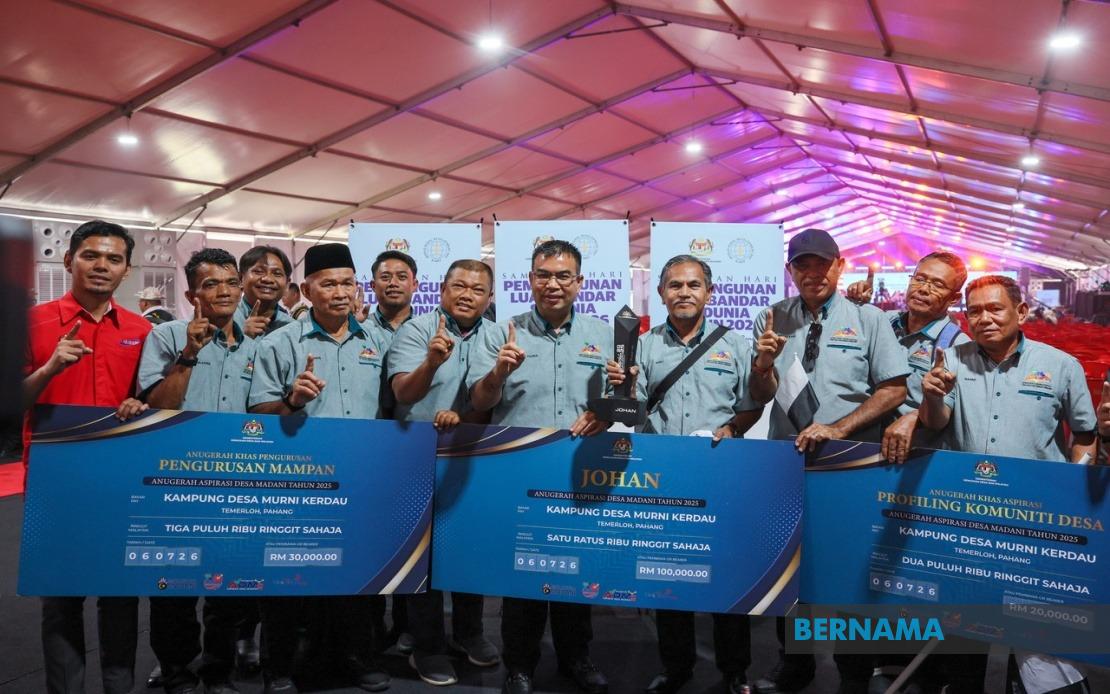
Desa Murni Kerdau, a traditional settlement located in Temerloh, Pahang, has emerged as a standout success story in rural development, claiming three major awards at the World Rural Development Day 2026 ceremony held at Tun Abdul Razak Stadium in Jengka Sentral. The accolades underscore a growing recognition across Malaysia's rural sector of communities that successfully blend traditional village structures with contemporary economic initiatives and sustainable practices. The triple honour positions this modest settlement as a benchmark for other rural communities across the country seeking to replicate sustainable development models.
The village received the 2025 MADANI Rural Aspiration Award Champion title, together with the Rural Community Profiling Aspiration Special Award and the Sustainable Management Special Award. The highest honour was handed over by Deputy Prime Minister Datuk Seri Dr Ahmad Zahid Hamidi, emphasizing the national significance attached to this recognition. The two additional accolades came from Datuk Rubiah Wang, Deputy Minister of Rural and Regional Development, signalling strong ministerial commitment to identifying and celebrating villages that exemplify the government's rural modernization agenda.
According to Mohamad Fazrul Ahmad, who chairs the Village Development and Security Committee of Desa Murni Kerdau, the achievements reflect the community's dedication to sound administrative practices, visionary local leadership, and inclusive approaches to improving residents' quality of life. In comments to the media following the ceremony, he emphasized that such external validation serves to motivate the village's continuing efforts in tackling the complex challenges facing rural Malaysia. The recognition carries particular weight as it comes from Malaysia's official development framework, lending credibility to the village's trajectory and methodologies.
The economic dimension of Desa Murni Kerdau's success cannot be overstated. The village has successfully nurtured approximately twenty entrepreneurs who operate across diverse sectors including small and medium-sized enterprises, agricultural ventures, and the automotive industry. This entrepreneurial ecosystem stands in marked contrast to the economic stagnation that characterizes many Malaysian villages, where young people frequently migrate to urban centres seeking employment. By creating homegrown business opportunities, Desa Murni Kerdau has managed to retain human capital while generating sustainable income streams for households.
Beyond enterprise development, the village has cultivated a distinctive tourism product through its "Kampung Stay" initiative, which has established itself as a recognized destination within Malaysia's rural tourism landscape. This accommodation concept allows visitors to experience authentic village life whilst contributing directly to local economic activity. The development demonstrates how communities can leverage their cultural heritage and traditional character as marketable commodities without compromising authenticity—a delicate balance that many rural tourism ventures struggle to achieve.
Desa Murni Kerdau's physical profile represents a well-maintained, organized settlement with approximately 200 residential units housing over 600 inhabitants. The scale and cohesion of the community creates conditions conducive to collective action and shared governance, distinguishing it from sprawling, fragmented rural settlements that often lack the social infrastructure necessary for coordinated development initiatives. The village's traditional character remains intact while absorbing modern administrative and economic frameworks, suggesting that preservation of rural identity need not preclude progress.
The financial rewards accompanying these awards will be deployed strategically to benefit the broader community rather than concentrated among leadership figures. Mohamad Fazrul indicated that prize money would be distributed among residents and earmarked for infrastructure improvements and community development schemes. This distributional approach reinforces the democratic ethos underlying the village's development philosophy and provides tangible benefits that will further strengthen community cohesion and support for ongoing initiatives.
For Malaysian policymakers and rural development professionals, Desa Murni Kerdau offers instructive lessons about scaling effective governance models. The village demonstrates that strong local leadership, coupled with organized community structures and strategic economic diversification, can generate meaningful improvements in rural livelihoods without requiring massive external capital infusions. The achievement becomes particularly significant when contextualized against Malaysia's broader rural development challenges, including aging populations, limited job opportunities, and the persistent rural-urban divide that continues to shape the country's demographic and economic landscape.
The awards also reflect evolving conceptualizations of rural development within government circles. The inclusion of categories recognizing community profiling and sustainable management indicates ministerial recognition that contemporary rural advancement extends beyond infrastructure provision to encompass environmental stewardship, social organization, and long-term ecological responsibility. This holistic approach aligns with global sustainable development frameworks whilst remaining grounded in Malaysian rural realities.
Looking ahead, Desa Murni Kerdau's recognition may catalyse increased attention from other villages seeking to replicate its success. Government agencies and development organizations may view the model as replicable, potentially leading to knowledge transfer initiatives and peer-learning networks across Pahang and neighbouring states. The village's achievement thus carries implications extending well beyond its boundaries, potentially influencing rural development trajectories across the region and contributing to Malaysia's efforts in addressing rural stagnation through community-driven rather than purely top-down interventions.

