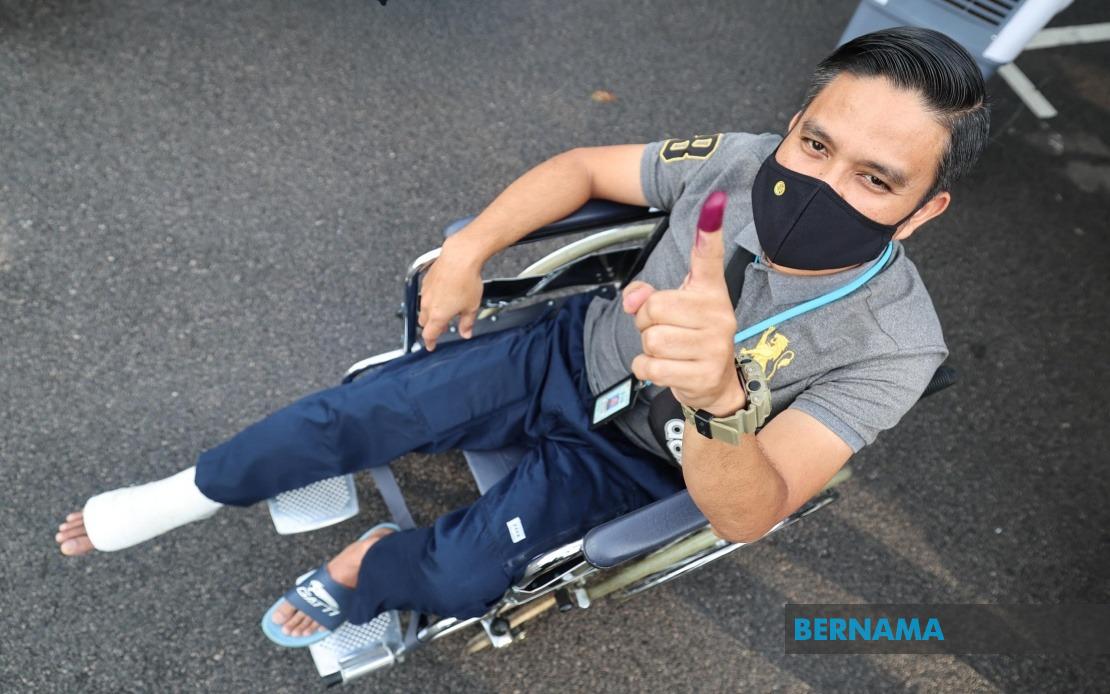
Sergeant Syahrizal Musa refused to let physical injury prevent him from fulfilling what he regards as a fundamental civic responsibility. The 40-year-old police officer, currently recovering from a torn Achilles tendon sustained during a sepak takraw match the previous week, made the journey to the early voting centre at Johor Police Contingent Headquarters on July 7 to cast his ballot in the 16th Johor state election. Despite being confined to a wheelchair and placed on medical leave until mid-July, Syahrizal demonstrated the kind of civic participation that election officials and democratic advocates consistently urge citizens to emulate.
The injury, confirmed by medical professionals as a minor tear, emerged from Syahrizal's passion for sepak takraw, a traditional Southeast Asian sport he has pursued actively since childhood. His involvement with the sport extended beyond personal recreation; he has represented the police contingent in multiple tournaments, showcasing the calibre of athleticism within Malaysia's law enforcement community. The incident occurred during a casual match, yet rather than viewing his subsequent mobility challenges as justification for electoral abstention, Syahrizal instead approached the voting centre with characteristic resolve, travelling from the police quarters in Tampoi with support from a colleague.
This decision carried particular weight given Syahrizal's extensive record of electoral participation. Throughout his 22-year tenure with the Royal Malaysia Police, spanning assignments at Muar IPD before his 2014 transfer to Johor IPK, he has maintained an unblemished record of voting in every election. His department placement within the Internal Security and Public Order Division underscores his professional commitment to maintaining Malaysia's democratic institutions and public welfare. The fact that July 7 marked his inaugural voting experience while using a wheelchair demonstrates not merely stubborn determination but a philosophical conviction about citizenship obligations that transcends temporary physical constraints.
The early voting arrangements themselves reflect Malaysia's institutional recognition that certain population segments require alternative voting mechanisms. A total of 64 polling centres operated on the day designated for advance voting, accommodating 24,751 individuals unable to vote during the standard election schedule. The cohort comprised military personnel and their families—12,041 from the Malaysian Armed Forces—alongside 12,710 members of the Royal Malaysia Police and General Operations Force with their respective spouses. These provisions acknowledge the irregular schedules maintaining national security and public order that necessitate alternative voting access for uniformed services.
The 16th Johor state election itself represented a significant democratic exercise for the peninsula's southernmost state. A total of 172 candidates competed for representation across 56 state assembly seats, with approximately 2.7 million ordinary voters scheduled to participate during the main polling day on Saturday. The magnitude of this electoral engagement highlights why individual decisions like Syahrizal's possess broader cultural significance beyond personal choice. When public servants—particularly those in security roles entrusted with upholding constitutional order—prioritise participation despite adversity, they communicate an implicit endorsement of democratic processes to the broader population.
Syahrizal's narrative also illuminates the intersection of sporting culture and democratic participation within Malaysia's institutional frameworks. Sepak takraw, deeply rooted in Malaysian and broader Southeast Asian heritage, represents a vehicle for community engagement and physical development across all socioeconomic strata. When practitioners of such traditional sports subsequently engage in formal democratic processes, they embody the integration of cultural continuity with modern civic responsibilities. Syahrizal's transition from the sepak takraw court to the voting centre, mediated by temporary disability, symbolises this continuity.
The sergeant's public articulation of his voting motivation carries pedagogical value for electoral engagement discourse. When interviewed at the polling centre, Syahrizal explicitly rejected the notion that his Achilles tendon injury constituted valid reason for electoral abstention, framing voting as an irrevocable personal responsibility transcending circumstantial obstacles. This perspective challenges the widespread tendency among some segments of the electorate to cite minor inconveniences as justification for non-participation. His emphasis on voting as a mechanism for shaping state and national futures reflects sophisticated understanding of how individual electoral choices aggregate into collective governance outcomes.
The institutional accommodation Syahrizal received—accessible facilities at the police headquarters voting centre capable of accommodating wheelchair users—demonstrates Malaysia's ongoing efforts toward inclusive democratic infrastructure. While challenges remain regarding accessibility provisions at certain polling locations nationwide, the availability of appropriate facilities at security force voting centres suggests that deliberate institutional planning can facilitate participation among voters with mobility constraints. Syahrizal's example implicitly challenges other constituencies and voting locations to examine whether comparable accessibility measures are universally available.
Within Johor specifically, where competitive electoral dynamics have intensified over successive state elections, Syahrizal's participation exemplified the seriousness with which security personnel approach their voting privileges. Police and military voters, whose professional obligations occasionally restrict participation, represent a constituency whose engagement levels merit particular attention. High turnout among uniformed services typically correlates with broader population participation rates, suggesting that when these groups prioritise voting despite logistical challenges, they establish normative expectations encouraging civilian participation as well.
The timing of Syahrizal's injury—occurring during recreational activity rather than operational duty—underscores the everyday risks within Malaysia's working population that can temporarily impede conventional civic engagement. His response illustrates how determination to participate can overcome such obstacles when voting is genuinely prioritised. For Malaysian voters contemplating potential barriers to participation, whether physical, logistical, or circumstantial, Syahrizal's example provides compelling counterargument: minimal inconveniences pale against the significance of electoral participation within democratic systems.
As the Johor election proceeded toward its Saturday polling day, stories like Syahrizal's functioned within the broader electoral narrative, reminding participants of the democratic principles transcending partisan competition. While candidates and parties pursued their respective campaigns, individual voters like the injured police sergeant quietly reinforced through their participation the notion that democracy ultimately depends upon the collective determination of citizens to engage, regardless of temporary impediments or competing demands.

