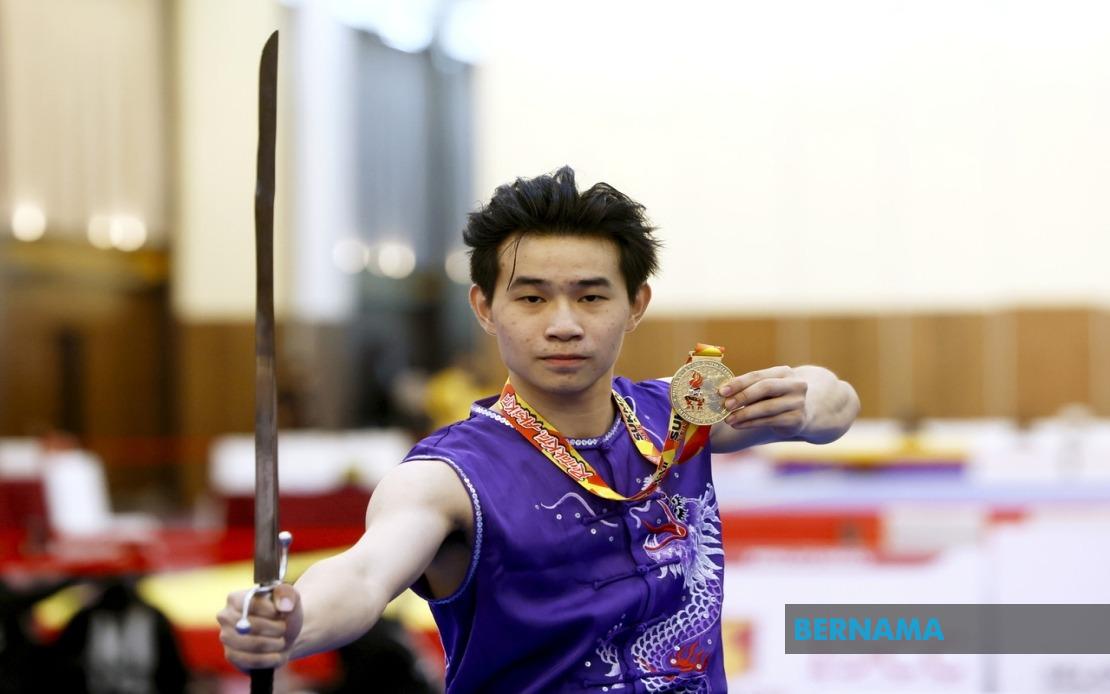
Wee Din Jun's wushu journey reached its pinnacle at the Ideal Convention Centre in Shah Alam when the 21-year-old Penang athlete captured gold in the men's nandao nangun event, delivering a poignant end to his Malaysia Games career. The achievement carried particular weight given the adversity he had overcome in the months preceding the competition—a hip injury sustained merely four weeks before SUKMA 2026 could have derailed his preparations entirely, yet the young athlete persevered through rehabilitation and training adjustments to produce a winning performance when it mattered most.
Din Jun's technical execution proved decisive on the day, accumulating 9.600 points to edge out Sarawak's John Phang, whose silver-medal effort garnered 9.563 points. Selangor's Tan Yu Zhe completed the podium with 9.550 points in a closely contested field that reflected the high calibre of wushu talent across Malaysia's regional delegations. The narrow margins separating the medalists underscored the precision and consistency demanded by traditional wushu competition, where judges assess movement fluidity, technical accuracy, and athletic expression with exacting standards.
For Din Jun, however, this gold medal represented far more than a single competition victory. His SUKMA trajectory had been marked by inconsistency and frustration during his previous two appearances at the Games. At SUKMA 2022 in Kuala Lumpur, he had managed only bronze, a respectable but modest result that suggested untapped potential. His sophomore Games experience at SUKMA 2024 in Sarawak proved devastating by comparison—navigating three events, he struggled with execution errors that prevented him from reaching any podium, returning to Penang empty-handed and questioning his competitive mettle.
The psychological dimension of redemption loomed large in Din Jun's mindset entering SUKMA 2026. The disappointment of 2024 had lingered, creating internal pressure to vindicate his abilities and demonstrate that his bronze from 2022 had not been a career peak. In interviews following his victory, Din Jun revealed the mental toll of his previous campaign, describing his second Games appearance as profoundly disappointing and acknowledging how the cascade of mistakes had shaken his confidence. That vulnerability made his subsequent triumph all the more significant, suggesting not merely technical improvement but also psychological resilience and emotional maturation.
The athlete credited his coaching team with facilitating his turnaround, recounting how his mentor had advised him to embrace calmness and genuine enjoyment of his performance rather than succumbing to competitive anxiety. This coaching philosophy—emphasising process over outcome and present-moment focus rather than result obsession—aligned with contemporary sports psychology principles that emphasise intrinsic motivation and flow states. Din Jun's conscious effort to silence extraneous thoughts and concentrate exclusively on executing his routine to maximum capacity proved the determining factor between his 2024 failure and 2026 success.
The Bayan Lepas native had harboured longstanding aspirations toward claiming a SUKMA gold medal, viewing it as essential validation of his wushu credentials. At 21 years old, Din Jun possessed the technical foundation and experience to contend for Malaysia's highest regional sporting honours, yet earlier campaigns had failed to translate his training into championship outcomes. This gold medal in the nandao nangun event represented the fulfilment of that ambition, a moment he could point to as evidence that his dedication and talent had finally coalesced into tangible achievement at Malaysia's premier multi-sport festival.
Din Jun extended his dedication of the gold medal to his former coach, who had since relocated to China, unable to witness his student's earlier SUKMA campaigns and receive the accolade in person. This gesture reflected the deep mentoring relationships that characterise elite Malaysian sport, where personal bonds between coach and athlete transcend competitive cycles. Though geographically separated, the former coach's influence remained apparent in Din Jun's mental framework and technical approach, a testament to the lasting imprint of quality coaching on athlete development.
Looking ahead to the immediate future, Din Jun's focus shifted toward maximising his final SUKMA appearance by competing in the nanquan event scheduled for the following day. This additional opportunity represented a chance to extend his medal haul and conclude his Games career with multiple podium finishes rather than a single gold medal. The nanquan competition would provide his ultimate opportunity to establish himself as a versatile and accomplished wushu competitor within the SUKMA framework, potentially securing a legacy as an athlete who transcended early disappointments to establish himself among Malaysia's regional wushu elite.
Din Jun's redemption arc holds broader significance for Malaysian sport beyond his individual achievements. His narrative illustrates how athletes can extract valuable lessons from failure and transform setbacks into motivational catalysts for improvement. The 2024 SUKMA disappointment, while painful in its immediacy, ultimately provided the contrast that made his 2026 success meaningful and memorable. His willingness to process his emotional response to previous underperformance and translate that processing into focused preparation offered an implicit lesson to other Malaysian competitors about resilience and the non-linear nature of athletic development.
The competitive landscape of Malaysian wushu continues evolving, with athletes across multiple states demonstrating increasingly sophisticated technical capabilities and serious commitment to the discipline. Din Jun's gold medal performance positioned him among the most successful contemporary Malaysian wushu competitors at the SUKMA level, though his final Games appearance meant his contributions to the sport would henceforth shift from competition to mentoring and contribution beyond the performance arena. His journey from bronze medalist to failed competitor to gold champion encapsulated the volatile nature of individual sport competition, where marginal improvements in mental processing and technical refinement can generate substantial changes in competitive outcome.

