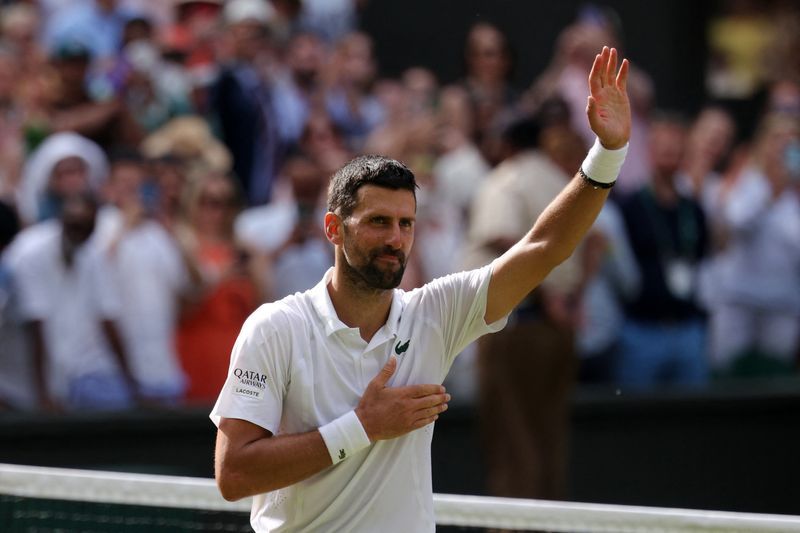
The quarter-finals of Wimbledon will see two compelling narratives unfold on Tuesday as Novak Djokovic pursues an unprecedented 25th Grand Slam championship while Naomi Osaka, remarkably restored to championship form, attempts to reclaim her place among tennis's elite. At 39 years old, Djokovic has already etched his name into the All England Club's history books with 106 victories across his career, surpassing any other player's record at the venue. Yet the Serbian champion remains acutely aware that every subsequent match represents uncharted territory for a man whose longevity at the sport's highest level defies conventional sporting logic. His path to the quarter-finals has proven unexpectedly gruelling, with consecutive four-set encounters forcing the veteran into extended battles that have consumed both time and energy on grass courts where efficiency typically reigns supreme.
Djokovic's round-of-16 victory over Roman Safiullin lasted three-and-a-half hours, a grinding affair that exposed moments of vulnerability rarely seen from the defending champion. Rather than viewing these struggles as warning signals, the 39-year-old has reframed them as part of the championship mentality required to succeed at tennis's highest echelons. In his post-match assessment, Djokovic acknowledged that winning without aesthetic brilliance remains an essential skill, describing his ability to find routes to victory even when performances lack lustre. This philosophical approach may prove invaluable against third-seeded Canadian Felix Auger-Aliassime, a 25-year-old player who stands at a critical juncture in his own career development. The Canadian split their two matches in 2022, demonstrating sufficient quality to trouble the world's greatest practitioners. Auger-Aliassime's youth and improving grasscourt credentials present a genuine examination of Djokovic's capacity to sustain excellence, particularly given the accumulating physical demands of extended matches on a surface that rewards both power and precision.
The Canadian has spoken reverently about the opportunity to contest such a fixture, recognising that his opponent's body of work over nearly two decades represents an almost incomprehensible achievement. For emerging players like Auger-Aliassime, the psychological dimension of facing Djokovic extends beyond tactical considerations to encompass a deeper appreciation of the sacrifices and consistency required to establish lasting legacies within professional tennis. His comments reflect the generational gap between those who grew up admiring Djokovic's dominance and those competing directly against him at the sport's highest level. Should Auger-Aliassime prevail, he would announce himself as a force capable of challenging entrenched hierarchies. Conversely, a Djokovic victory would represent another stride toward an implausible 25th major, though the energy expenditure in accumulating victories through extended contests raises questions about his recovery capacity for subsequent rounds.
On the women's side, Naomi Osaka's quarter-final pairing against Czech 10th seed Karolina Muchova represents something approaching a redemptive narrative within professional women's tennis. The Japanese 14th seed produced a display of commanding tennis to eliminate world number one Aryna Sabalenka in the round of 16, a performance suffused with the dominance characteristic of her earlier major-winning campaigns. Osaka's elimination of Sabalenka acquired particular significance because the Australian Open champion had defeated the Japanese star in three straight meetings earlier this year, establishing an apparent psychological edge that Osaka methodically dismantled through superior serve velocity and aggressive forehands that neutralised Sabalenka's own attacking arsenal. For Osaka, now 28 years old and seeking her first Grand Slam title since 2021, this resurgence follows extended periods navigating personal challenges and competitive uncertainty that threatened her standing within elite tennis circles.
The manner of Osaka's breakthrough at Wimbledon, where she has reached the quarter-finals for the first time in her career, suggests a genuine rekindling of the capabilities that secured four major championships during her peak years. Her self-described approach of treating her contest with Sabalenka as an extended practice match—albeit one contested before enormous crowds—reveals a psychological flexibility and reduced pressure that may prove liberating as she advances through the draw. Muchova, conversely, arrives at the quarter-finals seeking to transcend a structural limitation that has constrained her Wimbledon experience; the Czech champion has reached the last eight on three previous occasions without progressing further. However, Muchova benefited from competing in two preparatory tournaments before arriving at Wimbledon, a decision that permitted her to accumulate grasscourt matches and refine her technique on the surface where Osaka now demonstrates formidable authority.
Muchova's victory over fellow Czech and former Wimbledon champion Barbora Krejcikova underscores her capacity to elevate her performance against distinguished opposition. The pair have contested six matches, with each player claiming three victories, though Muchova holds the edge on grasscourts following her Bad Homburg Open success. This head-to-head balance suggests an encounter unlikely to be determined by overwhelming dominance, instead requiring sustained execution and tactical adaptation. For Malaysian and Southeast Asian observers, Osaka's resurgence carries particular resonance given the region's passionate engagement with tennis and Osaka's prior visibility across Asian markets. Her potential progression toward major titles would elevate the profile of women's professional tennis throughout Southeast Asia and inspire younger players throughout the region to pursue elite careers within the sport.
In parallel developments, defending champion Jannik Sinner faces German first-time Grand Slam quarter-finalist Jan-Lennard Struff, a fixture that pits Sinner's youth and ascending dominance against Struff's remarkable breakthrough. The 36-year-old German reached the quarter-finals for the first time in the Open Era following Hubert Hurkacz's retirement during their previous round encounter, an achievement that transcends typical sporting accomplishment by representing the culmination of sustained professional persistence across decades. Struff's emergence as a Grand Slam quarter-finalist at an age when many players have long since retired speaks to the evolving nature of professional tennis and the capacity for individuals with adequate technique and determination to achieve significant success. Sinner, by contrast, represents the vanguard of emerging generations, a four-time major champion whose steady accumulation of titles marks a transition toward his establishment as the sport's central figure.
Sinner's philosophical approach to successive encounters, emphasising that past results possess limited predictive value, reflects a pragmatic mindset suited to championship tennis. The Italian champion has defeated Struff consistently, but the German's presence in a Grand Slam quarter-final for the first time generates intangible factors—momentum, confidence, crowd support—that transcend historical head-to-head records. For Sinner, who remains focused on the mechanical and tactical adjustments required to navigate elite opposition rather than relying upon past patterns, this quarter-final represents another opportunity to reinforce his trajectory toward sustained dominance. The pressure differential between the two players, with Sinner bearing the defending champion's burden and Struff operating without considerable expectations, creates a tension that may produce unexpected outcomes despite the Italian's superior ranking and Grand Slam record.
The quarter-final schedule also features American pairing Jessica Pegula and Coco Gauff, continuing the dominance of American players at this year's championships. Pegula, seeded fourth, faces seventh-seeded Gauff in what represents an intra-national contest between two players at different career stages. The presence of multiple quarter-final matches featuring American participants underscores the continued strength and depth of American professional tennis, particularly within women's competition. For regional observers, these various narratives combine to create a compelling quarter-final slate that reflects the sport's evolving competitive landscape, with established champions like Djokovic pursuing unprecedented milestones, emerging talents like Sinner consolidating recent achievements, and redemptive figures like Osaka pursuing restoration to championship prominence. The outcomes of these contests will significantly shape the tournament's trajectory toward its conclusion and establish important precedents for subsequent major championships throughout the season.
As Wimbledon's quarter-finals commence, the competition reflects the fundamental tension within professional tennis between sustaining excellence across extended careers and the emergence of new forces capable of challenging established hierarchies. Djokovic's pursuit of a 25th major, Osaka's resurgence, Sinner's consolidation of dominance, and Struff's improbable breakthrough all inhabit this space, creating a tournament that encompasses multiple compelling dimensions beyond the technical brilliance of individual performances. The matches scheduled for Tuesday will determine which narratives advance toward the semi-finals and ultimately toward championships that will define this year's grand slam season.

