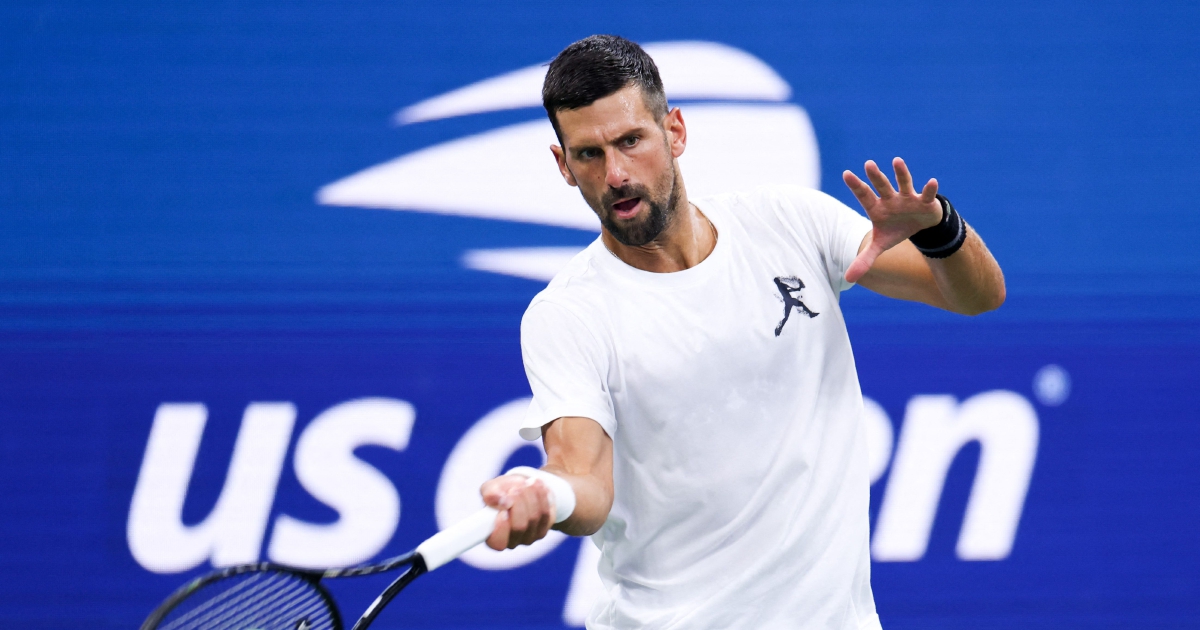
Novak Djokovic arrives at the US Open with singular focus: securing a 25th Grand Slam title that would elevate him beyond Margaret Court's 24-title benchmark and into unprecedented territory in tennis history. Since the Serbian champion claimed his last US Open crown in 2023, his quest for record-breaking success has intensified, transforming what might otherwise be a year of consolidation into a relentless pursuit of immortality on the sport's grandest stage.
The significance of this particular milestone cannot be overstated in the context of modern tennis. Djokovic's achievement in matching Court's record through 2023 represented a remarkable feat that seemed improbable just a decade earlier. Now, with the opportunity to surpass her standing at Flushing Meadows—the very venue where he claimed his 24th title—Djokovic enters the tournament with the mental fortitude that has defined his three-decade career. His preparation reflects not merely physical conditioning but a psychological readiness that suggests he remains as formidable a competitor as he has ever been.
For Malaysian and Southeast Asian tennis enthusiasts, Djokovic's pursuit carries particular resonance. The region has produced exceptional players who have watched the Serbian's dominance with a mixture of admiration and aspiration. His relentless drive to achieve new personal bests serves as an inspiration for emerging athletes across the region who dream of competing at the highest echelons of professional tennis. The exemplification of longevity and continuous improvement that Djokovic represents challenges conventional notions about athletic decline with age.
The dynamics of this US Open tournament differ markedly from previous years. The competitive landscape has shifted, with younger players demonstrating increasing capacity to challenge established champions. Yet Djokovic's record at Flushing Meadows suggests he possesses particular expertise on hard courts and within this specific venue's demands. His knowledge of the tournament's unique characteristics, combined with accumulated experience across multiple generations of competitors, provides advantages that transcend raw physical capability.
Djokovic's journey since claiming his 24th title reflects the extraordinary determination required to maintain championship-level performance across an extended career. Most athletes would view matching Court's 24 Grand Slams as a satisfactory legacy, a culmination worthy of retirement and reflection. Instead, Djokovic has structured his entire approach around pursuing that elusive 25th title, viewing it not as an endpoint but as a necessary threshold in his personal historical narrative.
The preparation methodology employed by the Serbian champion demonstrates evolution in how elite athletes approach their training and competition schedules. Rather than pursuing quantity of tournaments, Djokovic has become increasingly selective, concentrating his energies on events where victory appears most achievable. This strategic approach reflects maturity in competitive planning and recognition of resource allocation at the highest professional level. The US Open represents precisely the type of objective where such focused preparation yields maximum potential returns.
For the broader tennis community and Malaysian audiences following the sport, Djokovic's potential success carries implications beyond mere statistical accumulation. A 25th Grand Slam would cement a particular era of tennis in the collective memory, defined by the triumvirate of Djokovic, Rafael Nadal, and Roger Federer. Each player pushed the other toward unprecedented achievements, creating a competitive environment that elevated the entire sport. Djokovic's continued success represents the final chapter of this transformative period in tennis history.
The psychological dimension of pursuing a record previously held by an athlete from a different generation speaks to broader questions about athletic evolution and human performance potential. Djokovic's challenge to Court's record occurs within a fundamentally different competitive and technological context, yet the achievement carries undiminshed significance. Whether he succeeds or falls short, the attempt itself demonstrates commitment to excellence that transcends conventional career trajectories.
As the US Open approaches, Djokovic's preparation encompasses not merely physical readiness but mental clarity about the historical stakes. He carries into the tournament the weight of expectation—both internal and external—that accompanies someone on the verge of rewriting sport's record books. How he manages this psychological burden while maintaining the competitive sharpness necessary to defeat elite opponents will ultimately determine whether this US Open becomes the transformative moment in his legacy that he clearly envisions.

