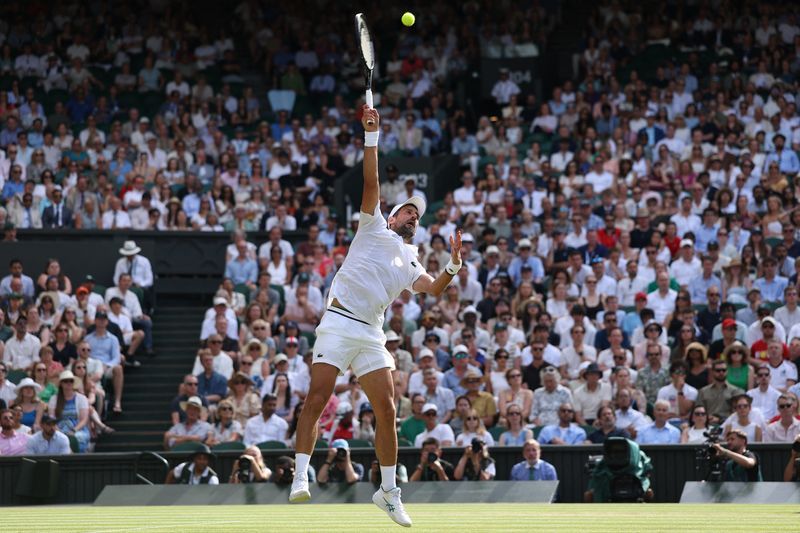
Novak Djokovic has etched another indelible mark on his Wimbledon history, vanquishing Russian qualifier Roman Safiullin in a grueling encounter on Centre Court to achieve his 106th victory at the All England Club. The victory—secured through a scoreline of 7-6(6), 6-3, 3-6, 6-3—catapulted the seventh-seeded Serbian past his legendary Swiss rival Roger Federer on the all-time list of match victories at tennis's most prestigious grass-court championship. At 39 years old, Djokovic continues to rewrite the longevity narrative in professional tennis, defying conventional expectations about athletic decline at an advanced age.
The significance of this milestone extends beyond mere statistics. Djokovic now stands within striking distance of matching Federer's eight Wimbledon titles—a benchmark that has long symbolized dominance at this particular Grand Slam. Should he claim the championship this fortnight, he would simultaneously be chasing a 25th major trophy overall, further consolidating his position as arguably the greatest player to have ever graced the sport. For Malaysian and Southeast Asian tennis enthusiasts who have watched this rivalry unfold across two decades, witnessing Djokovic systematically dismantle the various records associated with his predecessors represents a shifting of tennis's historical record books.
This particular match against Safiullin proved far from the commanding display one might expect from a player of Djokovic's stature. The world number 132, returning from months of injury layoff affecting his hip, arrived determined to capitalize on any openings. Djokovic himself struggled with consistency from the baseline throughout stretches of the match, committing uncharacteristic errors that included two service breaks and forcing him into dangerous territory. At one critical juncture in the opening set, trailing 2-5, the Serbian faced two set points before mounting a dramatic recovery to clinch the tiebreak 8-6.
Despite commanding experience and technical mastery, Djokovic found himself genuinely unsettled by his opponent's aggressive baseline game. The wind conditions blowing across the London courts added another complicating factor, forcing Djokovic to acknowledge candidly that he experienced rare discomfort rallying from the back of the court. Rather than pursuing extended baseline exchanges where Safiullin appeared competitive, Djokovic pivoted toward serve-and-volley patterns and aggressive serve placement—tactical adjustments that eventually proved decisive. This strategic flexibility, honed across countless matches at the highest level, highlights why age remains less consequential for Djokovic than it might for contemporaries lacking such technical diversity.
The second set represented Djokovic's platform for reassertion. Once Safiullin's resistance cracked at 2-4 when his backhand drove into the net, the seasoned champion accelerated decisively, deploying the refined racquet skills that have defined his dominance. However, Safiullin demonstrated admirable resilience by claiming the third set after breaking serve, extending his improbable run and suggesting the upset remained within reach. For Djokovic, this represented a reminder that even at his elevated skill level, concentration lapses and erratic execution could jeopardize advancement.
Djokovic's reflection on his performance carried telling candor. He acknowledged that maintaining baseline rallies had worked against his interests, a striking admission for a player whose defensive prowess once seemed almost supernatural. The emphasis shifted instead toward first-serve accuracy and court positioning that enabled him to conclude points more expeditiously. In the fourth set, following an initial tight service hold, Djokovic elevated his intensity measurably, demonstrating the championship-caliber intensity required to navigate tricky circumstances. The decisive break arrived through superior execution rather than opponent collapse—Djokovic simply executed when pressure mounted most acutely.
The path forward brings either Felix Auger-Aliassime, the third seed, or Spain's Alejandro Davidovich Fokina in the quarter-final round. Djokovic's comment that he had "survived to thrive" encapsulates his philosophical approach to progression through tournament brackets. Having dropped sets in three of his first four matches, he acknowledged that the early phase of this championship exhibited inconsistency—yet crucially, inconsistency coupled with the mental and tactical resources necessary to rectify it mid-match. This capacity to self-correct represents perhaps his most underrated competitive attribute.
For regional tennis observers, Djokovic's continued presence at the sport's highest competitive level offers fascinating perspective on athletic longevity and adaptation. Unlike some contemporaries who retired when physical decline became apparent, Djokovic has instead evolved his game, embracing tactical variety and accepting that baseline dominance might require supplementation through net play and serve placement. This evolution keeps him viable at tournaments demanding sustained excellence across multiple matches against increasingly specialized opponents.
The statistical accumulation of 106 Wimbledon match victories, while impressive numerically, gains deeper meaning when contextualized within professional tennis's broader competitive landscape. Djokovic has essentially maintained elite performance at this particular venue across multiple decades, navigating rule changes, surface evolution, racquet technology advancement, and generational shifts in playing styles. The consistency required to achieve such longevity transcends mere physical capability, demanding psychological resilience and competitive hunger that refuse conventional retirement timelines.
Djokovic's pursuit of an eighth Wimbledon crown represents the tournament's central narrative as the fortnight progresses. Each match victory brings him closer to equaling Federer's championship haul at this venue—a symmetry that seems almost predetermined by the tennis gods. Meanwhile, the 25th Grand Slam trophy remains within reach, though narrowing opportunities at his age suggest each major championship matters increasingly toward his legacy. The combination of both targets drives Djokovic forward with intensity that belies his age.
Looking ahead, Djokovic must maintain the elevated performance demonstrated in the crucial final set against Safiullin. The quarter-final stage traditionally separates serious championship contenders from pretenders, and his potential opponent—whether Auger-Aliassime's powerful serve or Davidovich Fokina's baseline versatility—presents distinct tactical challenges. Djokovic's victory over Safiullin, hard-fought and imperfect though it was, suggests sufficient reserve capability remains. The real measure comes when facing opponents matching his technical sophistication and competitive intensity.

