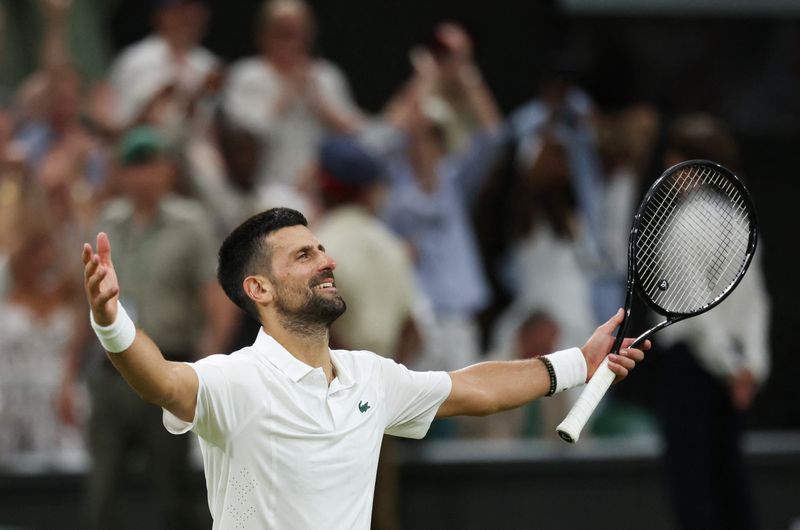
Novak Djokovic has secured a place in the Wimbledon semi-finals for the eighth consecutive year, grinding through a monumental test against Canadian Felix Auger-Aliassime with a 7-6(10) 3-6 6-3 6-7(4) 7-6(10-4) victory in a quarter-final marathon that stretched to five hours and 15 minutes. The contest, played on Tuesday at the All England Club, stands as the longest quarter-final in Wimbledon history, underscoring the relentless competitiveness that defined the clash between two determined competitors. The 39-year-old Serbian champion now awaits reigning champion Jannik Sinner in what promises to be another heavyweight encounter as the tournament moves toward its climax.
Djokovic's achievement carries profound historical significance for the sport. In reaching the semi-finals for an eighth straight year, he has become the first man in tennis history to accomplish this feat, surpassing the previous standard set by Roger Federer. This milestone accompanies his 106th match victory at the All England Club, which he secured in the previous round, also eclipsing Federer's record for most match wins at this particular venue. At nearly 40 years of age, Djokovic continues to defy expectations about athletic longevity, particularly on grass where movement and explosive power typically favour younger players.
The quarter-final itself was a study in contrasts and resilience. Auger-Aliassime, the Canadian world number 21, proved to be a formidable adversary who refused to yield despite numerous opportunities for Djokovic to close out the match decisively. The opening set descended into a marathon tiebreak that lasted 10 points, with Djokovic ultimately prevailing when his opponent's volley sailed long. The momentum shifted dramatically in the second set, where a double fault from Djokovic handed Auger-Aliassime a crucial break at 5-3, allowing the Canadian to draw level in the match and force a decider later that evening.
The match took an unexpected turn when the Centre Court roof closed at approximately 7.40 p.m. local time due to weather conditions. This development prompted vocal complaints from Djokovic, who has always been particular about playing conditions and their impact on his performance. Rather than allowing frustration to derail his concentration, however, the Serbian champion regrouped mentally and executed with greater precision once play resumed under the closed roof. The third set saw Djokovic find his rhythm, breaking Auger-Aliassime's serve in the sixth game and tightening his control of the match through improved shot-making and court positioning.
Auger-Aliassime's character shone through despite the mounting pressure and fatigue. After losing his opening service game in the fourth set, he briefly lost composure, striking his chair with his racket in frustration—a rare lapse that illustrated the emotional toll of such extended competition. Yet the Canadian refused to capitulate, recovering to force the match into a deciding fifth set via a tiebreak victory. For 12 games of the final set, neither player could break through the other's service, creating a tense stalemate that only resolved when Djokovic's experience and composure in the match tiebreak proved decisive.
Djokovic's reflection on the victory emphasised the psychological and physical demands inherent in such contests. He described winning "with a racket and a lot of heart," highlighting that the match was decided not merely by technical superiority but by nerve management and emotional resilience. He acknowledged the "extreme tension" and competitive balance throughout, noting that the contest remained genuinely competitive at every stage. The Serbian champion also revealed the human side of his competition, mentioning that he had instructed his children to sleep after the fourth set—a fatherly instinct that gave way when they refused to retire, insisting on witnessing the conclusion of what would become one of his most memorable Wimbledon battles.
The path forward places Djokovic in pursuit of ambitious milestones that would cement his legacy among tennis's greatest champions. An eighth Wimbledon title would equal Federer's record at the venue, while a 25th Grand Slam trophy overall would surpass Margaret Court's long-standing record of 24 major championships. These objectives, however, remain secondary in Djokovic's immediate focus. He has adopted a pragmatic stance toward the remaining tournament, emphasising the immediate priority of physical recovery and preparation rather than looking ahead to final outcomes. This measured approach reflects the wisdom of an athlete who understands that consecutive tournament demands exact a toll, particularly for someone in their fourth decade.
The upcoming semi-final against Sinner represents a fascinating narrative within professional tennis. Sinner, the current world number one and defending champion, represents the new generation of players who have grown up in the post-Djokovic era of dominance. Their rivalry is still developing, with each encounter carrying weight and potential historical consequence. Djokovic's description of Sinner as "the best player in the world" acknowledges the legitimacy of his opponent while simultaneously framing the semi-final as an opportunity to test himself against elite contemporary competition rather than a desperate gambit for legacy.
For Malaysian and Southeast Asian tennis enthusiasts, Djokovic's continued success at Wimbledon offers valuable perspective on athletic excellence across age brackets. His performance challenges prevailing assumptions about peak performance windows in professional sports, suggesting that experience, mental fortitude, and rigorous conditioning can enable competition at the highest levels well into what conventional wisdom would classify as the twilight of a career. The five-hour epic against Auger-Aliassime demonstrated that tennis at its finest remains as much about tactical awareness and emotional control as physical prowess.
The quarter-final also highlighted the emerging quality of players like Auger-Aliassime, who despite falling short, demonstrated the capability to compete evenly with one of the sport's greatest champions. This development suggests that the transition from Djokovic's era will involve genuine competition from multiple players rather than domination by a single successor. The Canadian's refusal to collapse mentally or physically over five sets, despite the eventual defeat, indicates that the next generation possesses the resilience and skill to eventually claim major titles and reshape the competitive landscape.
Djokovic's journey through the quarter-finals has restored an element of drama to this year's Wimbledon Championships. His advancement guarantees that the semi-finals will feature elite-calibre matchplay, with Sinner awaiting a Serbian champion who has proven, once again, that age represents merely a number rather than a determinative factor in professional tennis. The champion's ability to recover from a two-set deficit and prevail in extended tiebreaks suggests his semi-final opponent cannot approach the encounter with assumptions of dominance, regardless of current rankings or recent form.

