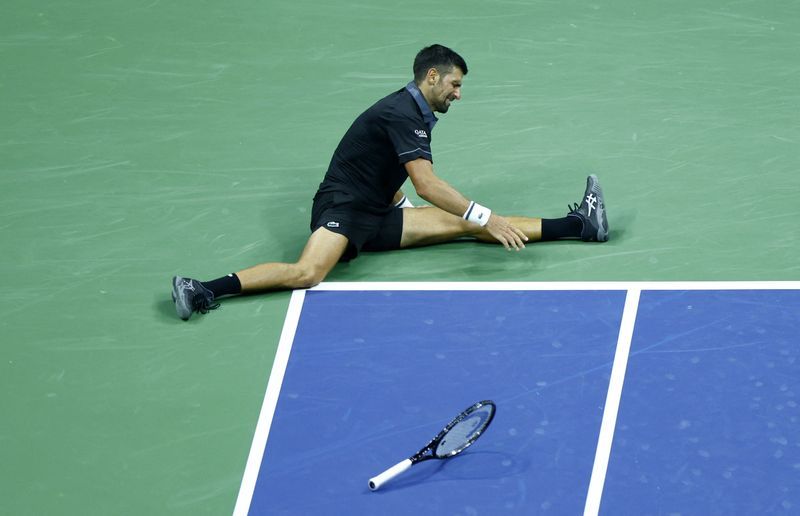
Novak Djokovic's pursuit of tennis history ended in disappointment on Sunday when the 39-year-old Serbian champion fell to unseeded Argentine Mariano Navone 7-6(5) 5-7 4-6 6-2 6-1 in a gruelling first-round encounter at the US Open. The result represents the most significant setback to Djokovic's illustrious career in recent memory, marking his earliest exit from a Grand Slam tournament since the Australian Open in 2006—nearly two decades ago. For a player still chasing his 25th major title, this first-round elimination at one of tennis's most prestigious venues signals a troubling chapter in what should have been a late-career renaissance.
Djokovic's physical struggles were evident throughout the four-hour-36-minute contest at Flushing Meadows. The Serbian star became visibly ill during the third set, vomiting into a courtside bin amid humid New York conditions. Beyond this acute episode, Djokovic revealed he has been battling a recurring pattern of gastrointestinal distress that has plagued him repeatedly throughout 2024. This chronic issue cascaded into systemic physical breakdown, with cramping and pain spreading throughout his body as the match progressed. His serve, historically his greatest weapon, deteriorated sharply in the closing sets as back and shoulder injuries undermined his ability to generate power, ultimately forcing him to concede the final two sets without meaningful resistance.
In an emotional display rare for the normally composed champion, Djokovic was visibly tearful at the conclusion of the match. He acknowledged the extent of his suffering, describing a body that had essentially collapsed under the accumulated stress of competing while physically compromised. "It's something that I've been carrying, unfortunately, pretty much every match this year," he explained to gathered media. The candid admission suggests his physical troubles extend well beyond Sunday's encounter, raising serious questions about whether his fitness concerns are chronic rather than acute. Despite leading 5-4 in the third set, Djokovic could not maintain his advantage, ultimately succumbing to Navone's determined challenge across a final two sets in which the Argentine exhibited superior endurance and mental fortitude.
Djokovic arrived in New York already burdened by doubt about his form and readiness. His preparation had been undermined just two weeks earlier when he suffered a straightforward loss to Thiago Agustin Tirante in his Cincinnati opening-round match, a tournament many top players use as their final preparation venue before the US Open. This earlier defeat served as a warning signal that he had not regained his championship edge. The twentieth appearance by Djokovic at this particular Grand Slam tournament thus carried less of the usual weight of expectation, yet few anticipated that concerns about his form would translate into such an embarrassing early exit.
Navone, ranked 49th in the world, seized the opportunity presented by his opponent's physical fragility and capitulated just once under immense pressure. The 25-year-old Argentine's victory represents the pinnacle achievement of his career to date. In the opening set, played under increasingly humid conditions with intermittent rain delays that required the showcourt roof to close, Navone demonstrated impressive tactical awareness by forcing a tiebreak despite Djokovic's bright start. When the Argentine prevailed 7-6(5) in the first-set decider, it signalled to both the crowd and Djokovic himself that this would not be a routine dismissal of a lesser opponent.
Navone's triumph appears even more remarkable when considering the stature of his opponent. Djokovic has won the US Open four times and remains one of only a handful of players to have mastered every Grand Slam venue across multiple eras. For an unseeded player to overcome such an opponent requires not merely superior shotmaking but also the psychological resilience to maintain belief when facing one of sport's greatest champions. Navone demonstrated both qualities across the contest's duration, remaining composed when Djokovic staged his brief recovery in the second set and when the Serbian seemed poised to regain momentum after breaking serve for a 5-4 lead in the third.
The significance of this result reverberates throughout professional tennis. Djokovic has been engaged in what many observers characterized as an unlikely quest to extend his dominance well into his fourth decade of life. His relentless pursuit of the 25th Grand Slam title—which would represent a record unattained by any male player in the modern era—has defined much of his recent narrative. This defeat effectively halts that momentum with devastating suddenness. Unlike gradual fading, which might allow for tactical adjustments or strategic rest periods, such a sudden collapse under competitive pressure suggests deeper physical issues that cannot be resolved through time management alone.
For Malaysian and Southeast Asian tennis followers, the significance of Djokovic's exit lies partly in what it means for the tournament's competitive balance going forward. With the top-seeded favourite compromised, other challengers now face a theoretically more manageable path through the draw. Additionally, the spectacle of a 39-year-old athlete struggling with degenerative physical issues raises questions that resonate across all endurance sports about the viability of extended careers at the highest levels of professional competition. Djokovic's situation underscores whether even extraordinary talent and meticulous preparation can overcome the fundamental biological reality of aging.
Navone's reaction to his victory was appropriately effusive yet grounded in the reality that he had just completed one of sport's most demanding physical ordeals. "Five sets, against the GOAT, it's not something you do every day," he said immediately after the match, reflecting genuine astonishment at having outlasted his legendary opponent. The Argentine later revealed to ESPN that he was still processing the magnitude of his achievement as his phone was inundated with communications from back home in Argentina. This overnight transformation in fortune—from a player competing in relative obscurity to one whose name is now discussed worldwide—encapsulates the dramatic nature of tennis's tournament format.
Djokovic was notably gracious in defeat despite his evident disappointment and physical misery. He refused to attribute his loss entirely to his ailments, instead crediting Navone's fighting spirit and tactical acumen. "I don't want to take too much out of his win. Congratulations to him. He's a nice guy, a fighter," Djokovic stated. This magnanimity contrasts sharply with some post-match commentary that might attribute the result primarily to the champion's compromised physical state rather than his opponent's merits. By acknowledging Navone's contribution to the victory, Djokovic maintained the dignity expected of a champion, even in loss.
The immediate aftermath leaves Djokovic facing difficult questions about his future. Whether he continues competing at Grand Slams or contemplates a fresh approach to his schedule remains unclear. His medical team will presumably now conduct thorough investigations into the vomiting episodes and physical breakdown that have characterized his recent matches. For the US Open and international tennis fans, meanwhile, the path is now open for younger, fresher competitors to vie for supremacy in the tournament's latter stages. Navone's reward for his monumental effort will be advancement to face a second-round opponent, though the physical and emotional toll of his four-hour-36-minute ordeal will itself demand recovery time before he can mount another competitive challenge.

