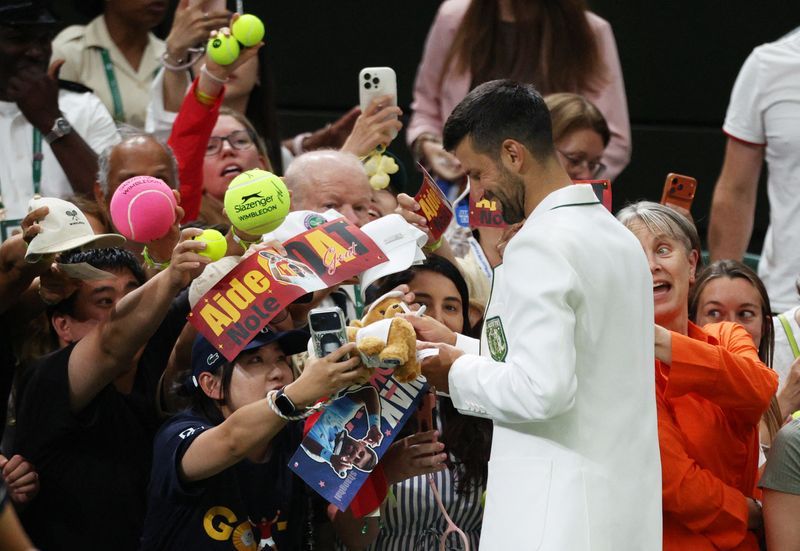
Novak Djokovic's commanding performance against Stefanos Tsitsipas at Wimbledon on Wednesday was marked not only by its clinical efficiency but also by the Serbian champion's visibly relaxed demeanor throughout the encounter. So comfortable was the 24-time Grand Slam winner during the demolition that he found himself in the mood for a lighthearted moment with one of the match officials. When needing to remove some black tape from his right shoulder, Djokovic enlisted a ball girl to assist him with scissors, then promptly let out a convincing cry of pain as she worked to cut the tape away from his skin.
The unsuspecting young official, believing she had actually inflicted an injury on one of tennis's greatest players before a global television audience numbering in the millions, visibly recoiled in shock and alarm. Her face registered the kind of genuine distress that comes from believing one has just caused serious harm in a high-pressure professional setting. She stepped back defensively, her hand clutching her chest as she appeared to contemplate the potential catastrophe of having injured Djokovic during such a prominent match. The moment stretched for just a fraction of a second before the champion's face broke into undeniable laughter, immediately revealing the prank for what it was.
The ball girl's relief at discovering the injury was fictitious quickly gave way to her own amusement at having been the subject of Djokovic's humor. Her nervous giggles soon matched the champion's own laughter, creating a shared moment of levity that reminded observers of the human side of professional tennis beneath all its competitive intensity. When later explaining his behavior during the post-match interview, Djokovic acknowledged that such moments of playfulness typically emerge only when a player holds a commanding advantage. "These kinds of things surface when you are two sets to love up rather than two sets to love down," he explained to the assembled media, referencing his commanding position in the match at that point.
Djokovic went on to apologize for startling the ball girl while simultaneously suggesting that the entire episode had actually enhanced his mental state during the competition. "I'm sorry if I scared her... it made me a bit more relaxed on the court. I was just having some fun," the champion elaborated, providing insight into the psychology of his approach to the match. The casual demeanor that allowed for such pranks manifested itself in his overwhelming dominance of Tsitsipas, whom he dispatched with a decisive scoreline of 6-3 6-4 6-2. The Greek opponent, despite his considerable ranking and abilities, appeared to have no answer for Djokovic's aggressive yet controlled play.
The positive atmosphere surrounding his victory carried forward into the on-court interview portion of the proceedings, when Djokovic noticed a figure in the Royal Box seated at Centre Court. Rory McIlroy, the Northern Irish professional golfer who has won the Masters Tournament on two separate occasions, was in attendance at the famous tennis venue and had brought along his Green Jacket, the iconic garment that represents victory at golf's most prestigious annual event. Spotting the distinctive blazer, Djokovic could not resist an opportunity to extend his playful mood in McIlroy's direction.
Djokovic initiated the exchange by complimenting his fellow sportsman's attire, calling out across the stadium to McIlroy and drawing his attention to the jacket draped across the golfer's shoulders. He inquired whether it was indeed the Masters jacket, a question that McIlroy answered with a simple nod of affirmation, clearly amused by where this interaction was heading. The tennis champion then escalated his lighthearted challenge into a full proposition, declaring his intention to acquire the prestigious golf jacket and suggesting an unconventional wager to make it happen.
"I want that jacket. I'll play you. This jacket for that jacket, we play tennis, no golf," Djokovic announced with tongue firmly in cheek, tugging at his own personalized cream-colored blazer that he had been wearing throughout the championship to draw additional attention to the contrast. The proposal was characteristically cheeky, suggesting that while McIlroy might be the reigning master of golf, Djokovic held supremacy in tennis and therefore the wager would necessarily be decided on the tennis court rather than the golf course. The suggestion was delivered with such obvious humor and self-aware confidence that even McIlroy, whose sporting achievements rival those of Djokovic himself, appeared bemused by the proposition.
The assembled crowd at Centre Court responded enthusiastically to the exchange, recognizing it as the kind of good-natured banter that transcends the boundaries of individual sports and speaks to a broader camaraderie among elite athletes. The moment captured something essential about the modern sporting landscape in which figures like Djokovic and McIlroy operate at the highest levels of their respective disciplines while maintaining the ability to interact with humor and warmth. For Malaysian and Southeast Asian readers, the interaction also highlighted the growing intersection of international sports culture, where tennis and golf increasingly share global audiences and where athletes from different disciplines regularly engage with one another at major sporting events.
Djokovic's performance and demeanor at Wimbledon underscored his current dominance in professional tennis at an age when many athletes begin to see their powers decline. His ability to control matches so completely that he could afford moments of levity and pranking spoke volumes about both his technical mastery and his psychological state as he continued his pursuit of major championship records. The interaction with McIlroy suggested that regardless of the sport or the competitive setting, the greatest athletes maintain a perspective that allows them to enjoy the moment and connect with fellow competitors and observers in meaningful ways beyond pure athletic competition.

