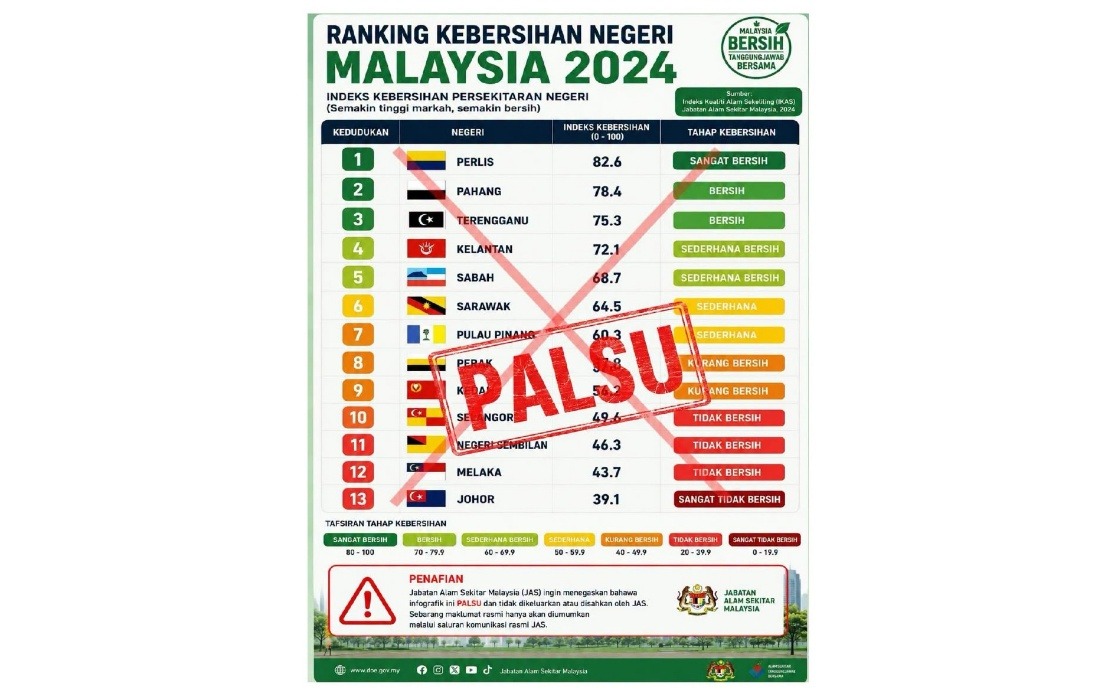
The Department of Environment (DOE) moved swiftly on July 7 to distance itself from a cleanliness ranking infographic that has gained traction across Malaysian social media platforms and messaging applications. In a formal statement issued from its Putrajaya headquarters, the agency categorically denied having created, published or validated the graphic titled "Ranking Kebersihan Negeri Malaysia 2024", which purports to grade the nation's states on environmental sanitation standards.
The infographic's viral circulation highlights a growing challenge facing Malaysian government agencies: the rapid spread of content that mimics official formats and branding without any authentic basis. The DOE's strong pushback underscores the stakes involved when fraudulent materials bearing the appearance of state authority gain credibility through social media sharing and word-of-mouth distribution. The department made clear that it had issued no accompanying media statement, explanatory report or official commentary supporting the rankings displayed in the graphic, a distinction emphasizing the distinction between genuine government outputs and fabricated material.
In its cautionary guidance to citizens, the DOE advised the public to refrain from sharing or citing the infographic without first confirming its legitimacy through the department's authenticated channels. This recommendation carries particular weight in Malaysia's media environment, where the speed and volume of social media circulation often outpace fact-checking mechanisms. The department framed its warning not as a technical clarification but as a broader appeal for digital literacy and responsibility among information consumers, urging Malaysians to question sources and verify claims before propagating content to others.
The stakes of misinformation extend beyond mere consumer confusion. The DOE argued that the proliferation of unverified claims risks undermining public trust in legitimate environmental governance data and conservation initiatives. When citizens encounter fabricated official-looking content, the cumulative effect can be erosion of confidence in authentic government pronouncements on matters as consequential as environmental quality and public health. This erosion of institutional credibility carries particular implications for Malaysia's environmental agenda, which depends on public cooperation and behavioral change to succeed.
The department emphasized that all authentic materials—including media statements, statistical reports, infographics, public notices and policy information—emanate exclusively through the DOE's official communication infrastructure. This includes its dedicated government portal and formally designated channels, ensuring that citizens have a reliable mechanism for distinguishing genuine from spurious content. By centralizing the distribution of authoritative information, the agency aims to create a clear institutional boundary that separates official data from the murky realm of social media rumor and speculation.
The DOE's statement carried an implicit warning to those potentially responsible for creating or distributing the false ranking. The department declared its commitment to pursuing legal remedies against any party found misusing the DOE's name, official logo or corporate identity for misleading purposes. This threat of enforcement action reflects the seriousness with which the government now treats impersonation and fraudulent attribution of agency materials, treating such conduct as a matter warranting formal investigation and potential prosecution rather than merely issuing cease-and-desist notices.
The incident illustrates the vulnerability of government institutions in the digital age, where graphic design tools and social media reach have democratized the ability to create ostensibly official-looking materials. For Malaysian citizens and businesses that depend on accurate environmental data to make decisions—from industrial compliance planning to residential location choices—the circulation of counterfeit cleanliness rankings poses tangible practical consequences. A false ranking could mislead investors, distort public perception of state environmental governance, or generate unwarranted criticism of state administrators.
The DOE framed its response within a broader commitment to information integrity and institutional transparency. The department reaffirmed its dedication to ensuring that communications to the public remain accurate, authentic and credible, aligning with its constitutional mandate as the nation's primary custodian of environmental protection and resource management. This positioning of information quality as central to environmental governance reflects evolving international best practices around evidence-based policy implementation and stakeholder engagement.
For regional observers, Malaysia's DOE response offers insights into how Southeast Asian governments are beginning to confront coordinated misinformation campaigns and opportunistic fraudulent content. As digital literacy remains inconsistent across demographic groups and as social media algorithms reward engagement over accuracy, government agencies increasingly find themselves on the front lines of defending institutional credibility. The DOE's multi-pronged approach—combining public warnings, centralization of authentic sources, legal deterrence and explicit appeals for citizen discernment—represents an emerging template that other Malaysian ministries and regional governments may emulate when facing similar challenges.

