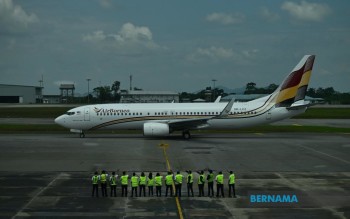
Deputy Prime Minister Datuk Seri Fadillah Yusof marked a significant moment in Malaysian aviation history by greeting AirBorneo Airways' inaugural commercial flight as it touched down at Kuala Lumpur International Airport Terminal 1 on July 20. The arrival of flight MY5005 from Kuching represented not merely a routine service launch but a watershed development for Sarawak's long-running quest to exercise greater autonomy over its own air transport infrastructure. Aboard the aircraft were Sarawak Premier Tan Sri Abang Johari Tun Openg, state cabinet members, and a contingent of prominent guests whose presence underscored the political significance of the occasion.
The establishment of AirBorneo reflects a strategic pivot by the Sarawak state government to reclaim control over domestic aviation capacity on terms that serve regional economic objectives. For several years, the state has been building towards this moment, recognising that reliable, affordable air connectivity forms the backbone of modern economic development. By launching its own airline rather than relying solely on incumbent carriers, Sarawak authorities aim to create competitive pressure that could stimulate service improvements, lower fares, and generate employment within the state. This venture sits within a broader pattern observed across Southeast Asia, where regional governments have invested in aviation assets to strengthen their bargaining positions and boost regional integration.
AirBorneo chairman Datuk Amar Mohamad Abu Bakar Marzuki, who simultaneously serves as Sarawak state secretary, articulated the deeper strategic rationale underlying the airline's creation. He characterised aviation connectivity as central to Sarawak's developmental trajectory, functioning as an economic conduit linking communities, facilitating business formation, and unlocking opportunities for residents. This characterisation reveals how policymakers view the airline not as a commercial venture aimed purely at profitability, but as infrastructure serving broader state-building and prosperity objectives. The airline enters the market equipped with two wet-leased Boeing 737-800 aircraft, marking AirBorneo's transition from regional turboprop operations into the commercial jet segment—a transformation that substantially enlarges the airline's capacity and reach.
The practical service architecture being deployed demonstrates careful attention to commercial viability. Beginning July 21, 2026, AirBorneo will operate two daily flights on the Kuching-Kuala Lumpur corridor, providing morning and evening options that accommodate both business and leisure travellers. Pricing has been structured to capture market share without triggering aggressive responses from competitors: economy fares commence at RM375 one-way, whilst business class offerings start from RM736. These price points position AirBorneo between ultra-low-cost carriers and full-service airlines, targeting middle-market passengers who value reasonable fares combined with service quality. The airline has already commenced ticket sales, indicating confidence in demand and operational readiness.
The Kuching-Kuala Lumpur route functions as the foundation upon which AirBorneo plans to construct a broader domestic network. Rather than pursuing an aggressive multi-route launch that could overwhelm operational capabilities, management has opted for measured, sequential expansion. This cautious approach reflects lessons learned by regional carriers that expanded too rapidly without adequate infrastructure or training capacity. By establishing operational excellence on the flagship domestic route, AirBorneo creates a platform from which to extend service to secondary cities and expand network coverage across Sarawak and beyond. Future expansion will progressively strengthen the state's internal connectivity whilst creating additional anchor points for regional hub development.
International expansion constitutes the next strategic horizon for the nascent carrier. Singapore has been identified as AirBorneo's initial international destination, a choice that makes geographical and economic sense. The Singapore market represents the wealthiest consumer base within commuting distance of Sarawak, whilst Singapore's Changi Airport provides connections to global networks. Establishing a Singapore service positions AirBorneo to capture transfer traffic, particularly from Australia and Asia-Pacific markets, whilst providing Sarawak residents with convenient access to Singapore's financial, medical, and educational institutions. For Malaysian readers and policymakers, this development signals emerging competition in regional air transport, with implications for ticket pricing, route frequency, and service competition across the region.
The ministerial attendance at KLIA underscored the political backing extended to AirBorneo's launch. Beyond Deputy PM Fadillah, the gathering included Tourism, Arts and Culture Minister Datuk Seri Tiong King Sing, Women, Family and Community Development Minister Datuk Seri Nancy Shukri, and Deputy Transport Minister Datuk Hasbi Habibollah. This cross-ministry representation indicates whole-of-government support for the venture, suggesting that AirBorneo will receive policy favours ranging from landing slot allocations to tax incentives and infrastructure investment. Such political backing matters significantly in aviation, where regulatory approval, airport infrastructure access, and navigation service prioritisation can materially affect operational viability.
AirBorneo CEO Megat Ardian Mohd Aminuddin framed the service launch as a pivotal inflection point for the airline's trajectory. He pledged commitment to safety, reliability, and service quality—the conventional assurances offered by airline leaders at inaugural ceremonies, yet assertions that carry particular weight for a new entrant lacking operational history. Customer confidence in a startup airline depends heavily upon demonstrable commitment to these fundamentals. Any significant safety incident, operational disruption, or service complaint could damage market perceptions and undermine the airline's ability to recruit and retain passengers. Accordingly, AirBorneo's management faces intense pressure to execute flawlessly during the critical launch phase.
The broader implications of AirBorneo's commencement extend beyond Sarawak's borders into regional aviation dynamics. Malaysia's airline sector has historically been dominated by Malaysia Airlines and AirAsia, with limited competition on core domestic routes. AirBorneo's entry introduces a new competitive actor with state backing, capital resources, and strategic objectives that differ from purely commercial operators. For consumers, this increased competition should translate into more frequent services, improved amenities, and downward pressure on fares—classic benefits of competitive markets. For incumbent carriers, AirBorneo represents a challenge requiring strategic response, potentially through capacity adjustments, pricing changes, or service enhancement on overlapping routes.
The timing of AirBorneo's launch reflects broader transformation within Malaysian aviation and transport policy. Federal and state authorities have increasingly recognised that aviation capacity constrains regional development, and that state-level infrastructure investment can stimulate growth. Similar initiatives have emerged in other Malaysian states seeking to strengthen connectivity and position themselves as regional hubs. AirBorneo's success or failure will therefore influence whether comparable ventures proceed elsewhere in Malaysia and across Southeast Asia, making this inaugural flight consequential for policy debates extending well beyond Sarawak itself.

