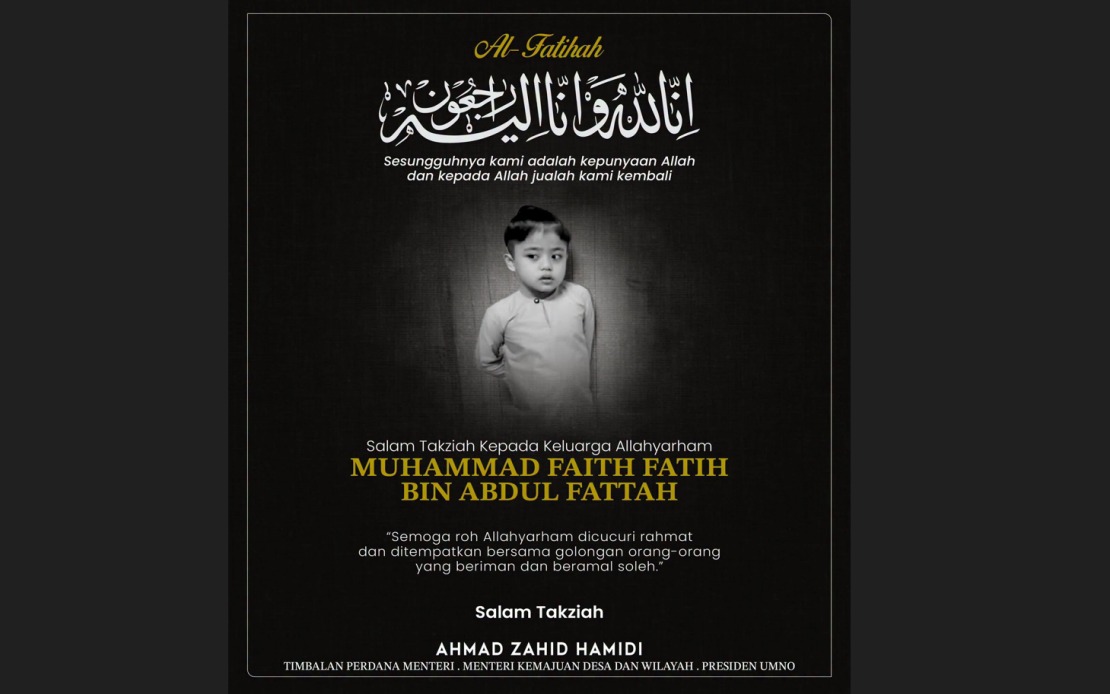
Deputy Prime Minister Datuk Seri Dr Ahmad Zahid Hamidi has expressed deep sorrow following the tragic death of Muhammad Faith Fatih Abdullah Fattah, a six-year-old child with autism, whose body was found in a drain within an oil palm plantation near Sungai Sumun in Hutan Melintang, Perak, on the evening of June 30.
The Bagan Datuk Member of Parliament took to social media to share his condolences with the grieving family, describing the loss as particularly heartbreaking given the child's tender age and special needs status. Ahmad Zahid acknowledged the extraordinary emotional burden that comes with such a tragedy, noting that few experiences rival the devastation of a parent losing their child. His message reflected the cultural and religious sensitivities of a largely Muslim society, emphasizing the profound nature of such loss within family structures and faith traditions.
According to police records, authorities received notification of the missing child at approximately 4:54 pm on June 30. The boy had last been observed in the living room of his family home, prompting his parents to initiate search efforts when they realized he was no longer present. The discovery came several hours later, at 10:08 pm, when search and rescue operations located the child's body in a drainage channel running through the plantation area.
The case highlights ongoing concerns in Malaysia regarding the safety and supervision of children with autism spectrum disorder, particularly in rural and semi-urban settings. Families managing the care of autistic children frequently face unique challenges in monitoring and protecting their children, especially those with significant support needs who may lack the communication skills to seek help or the understanding of potential dangers in their environment. The incident underscores the importance of community awareness and support systems for families navigating special needs care.
Bagan Datuk police chief Supt Mohammad Ali Mohd Jali confirmed the operational details of the search effort, noting the rapid police response following the initial report. The circumstances of how the child came to be in the drainage channel remain a matter of investigation, and authorities would typically examine factors such as barriers, supervision protocols, and environmental hazards that may have contributed to the tragedy. Such investigations are standard procedure in cases involving the unexpected death of young children, particularly those with developmental disabilities.
Ahmad Zahid's public expression of sympathy carries particular significance given his position as Deputy Prime Minister and his constituency responsibility for Bagan Datuk, the district where the tragedy occurred. His intervention reflects the customary practice of senior political figures acknowledging community losses and offering official condolences on behalf of the government. This gesture, while deeply symbolic within Malaysian political culture, also serves to underscore the government's recognition of families dealing with special needs children.
The incident may prompt discussions within policy circles regarding improved safety measures in residential areas, particularly those adjacent to agricultural zones. The proximity of oil palm plantations to residential settlements presents various environmental risks that require careful management, especially in communities with vulnerable populations such as young children or elderly residents. State and federal authorities may consider whether additional safeguards or community education initiatives are warranted.
Beyond the immediate tragedy, this case reflects broader questions about support networks for families with autistic children in Malaysia. While awareness of autism spectrum disorder has grown significantly over recent years, access to comprehensive support services, respite care, and specialized supervision resources remains unevenly distributed across the country. Rural and semi-urban areas often lag behind urban centers in available services, placing additional strain on families already managing significant care responsibilities.
The loss also underscores the vulnerability of children with autism in unstructured environments. Children on the spectrum may have difficulty recognizing danger, communicating distress, or following safety instructions that neurotypical children instinctively understand. For parents and caregivers, this reality necessitates constant vigilance and often isolation from normal community participation, as specialized supervision cannot easily be delegated to untrained individuals.
Ahmad Zahid's invocation of Islamic prayer traditions in his condolence statement reflects the spiritual dimension of grief processing within Malaysian Muslim communities. His references to Al-Fatihah and appeals for divine mercy align with established cultural practices for acknowledging loss and supporting bereaved families through collective spiritual reflection. Such public expressions of faith during tragedy also serve to bind communities through shared religious values and practices.
The broader implications of this incident extend to questions about infrastructure safety, community awareness, and support systems for vulnerable populations. Malaysia's rapid development and urbanization have sometimes outpaced the implementation of comprehensive safety protocols in areas where residential zones intersect with agricultural or industrial spaces. This case may catalyze renewed attention to environmental design and risk management in mixed-use areas.

