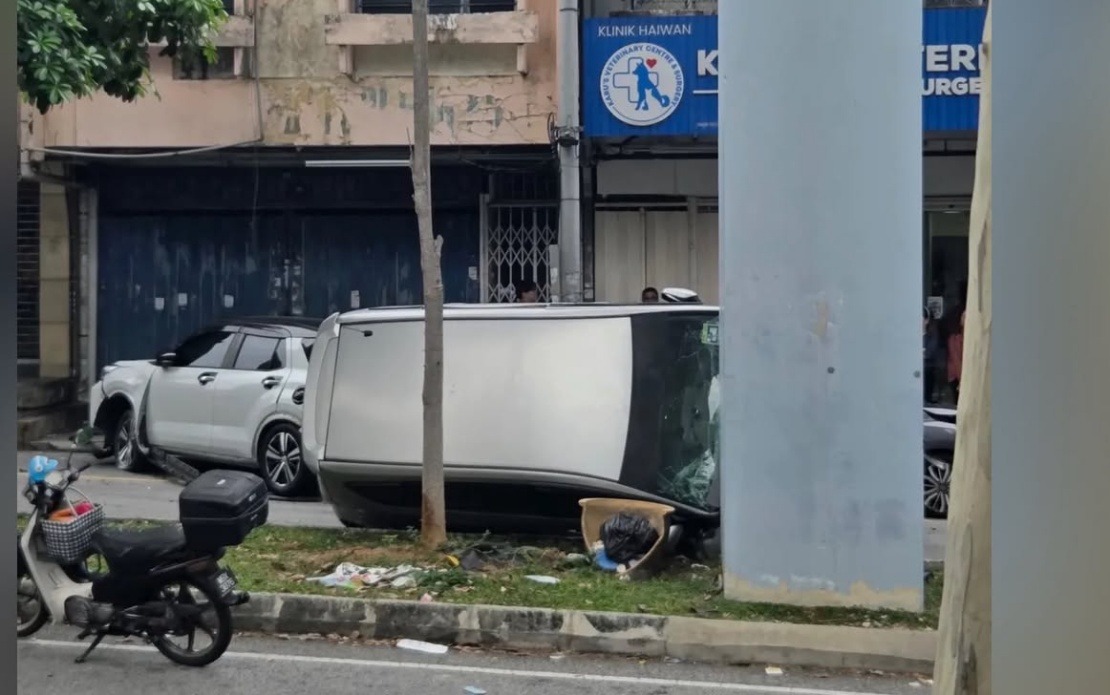
A medical emergency transformed an ordinary morning commute into a multi-vehicle accident on a Cheras residential street on Tuesday, when a 28-year-old driver experienced a sudden seizure while driving his BMW 320i. The incident unfolded at approximately 8.30 am on Jalan Midah 1, in the Taman Midah 1 area, as the driver was heading to work from his home. The seizure caused him to lose control of the vehicle, which veered across the road and collided with six parked cars positioned along the left shoulder, creating a scene of considerable automotive damage but, fortunately, no personal injuries.
According to Kuala Lumpur Traffic Investigation and Enforcement Department (JSPT) chief ACP Mohd Zamzuri Mohd Isa, the sequence of events unfolded with stark suddenness. The driver, without warning or apparent provocation, experienced a neurological episode that left him unable to maintain command of his vehicle. The loss of control proved catastrophic for the stationary vehicles in the collision's path, though the absence of occupants in any of the parked cars prevented what could have been a far more serious incident.
The vehicles struck belonged to a diverse group of residents and commercial entities in the area. Four women, ranging in age from 29 to 43 years old, owned four of the damaged vehicles, while a 39-year-old man was the owner of another. The remaining vehicle involved belonged to a company, broadening the circle of those affected by the accident. Despite the scale of the collision, with six vehicles sustaining damage, the outcome could have been significantly worse had any of these cars been occupied at the time of impact.
A critical detail emerged during the immediate investigation: the driver possessed a documented medical history extending back approximately ten years. Police established that seizures were not a new or isolated occurrence for this individual but rather part of a chronic condition he had been managing. This background information raised questions about driving safety and medical fitness to operate vehicles, though authorities did not immediately disclose whether the driver held any special medical exemptions or had disclosed his condition when renewing his driving license.
Sobriety testing formed part of the standard accident investigation protocol. A breathalyser test administered to the driver returned a reading of zero milligrammes per 100 millilitres, conclusively ruling out alcohol intoxication as a contributing factor. This negative result indicated that the seizure alone, uncompounded by impaired judgment or reduced motor control from alcohol, triggered the collision.
The police department invoked Rule 10 of LN 166/59 in classifying the case, a regulation governing traffic offences and vehicle-related incidents in Malaysia. This classification reflected the formal nature of the investigation, though the circumstances—a medical event rather than reckless or negligent driving—suggested the case would likely proceed along a path distinct from typical traffic violations. The classification nonetheless indicated that authorities intended to examine all aspects of the incident thoroughly.
Investigators appealed for public assistance in gathering additional information about the accident. Witnesses or individuals with knowledge of the incident were encouraged to contact the Tun H.S. Lee traffic police station at 03-2071 9999 or any nearby police facility. This open call for information reflected standard practice in traffic investigations, though in this case, the sequence of events appeared relatively straightforward given the medical nature of the incident.
The accident illuminates a persistent tension in traffic management across Malaysia: the challenge of balancing individual mobility with public safety when medical conditions affect driving capability. While most drivers experiencing chronic seizures are conscientious about managing their condition and may take necessary precautions, incidents such as this underscore the unpredictable nature of neurological episodes. The question of whether individuals with documented seizure histories should face additional licensing restrictions, mandatory medical checkups, or other oversight mechanisms remains contentious in public health and traffic safety circles.
For residents of Taman Midah 1 and surrounding areas in Cheras, the incident served as an unsettling reminder of how quickly a normal Tuesday morning can shift into chaos. The concentration of parked vehicles along Jalan Midah 1—itself reflective of the area's residential density—created a target-rich environment for the out-of-control BMW. The fortunate absence of pedestrians or occupied vehicles prevented a tragedy, but the six vehicle owners faced the substantial inconvenience and expense of repairs.
The broader implications for traffic safety in the Klang Valley and beyond merit consideration. Malaysia's growing vehicle population and increasingly congested residential areas mean that accidents stemming from medical episodes may become more frequent. Public education campaigns about recognizing medical conditions that affect driving, coupled with clearer guidelines for individuals managing seizures or similar conditions, could potentially prevent similar incidents. Insurance companies and road authorities may need to revisit how they assess risk and implement safeguards.
As investigations continued into the circumstances surrounding the accident, authorities would likely examine the driver's medical documentation, his disclosure of his condition to licensing authorities, and any relevant clinical guidance he may have received regarding driving. The outcome of these investigations could influence how Malaysian traffic and health authorities approach similar cases in future, potentially setting precedents for how drivers with chronic medical conditions are managed within the licensing and enforcement framework.

